

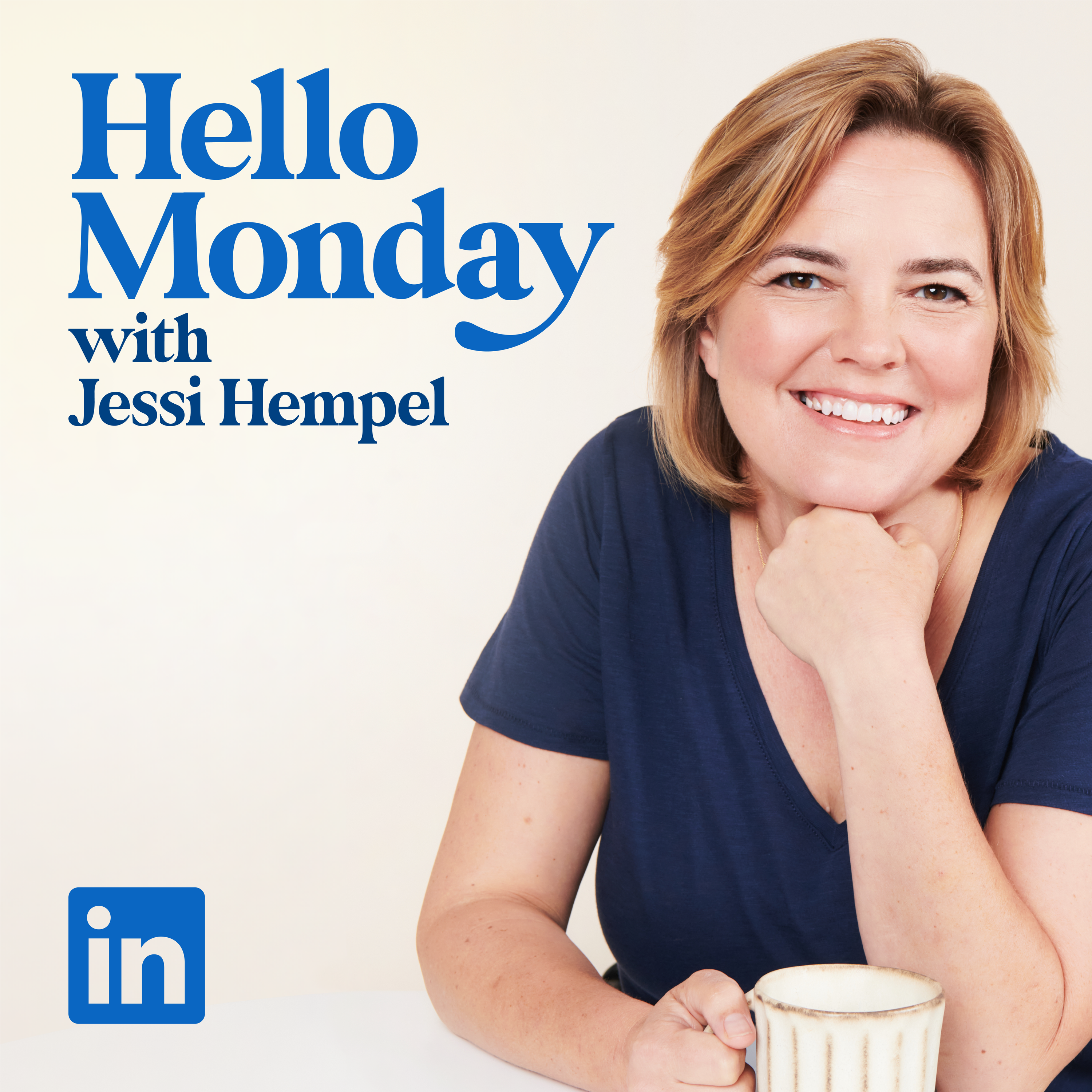
Hello Monday with Jessi Hempel
LinkedInAudio
- Format:
- Podcast
- New episodes:
- Weekly
- Typical length:
- about 30 minutes
- Latest episode:
About this show
Ever wish you had a pal who could break down the biggest ideas of the new world of work and distill them into actionable insights you could apply to your own life, right away? Meet LinkedIn's Hello Monday with Jessi Hempel! Each week, Jessi explores the changing nature of work and how that work is changing us. Jessi welcomes big thinkers to share their best ideas: everyone from game-changing entrepreneurs like Aurora James, to research-based experts like Daniel Pink, to notable figures like Megan Rapinoe and Bozoma Saint John. Start your week by joining us every Monday for a dose of fresh ideas, then join us in community and conversation on LinkedIn. New episodes weekly.
Covers: future of work, career development, leadership, workplace culture, personal productivity, conflict resolution, behavioral science, career change
Show details and episodes come from the publisher's public feed at feeds.megaphone.fm. Last updated . Names, artwork and text belong to their publishers.
Recently on this show
Summary of recent episodes, drawn from the publisher's feed.
Hello Monday, hosted by Jessi Hempel and published by LinkedIn, explores how work is changing and how that change affects people. Guests have included entrepreneurs, researchers and public figures. Recent episodes cover career pivots, building a long career, when perseverance turns into self-sabotage, and culture at restaurants.
Cosmos
Similar in subject
- Expert Intelligence with Paul Estes
Both cover: future of work, workplace culture, career development - Life of an Architect
Both cover: personal productivity, workplace culture, career development - Worklife with Molly Graham
Both cover: workplace culture, career development, leadership
Similar shows





Explore more
Episodes
The FBI Hostage Negotiator's Guide to Getting What You Want at Work
· 29 min
Most of us think of negotiation as something reserved for high-stakes boardrooms—or even hostage situations. But Christopher Voss (https://www.linkedin.com/in/christophervoss/), former FBI lead hostage negotiator and bestselling author of Never Split the Difference, says negotiation is everywhere: in salary talks, in team meetings, even in conversations with your kids. In this episode from the Hello Monday archives, Jessi Hempel (https://www.linkedin.com/in/jessihempel/) sits down with Chris to explore how we can all become better negotiators by focusing on empathy, collaboration, and trust. Drawing on decades of experience, Chris shares practical tools you can use to move conversations forward—whether you’re asking for a raise, dealing with a difficult boss, or navigating conflict at home. Chris and Jessi discuss: - Why negotiation is really about collaboration and long-term relationships - How to shift from seeking control to building influence - The power of labeling emotions to build trust and lower defenses - Why “no” is often more powerful than “yes” - How to recognize when a negotiation is over—or when it’s time to walk away - Strategies to reframe salary conversations and show your value This episode was recorded live in-studio. For an extended, behind-the-scenes version, watch on LinkedIn Premium (https://www.linkedin.com/posts/linkedin-news_want-to-walk-into-your-next-negotiation-with-activity-7330318611670032384-kHl1?utm_source=share&utm_medium=member_desktop&rcm=ACoAADCGmHYBpAfEov-rAtDaJbRy0XIfo-vYc6k).
Not rated yetThe AARP CEO's Playbook for Staying Competitive After 50
· 29 min
We tend to talk about AI and the future of work as a young person's game. Dr. Myechia Minter-Jordan, CEO of AARP, is here to challenge that notion. A physician turned healthcare executive turned nonprofit leader, she joins Jessi in the studio to talk about ageism, AI, and what it means to not just stay relevant, but to move ahead, in the second half of a working life. In this episode, Jessi and Dr. Minter-Jordan discuss: - How the fifty-plus workforce is upskilling faster than other generations - How to reframe experience as an asset in a job search, and why soft skills are having a moment - The move Dr. Minter-Jordan made that surprised everyone: going back to business school in her thirties, while practicing medicine - Why mentorship is one of the most powerful tools an older worker has for demonstrating value, and why stepping back from it is a mistake - How Dr. Minter-Jordan got her current job as CEO of AARP - What the trillion-dollar caregiving economy means for employers, and why the policies aren't keeping up - How to approach AI without feeling overwhelmed: start small, stay consistent, and focus on what's relevant to your field - Whether you should de-age your résumé - How to be strategic about timing a career pivot, especially when you have real responsibilities - What Dr. Minter-Jordan would tell a thirty-five-year-old building a career for the long arc This episode was originally recorded live and broadcast to LinkedIn Premium members. Premium members can watch the extended version here (https://www.linkedin.com/events/7462626252978343936?viewAsMember=true). Follow Dr. Myechia Minter-Jordan (https://www.linkedin.com/in/myechia/) and Jessi Hempel (https://www.linkedin.com/in/jessihempel/) on LinkedIn.
Not rated yetWhy Nobody Feels Financially Secure Anymore
· 28 min
“It’s not your fault.” This is the message Alissa Quart has spent over a decade trying to get people to believe when it comes to economic hardship. Right now, it feels harder than ever to embrace. Alissa Quart is the executive director of the Economic Hardship Reporting Project (https://economichardship.org/), the nonprofit Barbara Ehrenreich built after writing her groundbreaking exposé Nickel and Dimed. A journalist herself, Alissa is the author of seven books, including Squeezed: Why Our Families Can’t Afford America (https://www.harpercollins.com/products/squeezed-alissa-quart?variant=32117924986914) and Bootstrapped: Liberating Ourselves from the American Dream (https://www.harpercollins.com/products/bootstrapped-alissa-quart?variant=40517189599266). She's spent over a decade reporting on class, caregiving, and economic precarity. In this episode, Jessi and Alissa discuss: - Why "insecurity" is a more honest and unifying framework than "affordability," and how it builds solidarity across class lines - The data behind it: 52% of US families are now financially insecure by one measure, and nearly half of workers lack confidence they could find a job they'd want - "Apocalyptic insecurity": the new framework Alissa and economist Lynn Parramore developed to describe how employers use AI dread to manipulate workers - The Frederick Taylor parallel: how AI is repeating the logic of scientific management, a century later - "AI brain fry": the exhaustion of performing enthusiasm for AI at work while feeling something very different about it personally - Why losing the narrative of generational progress is its own kind of psychological injury - The AI dividend, universal basic income, and what a modern New Deal could look like - Why naming the problem matters: how failing to recognize insecurity as systemic — rather than personal failure — can curdle into self-blame and even disordered coping - What Alissa tells her own daughter about finding agency in an uncertain future Follow Alissa Quart (https://www.linkedin.com/in/alissa-quart-0a817a126/) and Jessi Hempel (https://www.linkedin.com/in/jessihempel/) on LinkedIn.
Not rated yetMost Companies Are Built to Fail Their Mission. Here's the Fix.
· 26 min
We've built an economy that rewards destroying value. Eric Ries wants to know how we got here, and whether we can build our way out. Eric wrote The Lean Startup in 2011 and helped define a generation of entrepreneurs. Since then, he's watched promising, mission-driven companies get hollowed out, and he thinks he knows exactly why. His new book, Incorruptible: How Good Companies Go Bad and How Great Companies Stay Great (https://www.incorruptible.co/), is his attempt to name what's happening, explain how we got here, and lay out a blueprint for building something better. In this episode, Jessi and Eric discuss: - What Eric calls "financial gravity": the systemic force that pulls organizations away from their mission and toward extraction - Why shareholder primacy isn't ancient law; it's a 1980s invention that was never voted on by anyone - The private equity problem: how you can taste the cost-cutting in your food when private equity buys your favorite restaurant - Why today's best practices are actually value-destroying, and what the data says about the alternative - The Public Benefit Corporation filing: a two-page form that could change what your company is legally obligated to do - Why "it's always too early until it's too late," and how founders miss their window to protect their mission - The AI layoff glee: why Eric thinks companies racing to replace people with robots is slow-motion suicide - How to find opportunity in this moment, even if you've been laid off, and why trust is the most underrated asset in business today Follow Eric Ries (https://www.linkedin.com/in/eries/) and Jessi Hempel (https://www.linkedin.com/in/jessihempel/) on LinkedIn.
Not rated yetLessons From a Year of Letting AI Do Everything
· 29 min
Joanna Stern spent a year using AI to do (almost) everything: write her emails, analyze her medical records, text her wife, drive her around, and even fold her laundry. The result is her new book, I Am Not a Robot (https://joannastern.com/), which documents what she learned testing AI as a journalist, a parent, and a newly independent founder. Joanna spent over a decade as a tech reporter at The Wall Street Journal before leaving to launch her own media outlet, New Things. She brought the same approach that's defined her career — hands-on, consumer-first testing of the technology itself — to her year-long experiment in living with AI.What she found was more nuanced than the hype: some of it works, some of it really doesn't, and some of it needs guardrails. In this episode, Jessi and Joanna discuss: - Why the same AI technology that's transforming cancer detection is also upselling you at the dentist - The data privacy moves everyone should make right now, including the settings most people never touch - What happened when Joanna tried to let AI handle all her communications - Why robots are bad at folding clothes - How AI gave Joanna the confidence to leave a staff job and start a business - The emotional difference between work you make yourself and work a machine makes for you - What it means to raise kids in a world where the struggle of figuring things yourself might disappear entirely Follow Jessi Hempel (https://www.linkedin.com/in/jessihempel/) and Joanna Stern (https://www.linkedin.com/in/joannastern/) on LinkedIn.
Not rated yetJenny Hagel on How to Build a Creative Career When the Odds Are Against You
· 28 min
Comedy writer Jenny Hagel has six Emmy nominations. The other week, she wrote 20 jokes. One made it to television. She doesn’t see this as failure, though. It’s the nature of the job. And it might offer the most useful career lesson you'll hear all year. Jenny is a writer on Late Night with Seth Meyers, where she also regularly appears on camera in the popular segment Jokes Seth Can’t Tell. She is also the author of a new book of essays called Advice No One Asked For. In this episode, Jessi Hempel sits down with Jenny to talk about the arc of her non-traditional career, and what it actually takes to keep going in the face of failure. In this episode, Jessi and Jenny discuss: - The live advice show Jenny built during the writer's strike, and how a room full of strangers asking earnest questions accidentally became the most community-building thing she's ever done - How humor acts as a spoonful of sugar that lets us endure the heavy stuff a little longer - The 411 call that landed Jenny a grad school internship - Why the find-yourself period matters, and what gets lost when young people skip it - The writing advice Jenny gives everyone: the part where you create and the part where you judge have to be two completely separate steps - How growing up queer in the '80s and '90s inadvertently became a blueprint for every out-the-box decision she's made since - Why a creative career isn't all-or-nothing, and what the middle actually looks like Find Advice No One Asked For (https://www.simonandschuster.com/books/Advice-No-One-Asked-For/Jenny-Hagel/9781668079614) wherever books are sold, and follow Jessi Hempel (https://www.linkedin.com/in/jessihempel/) on LinkedIn.
Not rated yetBonus: Lesbian Bars and the Secret Formula for Belonging
· 15 min
Lesbian bars aren’t just nightlife, they’re evolving spaces of community and chosen family, and they have a special place in Jessi Hempel’s heart. On this bonus episode, Jessi sits down with one of Hello Monday’s own producers, Rachel Karp, to talk about her new book The Lesbian Bar Chronicles: The Living History and Hopeful Future of America's Dyke Dives and Sapphic Spaces. Rachel’s journey started as a passion project: a documentary podcast in which the Cruising podcast team went on a road trip to visit every lesbian bar in the US. Their goal was to tell the history of lesbian bars and stories of the people who go to them. Now, those stories– and the lessons we can learn from them about how to create real-life community spaces–are in a book. In this episode: - Why Rachel and the Cruising podcast team went on their road trip - Why lesbian bars have endured, even as culture, technology, and rights have shifted - What makes physical spaces of belonging different from digital communities - The role of leadership in shaping inclusive, values-driven spaces - What “chosen family” looks like in practice, and why it matters - What anyone (queer or not) can learn from lesbian bars Follow Jessi Hempel (https://www.linkedin.com/in/jessihempel/)and Rachel Karp (https://www.linkedin.com/in/rachel-karp/)on LinkedIn.
Not rated yetHow to Build a Career You Actually Believe In
· 29 min
We're trained to climb ladders and chase titles, but what if the real metric of career success was the positive impact you have on the world? In this episode from the Hello Monday archives, host Jessi Hempel sits down with Rutger Bregman to explore moral ambition—a framework for building a career based on what positive impact you can have on the world. Rutger's groundbreaking book, Moral Ambition: How to Stop Wasting Your Talent and Start Making a Difference (https://www.moralambition.org/book), is a wake-up call for anyone who's felt something was missing from their work. Whether you're early in your career, questioning your path, or rebuilding after a layoff, this conversation offers a practical roadmap for pivoting toward meaningful work. In this episode, Jessi and Rutger explore: - What moral ambition is, and why it's the antidote to burnout - Why "follow your passion" is the wrong advice for building a sustainable career - How to shift from success-driven to service-driven work - Which industries funnel talented people into unfulfilling roles, and how to break free - Real-world examples of people solving humanity's biggest problems - How to build coalitions and find collaborators aligned with your values - The hidden cost of prestige, and how to redefine what winning looks like This episode is a call to action for anyone who wants to do good—and do it well. Follow Rutger Bregman (https://www.linkedin.com/in/rutgerbregman/) and Jessi Hempel (https://www.linkedin.com/in/jessihempel/) on LinkedIn
Not rated yetWe're Lonelier Than Ever. Ritual Is the Answer.
· 28 min
Rituals work. They help us make meaning, process transition, and connect with each other. That’s why we’ve been doing them for more than 300,000 years. So why, in this century, have we largely abandoned them? This week, bestselling author, repeat Hello Monday guest, and longtime friend Bruce Feiler joins us in the studio to talk about his new book, A Time to Gather: How Ritual Created the World and How It Can Save Us (https://www.brucefeiler.com/books-articles/a-time-to-gather/). Bruce traveled to 16 countries on six continents to explore why ritual matters and identify how we can bring it back into our everyday lives. In this episode: - Why ritual is the original human algorithm and why we've abandoned it - The difference between self-care and group care, and why the latter matters so much - The rise of new rituals: cancer-versaries, sober-versaries, infertility ceremonies, and divorce parties - Why funerals are disappearing, and what we're losing when they do - A live ritual design class: Bruce walks Jessi through building one for her daughter's preschool graduation - The three things every ritual needs: a beginning, a middle, and an end - From "rites of passage" to "bites of passage": why small, frequent moments of connection matter as much as the big ones - Virtual vs. ritual: why 2026 feels like the year we're choosing to come back together in person Follow Jessi Hempel (https://www.linkedin.com/in/jessihempel/) and Bruce Feiler (https://www.linkedin.com/in/brucefeiler/) on LinkedIn. And let us know how you’re incorporating ritual into your own life.
Not rated yetFeed Drop: WorkLife with Molly Graham
· 40 min
You might think the biggest, most prestigious job is always the right career move. Patty Stonesifer — founding CEO of the Bill & Melinda Gates Foundation and an early Amazon board member — says that’s exactly the wrong way to decide what to do next. So what should guide your career? In this special episode from WorkLife with Molly Graham, Patty shares the nine-word personal mission statement she’s used for decades to filter opportunities, turn down what doesn’t fit, and speak up for what matters. Patty shares how you can write your own, and even coaches Molly through creating hers in real time. WorkLife is a podcast from TED where host and company builder Molly Graham and her expert guests talk through the messy feelings we all experience at work. Ambition and failure, joy and burnout, confidence and self-doubt — this show digs into it all to help you build a career without losing yourself. Listen now: https://link.mgln.ai/7r9KAe (https://nam06.safelinks.protection.outlook.com/?url=https%3A%2F%2Flink.mgln.ai%2F7r9KAe&data=05%7C02%7Crkarp%40linkedin.com%7C10f10ecd29054c0433ff08deb11ef177%7C72f988bf86f141af91ab2d7cd011db47%7C0%7C0%7C639142943681512705%7CUnknown%7CTWFpbGZsb3d8eyJFbXB0eU1hcGkiOnRydWUsIlYiOiIwLjAuMDAwMCIsIlAiOiJXaW4zMiIsIkFOIjoiTWFpbCIsIldUIjoyfQ%3D%3D%7C0%7C%7C%7C&sdata=VAhAPkYJWX1pXMoGQQZ%2Bs9ZKXySyXtpiSGjq9u6efSQ%3D&reserved=0)
Not rated yet23,000 People Tried Moving Every 30 Minutes. Here's What Happened.
· 29 min
We talk a lot about what technology is doing to our minds. But what about everything below the neck? This week, Jessi is joined by Manoush Zomorodi, host of NPR's TED Radio Hour and author of Body Electric: The Hidden Health Costs of the Digital Age, and New Science to Reclaim Your Wellbeing (https://us.macmillan.com/books/9781250411211/bodyelectric/). Unfortunately, a killer workout or a standing desk won’t save us from the long-term health consequences of a sedentary lifestyle. But five minutes of gentle movement every half hour could. In fact, Manoush helped run a clinical trial with 23,000 people to prove it. Jessi and Manoush discuss: - Why sitting all day drains your energy even when you haven't done anything - The Columbia study that got 23,000 people moving, and what it proved - Why standing desks aren't actually the fix we thought they were - The "garden hose" model of what happens to your arteries when you sit or stand too long - How people can restructure their workdays (and their calendars) to make movement stick - What "information athletes" can learn from dancers, musicians, and pilots - The shift from screen-shaming to something kinder and more practical This one might make you want to stand up and take a lap while listening. That's kind of the point. Follow Manoush Zomorodi (https://www.linkedin.com/in/manoush-zomorodi-33904bb/) and Jessi Hempel (https://www.linkedin.com/in/jessihempel/) on LinkedIn.
Not rated yetFeeling Powerless at Work? Here’s Where Your Agency Still Lives
· 28 min
Work has always been demanding, but lately, it feels like the ground is constantly shifting. Business is moving faster, projects disappear overnight, expectations change without warning. Under pressure, teams see more tension and uncomfortable moments. So how do you stay steady through these times and even use workplace tensions to grow and improve? This week on Hello Monday, Jessi Hempel talks with Aiko Bethea, leadership coach and author of Anchored, Aligned, Accountable: A Framework for Transcending Bullsh*t and Transforming Our Lives (https://www.penguinrandomhouse.com/books/747123/anchored-aligned-accountable-by-aiko-bethea/). Aiko’s book comes with a forward from Brené Brown, and offers a road-tested framework for navigating modern work with more clarity and intention. Instead of looking outward for stability, she argues that the real work starts within: understanding your values, recognizing your impact, and reclaiming your sense of agency. In this conversation, Jessi and Aiko discuss: - Why work feels more chaotic than ever - What it really means to be “anchored” in your values—and why most of us get this wrong - How to align your decisions and behavior with what actually matters to you - A more generous, effective way to think about accountability (hint: it’s not about blame) - The many forms of power operating inside organizations - Why curiosity is the key to better leadership and stronger relationships - How to stop waiting for external conditions to improve and start creating your own stability This episode is for anyone looking for a way to regain clarity, ownership, and direction in the middle of constant change. Follow Aiko Bethea (https://www.linkedin.com/in/aikobethea/?lipi=urn%3Ali%3Apage%3Ad_flagship3_feed%3Bk8PL1MkqTd%2B8mW0Crm1rfg%3D%3D)and Jessi Hempel (https://www.linkedin.com/in/jessihempel/)on LinkedIn.
Not rated yetJury Duty Creators on What Company Retreat Gets Right About Work
· 27 min
Work can feel a little surreal. Jury Duty Presents: Company Retreat (https://www.amazon.com/Jury-Duty-Presents-Company-Retreat/dp/B0GMYJLHK6) makes that feeling literal. In this episode of Hello Monday, Jessi Hempel sits down with Lee Eisenberg, writer and co-creator of the Jury Duty franchise, and Nick Hatton, executive producer, to talk about the hit series. The show’s premise is simple but radical: one real person dropped into a completely staged world, surrounded by actors. In Company Retreat, that world is the workplace. Specifically, a hot sauce company navigating a looming acquisition in the midst of their annual retreat. Beneath the comedy, the show lands because it feels real. Lee has built his career capturing the nuances of human behavior at work, spending 5 years in the writer’s room for The Office before co-creating Jury Duty. Nick, too, has built a career in comedy, with past producing credits such as Sacha Baron Cohen’s Borat Subsequent Moviefilm and This Is America. In this conversation, they unpack how they recreate workplace dynamics so convincingly, why audiences connect so deeply with these stories, and what the show reveals about modern work culture. Jessi, Lee, and Nick discuss: - The "David vs. Goliath" design behind Company Retreat and why Anthony was cast as the lowest rung on the corporate ladder - How the show argues that ordinary people are capable of extraordinary decency when given the right environment - The unexpected discovery that many of their casting candidates were gig workers, and what that says about the modern economy - The ethics and mechanics of "laying breadcrumbs" for their hero without compromising his free will - Their fears and cautious hopes about AI's impact on the entertainment industry and the future of meaningful work Follow Jessi Hempel (https://www.linkedin.com/in/jessihempel/) on LinkedIn
Not rated yetFeeling Empty? Arthur Brooks Has a Formula for a Meaningful Life
· 29 min
When was the last time you felt truly bored? And when was the last time your life felt genuinely meaningful? For Harvard social scientist Arthur Brooks, those two questions are more connected than you might think. This week on Hello Monday, Jessi Hempel sits down with Arthur Brooks — professor at Harvard Business School, bestselling author, and one of the most compelling thinkers on happiness and purpose — to dig into his new book, The Meaning of Your Life: Finding Purpose in an Age of Emptiness. (https://www.arthurbrooks.com/the-meaning-of-your-life) In this episode, Jessi and Arthur discuss: - Why so many high-achievers feel empty even when everything is going right - How our devices are literally pushing us into the wrong hemisphere of the brain, and why eliminating boredom may have accidentally eliminated meaning - The psychology of strivers: why so many driven, successful people are secretly running on a fear that idleness means they'll stop being loved - The "arrival fallacy": why reaching your goals so often feels like a letdown, and what that tells you about whether you were chasing the right things - The four types of career paths, and why "spiral" careers — built from a series of reinventions — may be the most fulfilling model for this moment - How to retrofit a sense of calling into the job you already have - Arthur's gut-check formula for evaluating any career opportunity: 80% excitement, 20% fear, 0% deadness - Why suffering and meaning share the same part of the brain — and why trying to avoid all pain may be the very thing standing between you and a purposeful life This episode is for anyone who has achieved what they set out to achieve and still found themselves wondering, "Is this it?" — and for anyone still figuring out what they're actually working toward. This conversation was recorded live. If you’re a premium member, you can watch the extended version, featuring lots more audience questions, here (https://www.linkedin.com/events/howtofindmeaninginyourwork7438335345563287552/theater/). Follow Arthur Brooks (https://www.linkedin.com/in/arthur-c-brooks/) and Jessi Hempel (https://www.linkedin.com/in/jessihempel/) on LinkedIn.
Not rated yetHow to Start Your Career When the Old Rules Don’t Apply
· 28 min
Finding your path to a meaningful career has never felt more complicated. The job market is entirely unpredictable, AI is reading your resume, and entire industries seem to be disappearing. It’s a particularly uncertain moment to be entering the workforce for the first time. This week on Hello Monday, Jessi Hempel talks with Jodi Kantor about navigating the early years of a career. Jodi is one of the Pulitzer Prize–winning journalists who broke the Harvey Weinstein story, igniting the Me Too movement. Last year, she delivered a commencement speech to Columbia’s class of 2025 (https://www.youtube.com/watch?v=njFYlJIksSo&t=225s), offering practical and comforting advice for young people on the cusp of their professional lives. She’s expanded on that guidance in her new book, How to Start (https://www.hachettebookgroup.com/titles/jodi-kantor/how-to-start/9780316609555/), which offers a roadmap to a meaningful career. In this episode, Jessi and Jodi discuss: - Why the early stages of a career are inherently difficult, and how to embrace a “fruitful struggle” instead of giving up - Jodi’s own winding path, from law school dropout to journalist - How the job search itself has changed, including the rise of AI interviews and increasingly impersonal hiring processes - Why the real measure of a career isn’t prestige or stability, but how connected you feel to the work in your day-to-day tasks - The challenge of distinguishing your own voice and interests from expectations coming from parents, culture, or conventional career advice - Why trying to game the job market or chase the “safe” profession rarely works - How to hold onto the belief that work can be meaningful, satisfying, and sustainable, even in a difficult job market - How cold calling doesn’t get easier, and why you should do it anyway This episode is for anyone starting out, starting over, or helping someone else navigate the messy early chapters of a career. Follow Jodi Kantor (https://www.linkedin.com/in/jodi-kantor-3613aa4/) and Jessi Hempel (https://www.linkedin.com/in/jessihempel/) on LinkedIn
Not rated yetYour Screen Is Changing Your Brain. Take Back Control, with Jonathan Haidt
· 26 min
If you feel like your attention span has shrunk, you’re not imagining it. According to social psychologist Jonathan Haidt, our phones and social platforms have fundamentally reshaped childhood, work, and our ability to focus. In his bestselling book The Anxious Generation, Jon argues that the rise of smartphones and social media triggered what he calls the “great rewiring of childhood.” But the consequences extend far beyond kids. In this episode of Hello Monday, Jessi talks with Jon about what constant connectivity is doing to our minds,how we got here, and why reclaiming our attention may be one of the most important challenges of our time. Jon and Jess discuss: - How smartphones reshaped adolescent development - Why social media use is linked strongly to rising anxiety and depression among young people - How tech platforms are intentionally designed to capture and fragment our attention - Why today’s digital tools isolate people - Practical steps families, workplaces, and individuals can take to reclaim focus and develop healthier tech habits - Why restoring unstructured play, independence, and boredom is critical for healthy development At its core, this conversation asks a simple question: What happens when an entire society loses control of its attention, and how do we get it back? Find Jon’s new book for kids, The Amazing Generation: Your Guide to Fun and Freedom in a Screen-Filled World, here (https://www.penguinrandomhouse.com/books/797271/the-amazing-generation-by-jonathan-haidt-and-catherine-price-illustrated-by-cynthia-yuan-cheng/). Follow Jonathan Haidt (https://www.linkedin.com/in/jonathan-haidt-2a594666/) and Jessi Hempel (https://www.linkedin.com/in/jessihempel/) on LinkedIn.
Not rated yetWhy We Quit Too Soon, and How to Keep Going
· 29 min
Do you think of your beliefs as immutable facts? If so, you might be holding yourself back. In this episode of Hello Monday, Jessi Hempel sits down with Nir Eyal, bestselling author whose work sits at the intersection of psychology, technology, and human potential. His latest book, Beyond Belief (https://www.nirandfar.com/beyond-belief/), explores how the stories we tell ourselves shape our motivation, and how changing those stories can change our outcomes. In this conversation, Jessi and Nir explore how limiting beliefs take hold, why our brains default to helplessness, and how we can challenge the narratives that keep us stuck. Jessi and Nir discuss: - Why beliefs should be treated as tools, not truths - How limiting beliefs undermine motivation and progress - The “motivation triangle” and why belief is essential to action - Why we often quit too early, and what a famous rat experiment reveals about persistence - A practical method for questioning assumptions and collecting new perspectives - Why visualization can actually hurt motivation, and what to do instead - The difference between pain and suffering, and why separating the two matters At the heart of Nir’s work is a simple idea: our minds default to safety and survival, not growth. But when we learn to question the beliefs that hold us back, we can unlock more motivation, agency, and possibility in our lives. Follow Nir Eyal (https://www.linkedin.com/in/nireyal/) and Jessi Hempel (https://www.linkedin.com/in/jessihempel/) on LinkedIn. Office Hours are back! Join Jessi live (https://www.linkedin.com/events/7443405290340827136?viewAsMember=true) from her LinkedIn page on Wednesday 4/1 at 3pm EST.
Not rated yetWhy Women’s Health Is a Workplace Issue with Melinda French Gates and Regina Dugan
· 28 min
Women spend nearly a decade more of their lives in poor health than men. It’s a gap that doesn’t just affect individuals, it holds back entire organizations. This week on Hello Monday, Jessi Hempel sits down with Melinda French Gates, philanthropist and founder of Pivotal, and Regina E. Dugan, President and CEO of Wellcome Leap, to unpack the health disparities impacting women at work, and explore what it will take to close them. Melinda and Regina both operate at the intersection of capital, science, and equity. Together, they are rethinking how we invest in women’s health, examining why progress has been so slow, and identifying what leaders can do to drive meaningful change. Jessi, Melinda, and Regina discuss: - Why women spend more years in poor health, and how that affects their careers - The ways health inequities limit advancement and economic opportunity - Why investing in women’s health isn’t just the right thing to do – it’s a smart move financially - The role senior leadership plays in reshaping outcomes for women at work - How policy, science, and leadership all play a part in closing the health gap for women Follow Melinda French Gates (https://www.linkedin.com/in/melindagates/), Regina E. Dugan (https://www.linkedin.com/in/regina-dugan-321687121/), and Jessi Hempel (https://www.linkedin.com/in/jessihempel/) on LinkedIn This conversation was recorded live in Bellevue, Washington. If you’re a premium member, you can watch the extended version, featuring lots more audience questions, here (https://www.linkedin.com/events/7430000361857347584?viewAsMember=true). We will be launching the Hello Monday book club soon. If you’re interested in joining, send us an email at hellomonday@linkedin.com and let us know!
Not rated yetThink Like A Futurist: Respond, Don’t React
· 28 min
AI is reshaping industries and jobs faster than most of us can keep up. But futurist Amy Webb argues we have more control over what lies ahead than we might think. In today’s episode, Jessi Hempel sits down with Amy, founder and CEO of the Future Today Strategy Group and one of the world’s leading experts on strategic foresight. For nearly two decades, Amy’s annual tech trends report has helped leaders understand what’s coming next, and what to do about it. Amy and Jessi explore the concept of creative destruction—the economic force that disrupts old systems to make room for new ones—and what today’s wave of AI-driven change means for workers, leaders, and organizations. Amy and Jessi discuss: - What creative destruction really means, and why we should embrace it - How AI and emerging technologies are transforming industries faster than many leaders expect - How leaders can strategically prepare for trends and crises, rather than merely reacting to them - Why organizations need to invest in foresight and long-term thinking - How individuals can position themselves to adapt and thrive during rapid transformation Follow Amy Webb (https://www.linkedin.com/in/amywebb/) and Jessi Hempel (https://www.linkedin.com/in/jessihempel/?lipi=urn%3Ali%3Apage%3Ad_flagship3_profile_view_base%3BQX22DGf9TGC0fKMpD6z8LA%3D%3D) on LinkedIn Learn more about The Future Today Strategy Group (https://ftsg.com/) Watch Amy’s 2026 SXSW talk (https://www.youtube.com/watch?v=CFHlNmyGFFM) We will be launching the Hello Monday book club soon. If you’re interested in joining, send us an email at hellomonday@linkedin.com
Not rated yetThe New Intelligence That Matters More Than IQ
· 25 min
What skill is most critical in a world defined by constant change? Leadership coach and author Liz Tran believes it’s AQ, or agility quotient. In this episode of Hello Monday, host Jessi Hempel sits down with Liz to explore why traditional measures of intelligence like IQ and even EQ may matter less in today’s AI-powered, rapidly evolving workplace. Instead, Liz argues that what really predicts success is our ability to adapt, navigate uncertainty, and respond to change. Liz’s new book is AQ: A New Kind of Intelligence for a World That's Always Changing. Drawing from her work with executives, founders, and professionals across industries, she explains how AQ works—and why it’s a skill anyone can develop. Together, Jessi and Liz unpack how strengthening your agility quotient can help you navigate career transitions, unexpected challenges at work, and a future where skills evolve faster than ever. Liz and Jessi discuss: - What AQ (agility quotient) is—and why it may matter more than IQ or EQ in the modern workplace - Why AI and automation are leveling traditional intelligence advantages - The four AQ archetypes—Astronaut, Novelist, Firefighter, and Neurosurgeon—and how each handles change - How understanding your archetype can guide career decisions, leadership style, and personal growth - How to build resilience and adaptability in a world where careers span multiple industries and roles Follow Liz Tran (https://www.linkedin.com/in/liztran1/) and Jessi Hempel (https://www.linkedin.com/in/jessihempel/)on LinkedIn. We will be launching the Hello Monday book club soon. If you’re interested in joining, send us an email at hellomonday@linkedin.com and let us know!
Not rated yet