

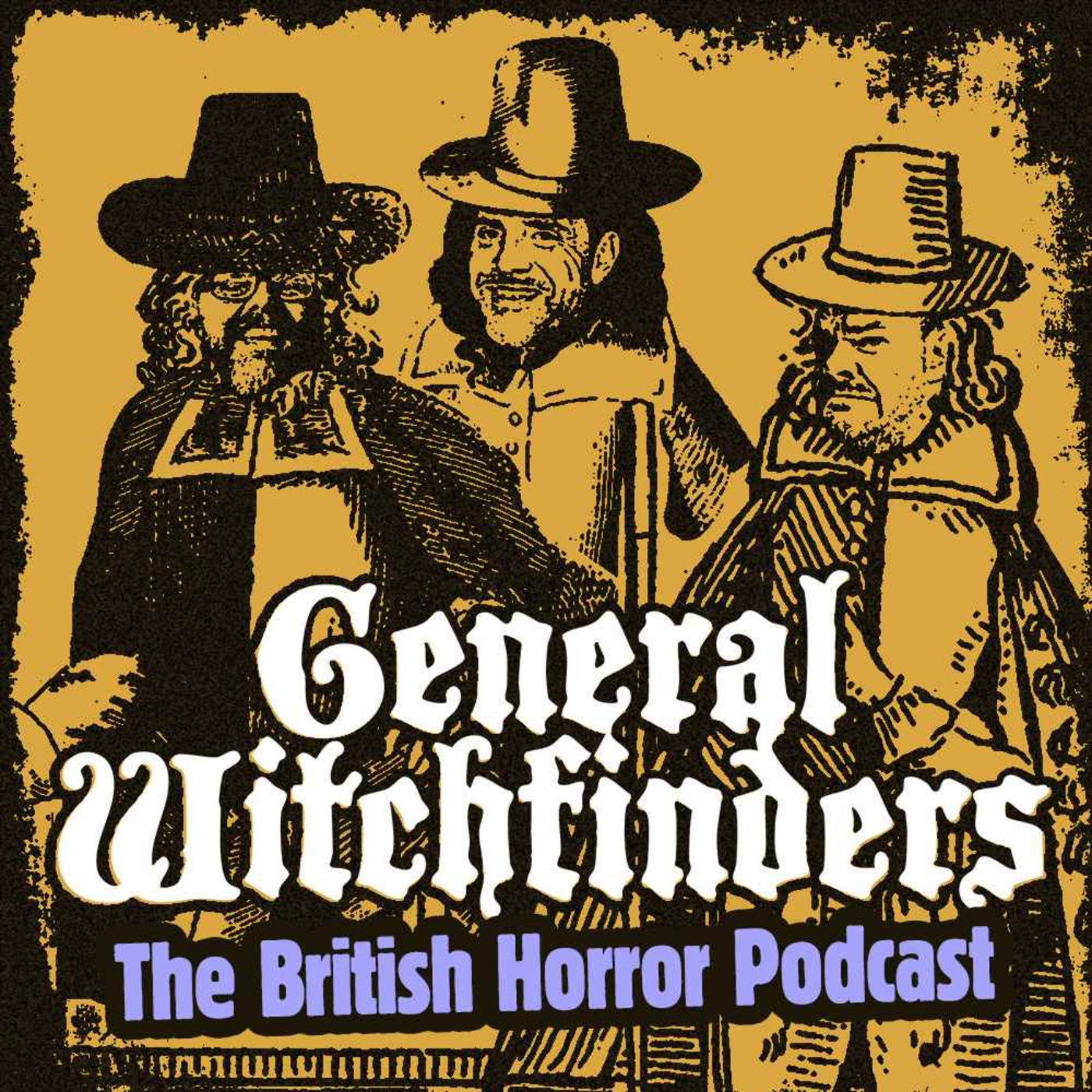
General Witchfinders: The British Horror Podcast
Ross, Jon & James | Exploring Cult British Horror Films, TV & BooksAudio
- Format:
- Podcast
- New episodes:
- Irregular
- Typical length:
- about 1 hour 30 minutes
- Latest episode:
About this show
General Witchfinders: The British Horror Podcast
Welcome to General Witchfinders, a podcast dedicated to the dark heart of British horror and classic Hammer horror films – officially selected for permanent preservation in the British Library’s National Sound Archive.
If you are passionate about British horror cinema, Hammer films, classic folk horror, Nigel Kneale’s Quatermass, and the chilling legacy of British supernatural television, this is the podcast for you.
Hosted by lifelong friends Ross, Jon, and James, General Witchfinders dives deep into the world of British horror, gothic cinema, and unsettling archive television.
We explore everything from Hammer horror’s blood-drenched vampire classics – starring Christopher Lee and Peter Cushing – to the eerie landscapes of The Wicker Man, Tigon’s The Creeping Flesh, and Amicus anthology films.
Whether it is cinematic British horror icons like Dracula AD 1972 and The Curse of Frankenstein, modern independent UK folk horror like Possum and In The Earth, or sci-fi horror thrillers like Event Horizon and The Medusa Touch, we unearth the films that shaped the genre.
We cover the definitive British sci-fi horror of Nigel Kneale – including The Quatermass Xperiment, Quatermass 2, Quatermass and the Pit, The Stone Tape, and his terrifying TV anthology series Beasts.
Our episodes shine a spotlight on classic British horror literature, including the tales of James Herbert from The Rats to The Survivor, alongside vintage television gems like the BBC’s Ghost Stories for Christmas (Whistle and I’ll Come to You, The Ash Tree), Doomwatch, Tales of the Unexpected, Inside No. 9, Ghostwatch, and classic Doctor Who horror stories like The Dæmons and Horror of Fang Rock.
Expect thoughtful commentary, dry wit, and nostalgic tangents about 1980s and 90s British culture.
Beyond the Podcast We also publish the independent General Witchfinders horror zine and host live podcast events and film screenings for the UK horror community.
General Witchfinders is your premier audio guide to British horror, Hammer films, folk horror, Quatermass, and everything that makes the UK’s supernatural tradition uniquely haunting.
Listen now on Spotify, Apple Podcasts, or grab our latest horror zine and live event tickets at www.generalwitchfinders.com (https://www.generalwitchfinders.com).
Listener Reviews
“Really entertaining and insightful. About half a dozen episodes done so far, and all on horror/supernatural things I personally love and wanted to hear more about. Lots of new facts and just downright entertaining takedowns. Great work.” – 5 Stars *****
🦴 “If you’re looking for a fun chat about vintage British horror and sci-fi, then this is the podcast for you.” – 5 Stars *****
Support this show http://supporter.acast.com/general-witchfinders.
Hosted on Acast. See acast.com/privacy (https://acast.com/privacy) for more information.
Covers: British horror, hammer horror, folk horror, nigel kneale, gothic cinema, British television drama, book club, occult fiction, parapsychology, horror literature
Show details and episodes come from the publisher's public feed at feeds.acast.com. Last updated . Names, artwork and text belong to their publishers.
Recently on this show
Summary of recent episodes, drawn from the publisher's feed.
General Witchfinders is a podcast about British horror, covering Hammer and gothic films, classic folk horror, and Nigel Kneale's sci-fi work. Recent episodes have covered a live recording of Dr. Jekyll and Sister Hyde, The Quatermass Conclusion, Alternative 3, Penda's Fen, and a book club discussion of Starve Acre.
Cosmos
Similar in subject
- Better Than Food
Both cover: occult fiction, horror literature - Conversations in Hammer Studio Horrors
Both cover: british horror
Similar shows





Episodes
43 - 28 Days Later (2002) - Danny Boyle
· 1 hr 35 min
28 Days Later is a 2002 British post-apocalyptic horror film, our first film from the 21st Century. Ewan McGregor was the original choice to play the protagonist, ‘Jim’, but he and director Danny Boyle had a falling-out at the time over The Beach, in which McGregor was to play the lead but was replaced by Leonardo DiCaprio (McGregor and Boyle have since reconciled). After McGregor, the role was offered to Ryan Gosling, who passed, having a scheduling conflict, leading to the film being offered to the relatively unknown Cillian Murphy. Danny Boyle films include: Shallow Grave, Trainspotting, A Life Less Ordinary, The Beach, Sunshine and 127 Hours. He was the artistic director for the opening ceremony of the 2012 London Olympics, which he was offered a knighthood but declined. In 2011 he directed Frankenstein on stage for the National Theatre, with dual Holmes’s: Cumberbatch and Miller, (that James was lucky enough to see live). Regular collaborator with Boyle, writer and director Alex Garland (who wrote this film) has a filmography that includes: Never Let Me Go, Dredd, Ex Machina, (for which he received an Oscar nomination), Annihilation and the fantastically bonkers ‘Men’. Garland has said he took inspiration for 28 days later from George A. Romero's Living Dead film series and John Wyndham's 1951 novel The Day of the Triffids. The crew filmed during early mornings and temporarily closed streets to capture recognisable and typically busy areas when they were deserted. For the scene in which Jim walks by the overturned double-decker bus, the crew placed the bus on its side and removed it when the shot was finished, all within 20 minutes. They had asked permission to place the bus outside Downing Street, but Westminster City Council refused. When they arrived at 4am and nobody from the council was present, they placed it there anyway. One of the first mainstream films to be shot entirely digitally, it was a financial success., grossing more than $82.7 million worldwide on its modest budget of $8 million, it became one of the most profitable horror films of 2002. Producer Andrew Macdonald had access to funding from the National Lottery, and pitched it to Universal Pictures, who declined to support it. Budget constraints proved to be an issue, with Christopher Eccleston having to take an emergency pay cut during filming. Macdonald announced to the crew that the production had run out of money, and filming ceased without a closing sequence being shot. After pitching several endings, the original, which featured Jim's death, tested badly with audiences, the studio granted more funding to film the ending scene that was eventually used. The crew organised for a real jet to fly overhead for them to film, as this was cheaper than approximately £70,000 for a computer-generated one. Despite Boyle not considering it a zombie film, 28 Days Later is credited with reinvigorating the zombie genre and influencing a revival in the decade after its release, with its fast-running monsters and character-driven drama. The film was followed by the 2007 sequel 28 Weeks Later and Boyle and Garland have been reportedly working on a 3rd part entitled “28 Years Later” (which may or may not be being released in 3 parts - depending on what rumours you read). Support this show http://supporter.acast.com/general-witchfinders. Hosted on Acast. See acast.com/privacy (https://acast.com/privacy) for more information.
Not rated yet42 - Nothing But The Night
· 1 hr 31 min
Nothing but the Night is a 1973 British horror film directed by Peter Sasdy and starring Christopher Lee and Peter Cushing. It is based on the 1968 novel of the same name by John Blackburn. A commercial failure, the film was the only production of Charlemagne Films, cofounded by Christopher Lee and Anthony Nelson Keys (producer of may Hammer films, this was his last listing on IMDB). #BigChrisLee and Charlemagne Films optioned two other books by John Blackburn, "Portrait of Barbara" and "Bury Him Darkly", which were envisioned as sequels to this movie, with Lee re-creating the role of Colonel Bingham, but it didn't work out. They also optioned some of Dennis Wheatley's books, but only "To the Devil a Daughter" was ultimately made by "Hammer." Peter Sasdy Also directed Taste the Blood of Dracula, Countess Dracula, Hands of Ripper, The Stone Tape AND both series of Adrian Mole. Screenwriter Brian Hayles Wrote six stories for "Doctor Who" and created the Celestial Toymaker (Recently brought back in the 60th anniversary episodes), the Ice Warriors, introduced in 1967, and the feudal planet Peladon (setting for 'The Curse of Peladon' and its sequel 'The Monster of Peladon'). Along with Lee and Cushing the film also features: Diana Dors as Anna Harb Dors (real name Diana Mary Fluck) came to public notice as a blonde bombshell, was promoted by her first husband, Dennis Hamilton, mostly in sex film-comedies and risqué modelling. After it was revealed that Hamilton had been defrauding her, she continued to play up to her established image, and she made tabloid headlines with revelations of the celebrity sex parties reportedly held at her house (with then boyfriend Bob Monkhouse). Georgia Brown as Joan Foster Who's breakthrough role was Nancy in Oliver!, a role she created in the original 1960 London production. But is most memorable to your hosts as Helena Rozhenko, Worf's adoptive mother in Star Trek: The Next Generation ("New Ground" and "Family". Keith Barron as Dr. Haynes Famous for playing David Pearce in the ITV sitcom Duty Free also featured in the Doctor Who story Enlightenment, replacing Peter Sallis who was unavailable Gwyneth (Cassandra Trotter) Strong as Mary Valley Also appeared in the "Observation" segment about detective Samantha Smith made for the 1990 series of The Krypton Factor, Fulton (Poridge) Mackay as Cameron John (Quatermas)Robinson as Lord Fawnlee Morris Perry as Dr. Yeats Michael (Dumbledoor) Gambon as Inspector Grant Duncan Lamont as Dr. Knight Shelagh (Aunt Beru ) Fraser as Mrs. Alison Kathleen Byron as Dr. Rose Andrew McCulloch as Malcolm Support this show http://supporter.acast.com/general-witchfinders. Hosted on Acast. See acast.com/privacy (https://acast.com/privacy) for more information.
Not rated yet41b - BBC Ghost Stories for Christmas: The Treasure of Abbot Thomas
· 54 min
The Treasure of Abbot Thomas is a supernatural drama produced by the BBC as part of the A Ghost Story for Christmas series. Once again, directed by Lawrence Gordon Clark, the screenplay was written by John Bowen (Writer of the Series’The Guardians’ In a declining England of the 1980s, the UK has broken up and England is ruled by a fascist military force), with an atmospheric musical score by Geoffrey Burgon (Who also created the music for the BBC Narnia series and Monty Python’s the Life of Brian). It is based on the 1904 short story "The Treasure of Abbot Thomas" by M.R. James, the drama was originally broadcast on December 23, 1974. The drama starred Podcast Hero, Michael Bryant as Rev. Justin Somerton. As listeners will remember, Bryant was one of the stars of the classic BBC television play The Stone Tape (made only two years previous to his appearance in this film), in which he played the leader of a team of scientists who investigate ghost sightings in a brooding Gothic mansion. The film also features: Paul Lavers as Peter, Lord Dattering, who appeared in the Fourth Doctor adventure "The Androids of Tara." Frank Mills as Mr. Tyson, known for being considered for the role of one of the security guards in the film "Lifeforce." John Herrington as Abbot Thomas, who had small roles in the television versions of "Quatermass 2" and "Quatermass and the Pit," as well as two Doctor Who television stories: as Rhynmal in "The Daleks' Master Plan" and Jim Holden in "Colony in Space." Sheila Dunn as Mrs. Tyson and Virginia Balfour as Lady Dattering also appear in the film. Although James's original story was set in Germany, for budgetary reasons, the television version was relocated to England. Clark used the grounds of Wells Cathedral in Somerset for the entrance to the well where Abbot Thomas hid his treasure. Wells Cathedral Chapter House and its adjoining steps were also used in various scenes. Regarding "The Treasure of Abbot Thomas," Clark recalls John Bowen's script "took some liberties with the story—which made it for the better, I think...It's really quite a funny story until it gets nasty, although the threat is always there. James has a mordant sense of humour, and it's good to translate that into cinematic terms when you can. I'd always wanted to do a medium scene, and John came up with a beauty." Support this show http://supporter.acast.com/general-witchfinders. Hosted on Acast. See acast.com/privacy (https://acast.com/privacy) for more information.
Not rated yet41a - BBC Ghost Stories for Christmas: The Stalls of Barchester
· 1 hr 6 min
The Stalls of Barchester was first broadcast on BBC 1 at 11:00 pm on December 24, 1971. It is based on the story "The Stalls of Barchester Cathedral" from the 1911 collection More Ghost Stories by M. R. James, it was adapted, produced, and directed by Lawrence Gordon Clark, who directed every BBC Ghost Stories for Christmas between 1971 and 1977. Can you name them all, Jon? - The Stalls of Barchester (1971) - A Warning to the Curious (1972) - Lost Hearts (1973) - The Treasure of Abbot Thomas (1974) - The Ash Tree (1975) - The Signalman (1976) - Stigma (1977) The cast of The Stalls of Barchester includes several actors now better known for their roles in situation comedies or lighter dramas: Clive (Richard Bucket) Swift as Dr. Black (a character who does not appear in the original story). As we have mentioned before, he has had two appearances in Doctor Who of which he was not particularly pleased, so we will only mention them again. Of his appearance in the 2007 Doctor Who Christmas special, Swift declared, "It wasn't until we'd been filming for two weeks that I realized that Mr. Copper is an alien!" And having been asked about his appearance in Revelation of the Daleks (1985), he said, "It was the most bizarre entertainment I have ever been part of." Will Leighton as the cathedral librarian. He also appeared in the previously discussed film, An American Werewolf in London, as one of the Tramps that get killed by David. Robert Hardy as Dr. Haynes. Hardy's birth name was Timothy Sidney Robert Hardy, his nickname being 'Tim'. He has played British Prime Minister Winston Churchill in six separate films, and has also twice played Winston Churchill's World War II ally and friend, American President Franklin D. Roosevelt. Thelma Barlow as Letitia Haynes. Famous for her part of Mavis Riley in Coronation Street, her first episode was transmitted in 1971, but her character only appeared regularly from 1973, when she joined the staff of "The Kabin". She remained in the series for 26 years, appearing in nearly 2,000 episodes. Harold Bennett as Archdeacon Pulteney. Not Pountney as Ross kept hearing. Best known as the lecherous, octogenarian 'Young Mr. Grace' in the long-running comedy series Are You Being Served?, Bennett had a career as an architect and only became an actor when he retired. Erik Chitty as the priest. Seen in Doctor Who: The Deadly Assassin as Engin the Time Lord Coordinator of the Matrix David Pugh as John and Ambrose Coghill as museum curator The adaptation was filmed on location at Norwich Cathedral and the surrounding cathedral close. Unusual for a BBC television drama of the 1970s, both interior and exteriors in The Stalls of Barchester were originated on 16 mm film, as opposed to the standard studio videotape for interiors. Support this show http://supporter.acast.com/general-witchfinders. Hosted on Acast. See acast.com/privacy (https://acast.com/privacy) for more information.
Not rated yet40 - The Brides of Dracula
· 1 hr 41 min
"Dracula the Damned" is a 1960 British supernatural horror film produced by Hammer Film Productions starring ‘Big’ Christopher Lee… Scratch that… Rather, the original sequel to the first Hammer Dracula film was cancelled without explanation, although Christopher Lee's decision not to return due to fear of typecasting probably led to The Brides of Dracula taking its place. #BigChrisLee did return five years later, however, when he starred in Dracula, Prince of Darkness. The Brides of Dracula is a 1960 British supernatural horror film produced by Hammer Film Productions. Directed by Terence Fisher, the film stars Peter Cushing, David Peel (who wore lifts in his shoes to make him the same height as actor Peter Cushing in the film. Peel, according to his bio at the time, was 5 foot 10. Cushing was six feet tall. To make his vampire look distinguishable from Christopher Lee's, Peel wore a full blonde hairpiece), Yvonne Monlaur, Andrée Melly, Miles Malleson (the hearse driver in the Ealing chiller compendium Dead of Night), Martita Hunt (known for her rich cluster of queens, dowagers, shrews, and evildoers—but it was her brilliant performance as the mad, reclusive Miss Havisham in the classic Great Expectations that earned her international recognition), and Freda Jackson (also an alumna of Great Expectations). Although, the character of Count Dracula does not appear in the film, and is instead mentioned only twice. After the success of Dracula, Hammer commissioned Jimmy Sangster to write a sequel titled Disciple of Dracula, about an acolyte of the vampire, with Count Dracula himself only making a cameo appearance. Sangster's script was rewritten by Peter Bryan to remove references to Dracula, while adding the character of Van Helsing. The screenplay was then further revised by Edward Percy. Filming began on January 16, 1960, at Bray Studios, and the film premiered at the Odeon Marble Arch on July 6. It was distributed theatrically on a double bill with The Leech Woman. The ending was originally planned to have the vampires destroyed by a swarm of bats, but this proved too expensive to stage and shoot, and was also vetoed by Peter Cushing, who did not think his character would perform the black magic required to summon the bats. However, the idea was recycled three years later for the climax of Hammer's The Kiss of the Vampire. The prop department put a lot of effort into making a realistic model bat, but it was lost and had to be replaced on short notice. This explains the unconvincing model bat in the movie. The front doors of Oakely Court served as the main entrance to Meinster Castle. Oakley Court has been featured in a number of classic horror films, including The Curse of Frankenstein, The Horror of Dracula, The Evil of Frankenstein, Die, Monster, Die, and The Rocky Horror Picture Show. $£$£$£$£$£$£$£$£$£$£$£$£$£$£$£$£$£$£$ Just in case anyone has too much money and wants to give a bit to us to help with our hosting n stuff. It would be amazing if you fancied sending us some pennies - thank you. https://supporter.acast.com/general-witchfinders $£$£$£$£$£$£$£$£$£$£$£$£$£$£$£$£$£$£$£ Support this show http://supporter.acast.com/general-witchfinders. Hosted on Acast. See acast.com/privacy (https://acast.com/privacy) for more information.
Not rated yet39 - Lifeforce AKA Space Vampires
· 1 hr 41 min
Lifeforce (aka Space Vampires) is a 1985 science fiction horror film directed by Tobe Hooper, adapted by Dan O'Bannon (writer of Alien!) and Don Jakoby, and starring Steve Railsback, Peter Firth, Frank Finlay, Mathilda May, and Patrick Stewart. It also features John Forbes-Robertson as ‘The Minister’ The film is based on Colin Wilson's 1976 novel, The Space Vampires. It portrays the events that unfold after a trio of humanoids in a state of suspended animation are brought to Earth after being discovered in the hold of an alien spaceship. This was the first film of Hooper's three-picture deal with Cannon Films, the other two films are the remake of Invaders from Mars and The Texas Chainsaw Massacre 2. Prior to Lifeforce, Hooper was originally offered the script for E.T. but turned it down. Spielberg then suggested Hooper direct Poltergeist, a project he had written himself and had planned on directing. he took the job and Spielberg went on directed E.T. (and most people also believe Poltergeist as well) Before Hooper, Michael Winner was offered the Lifeforce director's gig, but it didn't work out. And Billy Idol said he had been offered a lead role as a vampire by Hooper, who had directed the video for "Dancing with Myself", but turned it down due to touring commitments. It has been suggested that this is a remake of Hammer Film Productions' Quatermass and the Pit. In an interview, director Tobe Hooper discussed how Cannon Films gave him $25 million, free rein, and Colin Wilson's book The Space Vampires. Hooper then shares how giddy he was: "I thought I'd go back to my roots and make a 70mm Hammer film." Hooper came up with the idea of using Halley's Comet in the screenplay, rather than the asteroid belt as originally used in the novel, as the comet was going to pass by Earth one year following the film's release. Colin Wilson, the author of the source material, was unhappy with the way the film turned out. He wrote of it, "John Fowles had once told me that the film of The Magus was the worst movie ever made. After seeing Lifeforce I sent him a postcard telling him that I had got one better." According to interviews with Bill Malin, who plays one of the male vampires, the film went over schedule during production. Because of this, some important scenes were never shot, and the film was shut down at one time because the studio had simply run out of money. The film marked the fourth project to feature special effects produced by Academy Award winner John Dykstra. Dykstra who has worked on 38 films including: Star Wars, Star Trek the Motion Picture, Batman Forever and Batman and Robin, Spider-Man 1 and 2, and the last three Tarantino films. His last IMDB credit is a fan man Spiderman film that is getting some heat because of racist slurs used by some of the cast whilst promoting the film. The umbrella-like alien spaceship was modelled after an artichoke, while the miniature London destroyed in the film was actually the remains of Tucktonia, a model village near Christchurch, United Kingdom, that had closed not long before the shooting of the film. The initial Director's cut was 128 minutes long. This is 12 minutes longer than the final version, which had several scenes cut, most of them taking place on the Space Shuttle Churchill. According to an interview he gave on the UK talk show Wogan in 1985, most of Nicholas Ball's performance ended up on the cutting room floor Mathilda May had to learn her lines phonetically, for her audition as Space Girl, because she didn't know any English at the time. She then went on to learn the language during the six months she spent in England on this movie. Patrick Stewart has said several times that Tobe Hooper was his favourite director to work with (which is rather unkind to Jonathan Frakes I thought). Music and SFX provided by https://slip.stream and Audio jungle Support this show http://supporter.acast.com/general-witchfinders. Hosted on Acast. See acast.com/privacy…
Not rated yet38 - Nigel Kneale's - The Quatermass Xperiment / AKA The Creeping Unknown
· 2 hr 15 min
Tonight, we complete the Hammer Quatermass trilogy (albeit out of order) with The Quatermass Xperiment (a.k.a. The Creeping Unknown in the US) is a 1955 British science fiction horror film from Hammer Film Productions, based on the 1953 BBC Television serial written by Nigel Kneale. Produced by Anthony Hinds, one of the of 37 films he made for Hammer. Hinds wrote a number of films under the pseudonym 'John Elder' which he adopted after Her couldn't afford a screenwriter for The Curse of the Werewolf). It is directed by Val Guest, writer and director of the Cannon and Ball vehicle, Boys in Blue and Confessions of a Window Cleaner. (and of course director of Quatermass 2) The film stars Oscar Nominee, Brian Donlevy in his fist of 2 portrayals as the eponymous Professor Bernard Quatermass. Richard Wordsworth, Who feature as a sinister taxidermist with James Stewart in Alfred Hitchcock's second version of The Man Who Knew Too Much, as well as appearing in British TV dramas such as Huntingtower and The Tripods, and notablble in other Hammer films - The Revenge of Frankenstein and The Curse of the Werewolf, plays the tormented astronaut Carroon. Jack Warner plays Inspector Lomax (insanely famous in his time as the titular Dixon of Dock Green appearing in 432 episodes on tv from 1955 to 1976) Margia Dean plays Judith Carroon. Dean only passed away, sadly, this June. We also briefly see Thora Hird in one scene as 'Rosie'. Thora lived so long and did achieved so much, she was the subject of 'This is your Life' Twice. The Quatermass Experiment was originally a six-part TV serial broadcast by BBC Television in 1953. It was an enormous success with critics and audiences alike, later described by film historian Robert Simpson as "event television, emptying the streets and pubs". Among its viewers was the forementioned Hammer Films producer, Anthony Hinds, who was immediately keen to buy the rights for a film version. Nigel Kneale also saw the potential for a film adaptation and, at his urging, the BBC touted the scripts around a number of producers. Kneale met with Sidney Gilliat to discuss the scripts but Gilliat was reluctant to buy the rights as he felt any film adaptation would inevitably receive an 'X' Certificate from the British Board of Film Censors. Hammer's offer met some resistance within the BBC, with one executive expressing reservations that The Quatermass Experiment was not suitable material for the company, but the rights were nevertheless sold for an advance of £500. Kneale was a BBC employee at the time, which meant that his scripts were owned entirely by the BBC. He received no extra payment for the sale of the film rights. This became a matter of some resentment on Kneale's part, and when his BBC contract came up for renewal he demanded and secured control over any future film rights for his work. Kneale remained bitter over the affair until the BBC made an ex-gratia payment of £3,000 to him in 1967, in recognition of his creation of Quatermass. We also include the concept Album 'Victor Caroon', available on Soundcloud here: https://soundcloud.com/victor-caroon Support this show http://supporter.acast.com/general-witchfinders. Hosted on Acast. See acast.com/privacy (https://acast.com/privacy) for more information.
Not rated yet37 - Murder By Decree
· 1 hr 36 min
Murder by Decree is a 1979 mystery thriller directed by Bob Clark (Director of ‘Children Shouldn't Play with Dead Things’ and ’Dead of Night’ (not the brilliant black and white British film from 1945 - featured in episode 13, but the 1974 American film ), he also directed ‘Black Christmas’, ‘Porkys’ and ‘Porkys 2’ Murder by Decree was written by playwright John Hopkins, who scripted the Bond film Thunderball, and the Alec Guinness TV version of Smileys People. Hopkins referenced Conan Doyle's work, particularly Holmes' deduction and science skills but downplayed other aspects of the characters, such as Holmes' drug use, in favour of making them more likeable and human. Peter O'Toole was originally cast as Sherlock Holmes, and Sir Laurence Olivier was cast as Dr. Watson. But the two actors had not worked well together in the past, and were unable to overcome their differences for this movie. Rather, Holmes is played by Christopher (Captain Georg von Trapp) Plummer and Dr. Watson is played by James Mason. Plummer, described by IMDB as“ perhaps Canada's greatest thespian”, turned down the role of Gandalf in Sir Peter Jackson's "Lord of the Rings" trilogy, and admits to regretting that decision. Question for James and Jon? Christopher Plummer had two roles in common with Peter Cushing, can you name them? James Mason reportedly, he once saved the life of Max Bygraves' son at a party at Judy Garland's house. The boy fell into the pool and Max did not notice. James Mason did and, fully clothed, he jumped into the water and pulled him out. He was scheduled to play James Bond in a 1958 television adaptation of "From Russia with Love", which was ultimately never produced. Later, despite being in his 50s, Mason was a contender to play Bond in Dr. No before Sean Connery was cast. He later turned down the role of Hugo Drax in the James Bond film Moonraker, which went to Michael Lonsdale. In his autobiography, "In Spite of Myself", Plummer noted that Mason was the best Watson he had seen, and that his death halted a proposed furthering of their on-screen partnership. The film also features: David Hemmings (Blow Up, Deep Red, Brabarella, Gladiator, Magnum Pi and Airwolf) as Inspector Foxborough, Anthony Quayle (Lawrence of Arbia, The Guns of Navarone) as Sir Charles Warren, Frank Finlay (Lifeforce, The Three Musketeers) as Inspector Lestrade, Geneviève Bujold as Annie Crook, Susan Clark as Mary Kelly, John Gielgud as Prime Minister Lord Salisbury, Donald Sutherland as Robert Lees and the Mighty June Brown as Anne Chapman The film's premise of the plot behind the murders is influenced by the book Jack the Ripper: The Final Solution, by Stephen Knight, who presumed that the killings were part of a Masonic plot. The original script contained the names of the historical suspects, Sir William Gull and John Netley. In the actual film, they are represented by fictional analogues: Thomas Spivy (Gull) and William Slade (Netley). This theory on the perpetrators of the killings is featured in a number of other Jack the Ripper-themed fictions, including the graphic novel ‘From Hell’. The replica nineteenth century dockland set took two months and fifty men to construct at Shepperton Studio's largest soundstage. The set also included a replica muddy Thames River, Alien was shooting concurrently in the same studios. Support the show by buying from our affiliate links… https://tinyurl.com/Murder-Decree-Blu-ray https://tinyurl.com/Murder-Decree-DVD https://tinyurl.com/From-Hell-Book https://tinyurl.com/From-Hell-Companion-book https://tinyurl.com/The-Five-Book Support this show http://supporter.acast.com/general-witchfinders. Hosted on Acast. See acast.com/privacy (https://acast.com/privacy) for more information.
Not rated yet36 - Nigel Kneale's / Susan Hill's - The Woman in Black (1989)
· 1 hr 24 min
Tonight we are discussing the 1989 British horror drama television film directed by Herbert Wise (most famous for I, Cladius, who worked solidly from 1957 to 2001 on everything from The Bill to 9 episodes of Tales of the Unexpected - including ‘The Landlady’ which may well be the episode that Jon talked about remembering in episode 29) It stars Adrian Rawlins (Harry Potters Dead Dad in the movies and Mr Pike in one episode of Neighbours), Bernard Hepton (I, Claudius, Get Carter Tinker Tailor, Soldier Spy and Colditz), David Daker (93 episodes of Boon, 84 episodes of Z cars, Time Bandits and 2 Doctor Who stories: Irongron in The Time Warrior and Captain Rigg in Nightmare of Eden) and Pauline Moran ( who was Miss Lemon in many episodes of Poirot and was bass player in the all female band ‘The She Trinity’ who had a top 40 hit a cover of "He fought the law" in 1966.). Hill’s The Woman in Black had already been adapted into a beloved stage-play that went to become the West End’s second longest running, non-musical after The Moustrap. More recently, the story was filmed by Hammer in 2012, staring Daniel Radcliff and going on to be the highest grossing British horror movie of all time. This teleplay is adapted from the 1983 novel of the same name by Susan Hill. It focuses on a young solicitor who is sent to a coastal English village to settle the estate of a reclusive widow, and finds the town haunted. The programme was produced by Central Independent Television for ITV, it was filmed at Stanlake Park in Berkshire, using the causeway to Osea Island, near Goldhanger in Essex, and the local salt marshes, whilst scenes to represent Crythin Gifford were filmed at the National Trust village of Lacock, near Chippenham, Wiltshire. and premiered on Christmas Eve 1989. It was an unexpected success, though author Susan Hill reportedly disagreed with some of the slight changes made in the adaptation By General Witchfinder’s favourite Nigel Kneale, who you will all most like be aware of as the writer of the eerie and downright terrifying with his Quatermass tetralogy and, the classic ‘The Stone tape’, The Road and Beasts, a six horror stories based around animals, for ITV. (Go and check out episodes 5, 17, 27, and 34 for more Kneal goodness) $£$£$£$£$£$£$£$£$£$£$£$£$£$£$£$£$£$£$ Just in case anyone has too much money and wants to give a bit to us to help with our hosting n stuff. It would be amazing if you fancied sending us some pennies - thank you. https://supporter.acast.com/general-witchfinders $£$£$£$£$£$£$£$£$£$£$£$£$£$£$£$£$£$£$£ Support this show http://supporter.acast.com/general-witchfinders. Hosted on Acast. See acast.com/privacy (https://acast.com/privacy) for more information.
Not rated yetClip show - episodes 4-6
· 2 hr 19 min
Clips from the best bits from episodes four to six 4 - James Herbert - The Rats https://podfollow.com/general-witchfinders/episode/fcc6efe904b6f9160ab7a0656bc46dd0f5901e93/view 5 - Nigel Kneale’s - The Stone Tape https://podfollow.com/general-witchfinders/episode/ff8003920d88e2462eaa2353dc2a007a102c2789/view 6 - The Satanic Rites of Dracula https://podfollow.com/general-witchfinders/episode/75233646bd312312a10f794fb49b2ffed51b2a72/view Support this show http://supporter.acast.com/general-witchfinders. Hosted on Acast. See acast.com/privacy (https://acast.com/privacy) for more information.
Not rated yet