

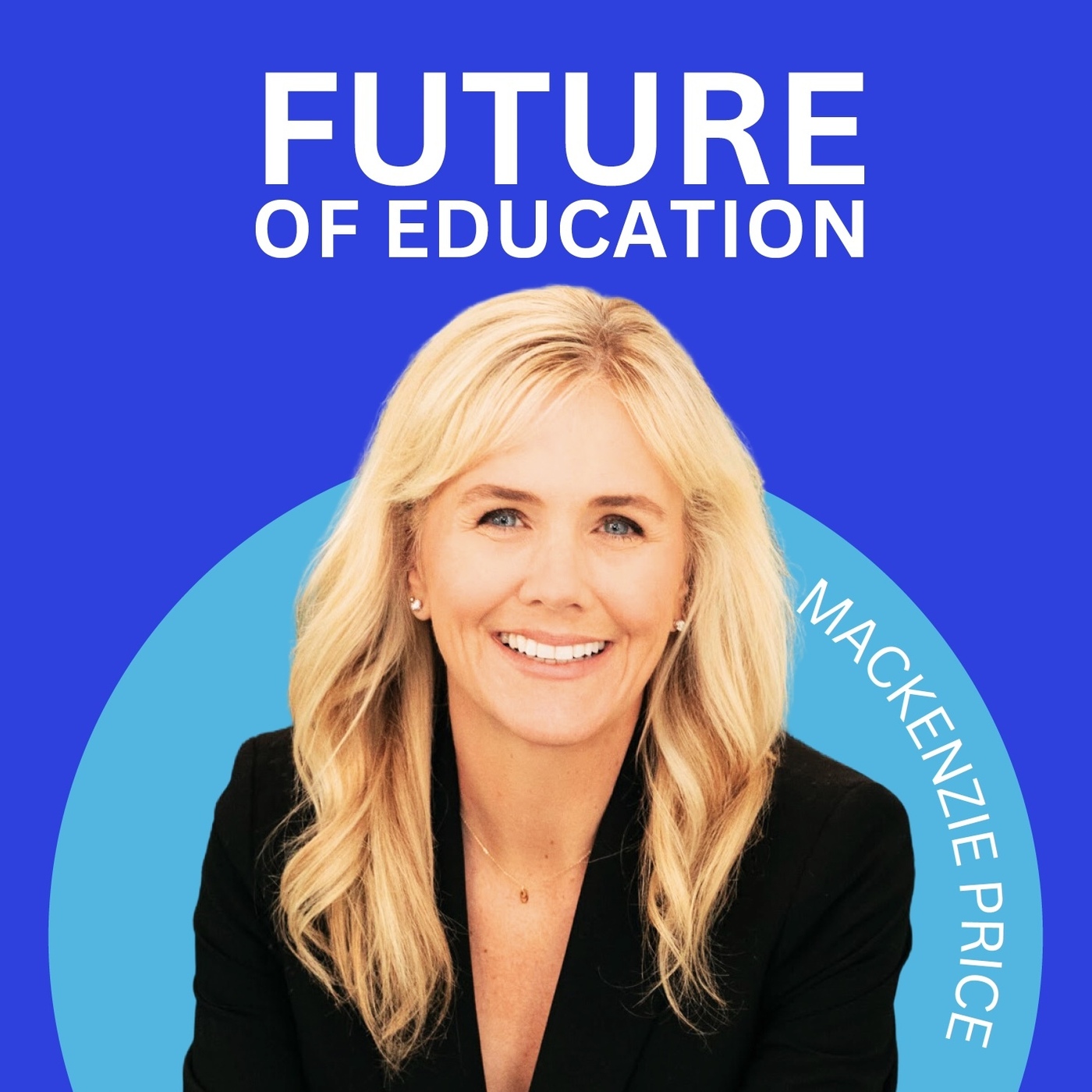
Future of Education Podcast
MacKenzie PriceAudio
- Format:
- Podcast
- New episodes:
- Weekly
- Typical length:
- about 45 minutes
- Latest episode:
About this show
The Future of Education Podcast is the place to find out what's happening in schools. Our guests are wide and varied, from educators, entrepreneurs, athletes, celebrities, influencers and most importantly-our students! They all have one thing in common- they are passionate about reinventing education to make it relevant and efficient.
Our host, MacKenzie Price, is the Co-Founder of 2hr Learning (2hourlearning.com (https://2hourlearning.com/)) and some of the top-performing schools in the country. 2 Hour Learning is a groundbreaking school model that is reshaping the landscape of K-12 education. It's powered by AI technology, enabling schools to provide personalized curriculum to students. Our K-12 schools perform in the top 2% nationwide by leveraging this personalize model to help students love school, learn twice as much, and build life skills. MacKenzie is at the forefront of educational transformation, striving for a balanced and enriching learning experience for every child. She graduated with a BA in Psychology from Stanford University and resides in Austin, Texas, with her husband and two daughters.
The Future of Education podcast is produced by 7 Lyons Media (7LyonsMedia.com). Please send press inquiries to mkp@2hourlearning.com.
Covers: parenting, child development, AI in education, reading instruction, homeschooling, alternative schools, personal finance, learning science, school reform
Show details and episodes come from the publisher's public feed at rss.art19.com. Last updated . Names, artwork and text belong to their publishers.
Recently on this show
Summary of recent episodes, drawn from the publisher's feed.
This podcast explores the future of schooling, featuring educators, founders, and other guests who want education to feel more relevant and efficient. Recent episodes examine AI in classrooms, reading instruction, raising critical thinkers, overprotective parenting, and building an alternative school.
Cosmos
Similar in subject
- The Southern Tea
Both cover: homeschooling, parenting, personal finance - Kohn's Zone
Both cover: school reform, reading instruction, parenting - Homeschool Moms Unfiltered
Both cover: homeschooling, child development, parenting
Similar shows





Explore more
Episodes
S2E367: What Happens When Four-Year-Olds Use AI to Learn?
· 36 min
Can four-year-olds really use AI to learn? It’s one of the most common questions we get, and the answer might surprise you. In this episode, MacKenzie sits down with Mallory, an original Alpha guide with six years at the school and the leader of Alpha’s pre-K program, to talk about what learning actually looks like for four-year-olds and how parents can bring those lessons home. We’re covering: Screen Time, Done Intentionally: What subjects we focus on, how long we spend on screens, and why clear expectations make all the difference. Meeting Every Kid Where They Are: How personalized learning means no one waits and no one gets left behind. Loving Environments With High Standards: Why kids feed off your energy, and how to help them tackle hard things without the fear. Episode Timestamps: 00:00 – Four-Year-Olds Learning With AI: Is It Too Young? 01:07 – Why Alpha Finally Said Yes to Pre-K 02:58 – Building a Positive Self-Image at Age Four 04:21 – Screen Time and the Pre-K Day 06:02 – Reading and Math: What Four-Year-Olds Actually Do on Apps 12:26 – Reading Tips for Home (and AI Bedtime Stories) 16:00 – How Alpha’s Pre-K Students Are Performing 18:27 – “Kids Can Do Impossible Things”: Building a Treehouse 20:54 – Challenge: Swimming the Length of Barton Springs 26:30 – A Loving Environment With High Standards 28:19 – Four-Year-Olds, 1,200-Piece Lego Sets, and Grit 33:20 – Growth Mindset and Kids Helping Kids 34:36 – Letting Your Little One Join In Watch the Future of Education on YouTube: www.youtube.com/@future_of_education (https://www.youtube.com/@future_of_education) Read MacKenzie’s Substack: www.futureofeducation.substack.com (https://www.futureofeducation.substack.com) Learn more about our schools: www.2hourlearning.com/schools (https://www.2hourlearning.com/schools) Learn more about Alpha School: www.alpha.school (https://www.alpha.school)
Not rated yetS2E366: Live Episode: What Your Child’s Behavior Says About You, with Dr. Shefali Tsabary
· 1 hr 12 min
What if parenting is less about raising your child and more about raising yourself? It’s the big idea behind conscious parenting, and in this special live episode recorded in New York in front of a room of Alpha parents, Mackenzie and leading clinical psychologist Dr. Shefali explore how a parent’s fears, ego, and expectations shape the way kids grow up. Dr. Shefali Tsabary is a clinical psychologist with a doctorate from Columbia University and the New York Times bestselling author of The Conscious Parent. And in this special talk, she explains why your most defiant child may be your greatest teacher, the difference between achievement and performance, what a child’s worst behavior is really trying to tell you, and one simple thing you can do tonight to help your child feel truly known. The conversation gets personal, and Mackenzie ends up in the hot seat a few times herself, so tune in and enjoy this exclusive live discussion. Episode Big Ideas - Parenting Is About Raising Yourself: Why every parent starts with a fantasy of who their child will become, and how kids act as a mirror for what we haven’t yet healed. - Where to Begin: Why your biggest pain point (the yelling, the anxiety, the C grade that sets you off) is the doorway in, and how to peel back the fear underneath your reaction. - Mackenzie’s Mirror Moment: How a question from her husband about her daughter’s choices led Mackenzie to realize she was chasing her own ego, and what changed once she let go. - Your Defiant Child Is Your Awakener: Why the “difficult” child pushes parents to grow, and why the “good” child can keep parents stuck in control. - Achievement vs. Performance: How achievement that doesn’t come from the child turns into performance, and how Alpha tries to pair high standards with real ownership and autonomy. - “I Want My Child To...”: Why this sentence is one of the most dangerous a parent can say, and how curiosity about a child’s interests (like video games) can open a better path. - What Behavior Is Really Saying: The three reasons kids act out, why a “scratched lens” explains most parent frustration, and how to see the child beneath the behavior. - Connection Without an Agenda: Why presence matters more than busyness, and a 15-minute practice for being with your child with nothing to teach or fix. - Feeling Known: Why seeing your child in their ordinariness is one of the most powerful things a parent can do. Episode Timestamps: 00:00 - Introduction: chasing what’s best for our kids vs. what they actually need 01:01 - Dr. Shefali’s opening talk: why we need to reclaim childhood 03:25 - Why every parent was “perfect” until they had a child 08:14 - Your child as a mirror: parenting is about raising you 10:41 - The fantasy every parent brings to parenthood 15:34 - From fixing the child to getting out of the way: the shared mission of Alpha and conscious parenting 18:22 - Ara Katz, a founding Alpha parent, on his son feeling “seen” and the idea of conscious educating 23:01 - Where to begin: start with your biggest pain point 27:36 - Mackenzie’s story: letting her daughters choose their own path 33:15 - Why your defiant child is your greatest teacher 36:26 - High standards with support, and the bagel dough story 38:58 - Achievement vs. performance 45:18 - “I want my child to...”: the most dangerous sentence parents say 47:12 - What a child’s behavior is really saying 48:11 - The three reasons kids act out 50:30 - The “scratched lens” that makes normal kids look like problems 52:12 - When your child breaks the rules: seeing the child beneath the behavior 57:29 - Mackenzie’s dining room table moment 1:02:17 - A 15-minute practice: being with your child with no agenda 1:04:39 - What we inherit from our parents, and what we pass on 1:05:14 - “Hello, ego”: why you can’t out-conscious yourself 1:10:52 - One small thing to help your child feel known Watch the Future of Education on YouTube:…
Not rated yetS2E365: Is AI Good for Classrooms? 6 Learning Science Principles It Can Help Deliver (A Former Teacher Explains)
· 46 min
Is AI going to help students learn better, or is it the worst thing we could put in a classroom? It’s one of the biggest debates in education right now, and Mackenzie makes the case that decades of learning science research point to practices a single teacher in front of a classroom simply can’t deliver at scale. To dig into it, Mackenzie sits down with Sam DePalo, a former traditional teacher and Alpha guide with over 10 years of classroom experience. A Fulbright scholar with degrees in linguistics, literature, and mathematics, plus a postgraduate focus on neurodiversity and executive function, Sam taught high school math through Teach For America in a Title I public school (with a class of 47 students), then worked in private schools with much smaller class sizes. She saw the same limits in both. In this conversation, Sam explains six learning science principles and why she believes an AI tutor (not a chatbot) can help deliver them, while freeing teachers to focus on motivating and connecting with kids. In this episode, we discuss: - Why the Traditional Model Falls Short: How the industrial-era classroom was built to educate the masses, and why Sam saw the same limits in a 47-student Title I class and in small private-school classrooms. - One-to-One Instruction: Why individualized learning is the most powerful principle, and how an AI tutor can assess what a student knows and meet them at the right pace and level. - Mastery-Based Learning: Why moving on before a student has mastered a concept leaves gaps, what a 90% mastery bar looks like, and how grade inflation and the bell curve blur what an “A” really means. - Spaced Repetition and Retrieval Practice: How constantly revisiting past material, and being quizzed on it, beats cramming, and why a teacher with 25+ students can’t realistically build this in for every kid. - The Zone of Proximal Development: How kids shut down when work is too hard or too easy, and why productive struggle (not gamified, easy learning) is the goal. - Cognitive Load Theory: Sam’s “working memory whiteboard” explanation of why shaky math facts get in the way of learning algebra. - The Teacher’s Role: What changes when AI takes on grading, data analysis, and differentiation, so adults can focus on motivation and connection. Episode Timestamps: 00:00 - The great debate: Is AI good for classrooms or the worst thing for them? 01:37 - Sam’s background: from Fulbright scholar to Teach For America 04:16 - Why learning science doesn’t support the one-teacher model, even in small private schools 07:54 - Learning Science Principle 1: One-to-one instruction 09:08 - How an AI tutor (not a chatbot) makes individualized learning possible 12:36 - Learning Science Principle 2: Mastery-based learning 13:30 - Why Alpha sets the mastery bar at 90% 16:31 - Grade inflation, the bell curve, and the paper that got a 95% without being read 19:06 - Learning Science Principle 3: Spaced repetition and distributed practice 22:49 - Why cramming fails: the accounting class story 24:18 - Learning Science Principle 4: Retrieval practice 28:03 - Standardized assessments as feedback, not high-stakes judgment 30:00 - Hole-filling in action: how a student went from a 720 to a 790 on SAT math 32:12 - Learning Science Principle 5: The zone of proximal development 36:02 - Productive struggle vs. gamified learning 37:21 - Learning Science Principle 6: Cognitive load theory 41:19 - Why a motivated student matters most 43:13 - What AI frees teachers to do Watch the Future of Education on YouTube: www.youtube.com/@future_of_education (https://www.youtube.com/@future_of_education) Read MacKenzie’s Substack: www.futureofeducation.substack.com (https://www.futureofeducation.substack.com) Learn more about our schools: www.2hourlearning.com/schools (https://www.2hourlearning.com/schools) Learn more about Alpha School: www.alpha.school (https://www.alpha.school)
Not rated yetS2E364: Are You Coddling Your Kid? Signs and Fixes From a Veteran Educator
· 23 min
Overprotectiveness often stems from good intentions, but it can unintentionally strip children of the confidence, problem-solving skills, and resilience they need to thrive. In this episode of The Future of Education, Mackenzie speaks with Eric Salgado—an educator with over two decades of experience as a teacher, principal, school-system director, and Alpha School guide—about how to spot overprotection and replace it with high-support frameworks. Eric details the subtle classroom signs of overparenting, explains how to implement the "1% better every day" mindset at home, and breaks down why holding firm boundaries with natural consequences builds genuine independence. Key Topics Covered - Spotting Coddling in Real Time: Telltale behavioral signs of overprotection in school. - High Standards, High Support: Balancing firm boundaries with empathetic mentorship. - The "1% Better Every Day" Mindset: Helping children replace perfectionism with positive micro-habits. - Tactical Routines for Independence: Practical strategies for fixing stressful morning wake-ups, handling forgotten sports gear, and using pre-departure checklists. - Building Teacher-Parent Partnerships: How parents and educators can collaborate as a unified team to mentor the whole child. Episode Timestamps - 00:00 - Defining Coddling: Overprotection & Telltale Signs - 01:56 - Helicopter Parenting & Classroom Behavioral Cues - 04:27 - High Standards + High Support: The Mentor Model - 06:38 - Outsourcing High Standards & Partnering with Educators - 08:39 - The "1% Better Every Day" Mindset Explained - 11:21 - Case Study: How Small Wins Unlocked a Struggling Student - 16:26 - Setting Boundaries: Morning Routines & No Empty Threats - 19:20 - Building Daily Independence in Young Children - 21:07 - The Forgotten Sports Gear Test: Letting Kids Face Consequences - 22:33 - Building a Unified Parent-Teacher Partnership Watch the Future of Education on YouTube: www.youtube.com/@future_of_education Read MacKenzie's Substack: www.futureofeducation.substack.com Learn more about our schools: www.2hourlearning.com/schools Learn more about Alpha School: www.alpha.school
Not rated yetS2E363: How to Be a Mentor to Your Kid (Not Just a Parent)
· 38 min
Many parents worry about whether their kids are developing the character, resilience, and adaptability needed for a fast-changing world. In this episode, Mackenzie sits down with Chauncey—a former Teach for America core member, NYC Department of Education leader, Goldman Sachs talent executive, and current Alpha School guide. Chauncey shares how combining high standards with high support creates the ultimate mentor mindset, and how parents can bring these exact frameworks into their homes. Chauncey breaks down why most life lessons are "caught, not taught," how to decouple age from learning stage so kids master concepts without shame, and practical ways parents can step into their child’s world to unlock quiet or anxious kids. Episode Timestamps - 03:28 - Chauncey’s Journey: Teach for America, Penn, Dept of Ed & Goldman Sachs - 08:08 - Why AI Education Is 90% Human Mentorship, 10% Technology - 09:02 - The "Big Game" vs. "Little Games": Raising Kids with Character - 11:57 - Transitioning from Traditional Teaching to the Mentor Model - 13:59 - Lessons Are Caught, Not Taught: The Mirror Loop for Parents - 15:33 - The "Glows, Grows & Everyone Should Know" Daily Framework - 18:31 - How Taking Immediate Ownership Neutralizes Conflict - 20:04 - "Love of School Is Love of Life": Making Daily Routines Joyful - 22:50 - High Standards + High Support: Why Kids Crave Real Challenges - 26:18 - Decoupling Age and Stage: Eliminating Academic Shame in Kids - 31:20 - How to Step Into the World of a Quiet or Anxious Child - 34:09 - Bringing World-Class Educational Innovation to a Billion Kids Watch the Future of Education on YouTube: www.youtube.com/@future_of_education Read MacKenzie's Substack: www.futureofeducation.substack.com Learn more about our schools: www.2hourlearning.com/schools Learn more about Alpha School: www.alpha.school
Not rated yetS2E362: Is Your Kid's School Teaching Reading Wrong? 5 Non-Negotiables from a Curriculum Expert
· 44 min
National reading scores are plummeting, yet many schools are still using reading programs that completely ignore basic learning science. In this episode, Mackenzie sits down with curriculum expert and learning scientist Karen Vaites to unpack the national literacy crisis and expose what most schools get wrong about teaching kids to read. Karen unveils the 5 non-negotiables every parent must evaluate their child’s elementary reading curriculum for. She exposes why traditional classrooms are failing young readers and gives parents an actionable 5-step checklist—covering phonics, progress screening, knowledge-building, reading volume, and writing—to ensure their child gets the reading education they deserve. Episode Timestamps: 00:00 - The National Literacy Crisis & Guest Introduction 01:12 - Why Early Reading Is the Tailwind for All Academic Success 02:51 - What’s Driving the Reading Decline? Screens & School Distractions 05:23 - Science of Reading vs. Faddish Classroom Methods 08:08 - The Cricket Passage Test: Why Background Knowledge Drives Comprehension 12:38 - The "Southern Surge": How Mississippi & Louisiana Turned Scores Around 15:37 - Phonics vs. Whole Language: How Kids Actually Learn the English Code 22:44 - Non-Negotiable 1: Phonics (What to Look For) 25:43 - Non-Negotiable 2: Third-Party Screening 27:38 - K–2 Milestones: When Should Parents Actually Worry? 30:14 - Non-Negotiable 3: Knowledge-Building Curricula 33:21 - Non-Negotiable 4: High Volume of Reading Full Books 34:00 - Non-Negotiable 5: Integrated Daily Writing 34:30 - What Parents Can Do at Home to Safeguard Literacy 37:08 - Next-Gen Tools: Alpha Phonics & Science-Backed Learning 38:34 - Decoding Irregular Words 41:39 - Debunking the Biggest Literacy Myth in American Education Resources & Links Mentioned - UFLY (University of Florida Literacy Institute): www.ufli.education.ufl.edu/ - Teach Your Child to Read in 100 Easy Lessons: https://a.co/d/0j64tHNY - The Knowledge Matters Campaign: https://knowledgematters.org/ Watch the Future of Education on YouTube: www.youtube.com/@future_of_education Read MacKenzie's Substack: www.futureofeducation.substack.com Learn more about our schools: www.2hourlearning.com/schools
Not rated yetS2E361: The Harvard Business Approach to Raising Critical Thinkers
· 43 min
Many kids today are struggling to think independently, handle high-pressure moments, and make strategic choices on their own. Terrence McMullen—a Harvard MBA graduate and Dean of Parents at Alpha—is on a mission to fix that. Having spent 15 years teaching advanced business acumen and negotiation to K-12 students, Terrence has built programs alongside Goldman Sachs and partnered with over 20 top independent schools across New York. In this conversation, Terrence shares how adapting the Harvard Business School case method equips parents to build deep critical thinking, refine real-world communication, and raise adaptable children who know how to analyze complex situations on the fly. In this episode, we discuss: - The Harvard Business School Case Method: How Socratic questioning and real-world business scenarios encourage kids to think on their feet and question their own assumptions. - Teaching Strategy Through Scenarios: An inside look at how a Steve Jobs iPhone launch case teaches 10-year-olds pricing, positioning, and market trade-offs. - Real-World Application: How student-led projects give kids direct experience. - Practical At-Home Exercises: Simple strategies parents can use during daily routines. - Recognizing Critical Thinking Gaps: Behavioral signs that indicate a child needs practice in evaluating alternatives. - Strategic Communication & Empathy: How teaching kids to read non-verbal cues improves social competence and negotiation skills. Episode Timestamps: - 01:28 - The Socratic case method at Harvard Business School - 02:37 - Adapting business challenges for young students - 04:13 - Example: Using the Steve Jobs iPhone launch to teach marketing and pricing - 07:16 - Real-world simulations: Student-run operations and financial accountability - 08:58 - The limitations of test-focused traditional classrooms - 11:32 - Why business topics serve as an engaging medium for critical thinking - 12:50 - Step-by-step guide for parents to run case discussions at home - 19:49 - Behavioral indicators that a child lacks problem-solving flexibility - 22:26 - Resist the "easy button": Supporting children without solving every issue - 27:50 - Using post-mortem discussions to reflect on decisions without judgment - 33:20 - Developing strategic communication, empathy, and active listening - 38:52 - How parental mindfulness and reflection support child development Watch the Future of Education on YouTube: www.youtube.com/@future_of_education Read MacKenzie's Substack: www.futureofeducation.substack.com Learn more about our schools: www.2hourlearning.com/schools Learn more about Alpha School: www.alpha.school
Not rated yetS2E360: A Stanford ER Doctor’s Blueprint for Raising Healthy Kids— With Dr. Viveta Lobo
· 57 min
What does it actually take to keep kids healthy, active, and out of the emergency room? In this episode, MacKenzie sits down with Dr. Viveta Lobo—a Stanford ER physician, professor, Alpha parent, and mother of three—to unpack a practical, preventive approach to childhood health, physical fitness, and nutrition. In this conversation, Dr. Lobo breaks down commonly asked questions in a compilation of essential, doctor-approved best practices for parents. In this episode, we cover: Movement as Brain Fuel: How physical activity releases BDNF ("Miracle-Gro for the brain") to improve executive function, memory, and classroom focus. Strength Training for Kids: Dispelling myths around weightlifting, and why resistance training helps kids—especially those carrying extra weight—build physical competence over humiliation. Building Child Agency: Why letting kids handle age-appropriate responsibilities (from setting alarms to planning family meals) builds real-world judgment that AI cannot replace. Practical Family Nutrition: The 80/20 approach to snacks, hitting daily protein targets (~1.5g/kg), and enforcing the "three-bite rule" for picky eaters. Preventive Healthcare: Moving away from reactive ER visits to establish core lifestyle habits (movement, nutrition, mental health, community) early in life. Episode Timestamps: 00:00 - Meeting Dr. Viveta Lobo 00:56 - Shifting from Reactive ER Care to Preventive Health 03:38 - Relocating to Austin & Choosing Texas Sports Academy 05:00 - Why Physical Activity is "Miracle-Gro" for the Brain (BDNF) 09:33 - Debunking Myths: Strength & Resistance Training for Children 13:17 - Reframing Exercise for Overweight & Non-Athletic Kids 22:52 - Building Agency & Independence in Children at Home 25:07 - Food Formulas: Pantry Management, the 80/20 Rule & Gas Station Treats 30:22 - Child Nutrition: Protein Targets & Complete Amino Acids 39:22 - Overcoming Picky Eaters & The "Three-Bite Rule" 43:38 - Maximizing Growth Potential & Childhood Height 45:53 - Changing the Paradigm: Lifestyle Medicine Over Emergency Rooms 49:26 - Early Warning Signs of Mental Health Struggles in Teens 55:05 - Dr. Lobo’s Personal Journey: Micro-Preemies & Unlocking Limitless Potential Watch the Future of Education on YouTube: www.youtube.com/@future_of_education Read MacKenzie's Substack: www.futureofeducation.substack.com Learn more about our schools: www.2hourlearning.com/schools Learn more about Alpha School: www.alpha.school
Not rated yetS2E359: The Reality of Building an Alternative School—With Infinity Academy Founders Gillian and Jenna
· 49 min
What actually happens when you leave traditional careers to build an alternative school from scratch? In this episode, MacKenzie sits down with fellow alternative school founders Gillian Berard (former public school teacher) and Jenna Baggott (former NICU nurse) to unpack the practical realities of launching Infinity Academy, a project-based microschool on 17 acres in Ontario. From navigating local zoning laws using yurt classrooms to balancing AI-powered personalized academics with outdoor life skills, it’s a candid, unfiltered look at the practical realities of launching an alternative school today. Episode Timestamps: 00:00 - Intro: Meeting the Founders of Infinity Academy 01:29 - Why Reforming Public Education Feels Like "Steering the Titanic" 03:22 - Leaving Nursing & Teaching to Build Something New 06:31 - Infinity Academy’s Vision: Self-Directed & Nature-Based 08:18 - Using AI & Adaptive Tools for Core Academics 12:45 - The Role of the Educator as a "Guide" 14:53 - Addressing Common Misconceptions About Alternative Schools 17:37 - Student Motivation & Real-World Application 19:09 - The Reality of Year 1: Zoning, Funding & Risk 24:09 - Yurt Classrooms & Bypassing Structural Permits 25:30 - Using Social Media to Prove What School Can Be 27:45 - Practical Advice for Launching Your Own Microschool Connect with Infinity Academy on Instagram: @infinity_education.inc Learn more about Infinity Academy: www.infinityacademyed.com/ Watch the Future of Education on YouTube: www.youtube.com/@future_of_education Read MacKenzie's Substack: futureofeducation.substack.com Learn more about all our schools: 2hourlearning.com/schools Learn more about Alpha School: alpha.school
Not rated yetS2E358: The Ambitious Parent Trap (& The Leadership Skill You Need to Escape It) with Heather Chauvin
· 44 min
Leadership skills in the workplace don't always translate to leadership skills in the home. Often times, the well-intentioned efforts of ambitious parents can lead to surprising consequences for their kids. As it turns out, the secret to raising extraordinary, self-driven kids isn't just pushing harder and chasing optimization...and today's guest is here to unpack just that. In this episode, MacKenzie sits down with Heather Chauvin—former social worker, stage 4 cancer survivor, host of the Emotionally Uncomfortable podcast, and advisor to high-achieving leaders—to talk about how ambitious parents can lead their families without burning out in the process. We're covering: - Energy Management vs. Time Management: What happens when you fill your calendar without first seeking emotional alignment. - Intentionality vs. Control: How to stop micromanaging and support your child's innate development. - The Overparenting Trap: Why high achievers accidentally create a "comfort crisis" for their kids and how to break the cycle. - Parenting as Quiet Leadership: How to shift out of being "the doer" who controls every task. Episode Timestamps: 02:42 – Performative Parenting: Trapped in the Comparison Game 05:14 – A Stage 4 Cancer Diagnosis and a Burnout Crisis 07:47 – Energy Management vs. Time Management 09:53 – Why Reactive Living Drains Your Daily Capacity 14:43 – Intentionality vs. Control: Are You Supporting or Micromanaging? 15:43 – The "Time & Energy Audit": Making Invisible Stress Visible 18:44 – The #1 Mistake High-Achieving Parents Make With Their Kids 25:38 – Overparenting and the "Comfort Crisis" in Modern Childhood 27:28 – Why Emotional Regulation Beats Quick Fixes Every Time 31:44 – From "The Doer" to "The Be-er": Reframing Parenting as Quiet Leadership 34:56 – Simple Steps to Buy Back Your Time and Reclaim Vitality Learn more about Heather Chauvin: www.heatherchauvin.com Watch the Future of Education on YouTube: www.youtube.com/@future_of_education Read MacKenzie's Substack: www.futureofeducation.substack.com Learn more about our schools: www.2hourlearning.com/schools Learn more about Alpha School: www.alpha.school
Not rated yetS2E357: The 15-Minute Weekly Habit That Turns Kids into Self-Starters
· 45 min
What if one focused conversation each week could help your child identify roadblocks, set meaningful goals, and take ownership of what happens next? In this episode, MacKenzie speaks with Jackson—an Alpha Guide with a background in sports psychology—about Limitless Meetings: recurring, one-on-one coaching conversations that transform a student's ability to set and stick to goals. Jackson explains how to structure a quick, focused check-in, adapt the conversation to a child’s age and interests, and use motivational interviewing instead of defaulting to lectures or quick solutions. Parents and educators will leave with a practical framework for helping children articulate what they want, identify what is getting in the way, choose their own next step, and determine exactly how they want to be held accountable. Episode Timestamps: 00:00 – An Introduction to Limitless Meetings 02:58 – Finding the Sweet Spot: Ideal Meeting Lengths for Every Age 05:06 – From Songwriting to Social Skills: Setting Clear, Actionable Goals 06:36 – The Paint-by-Numbers Trick: Keeping Kids Engaged During Deep Conversations 10:48 – Moving from Parent-Led Directives to Student-Owned Agendas 11:56 – The Two Golden Rules: Confidentiality and Tying Goals to Real Life Skills 16:58 – Motivational Interviewing: A Simple Questioning Framework for Parents 24:28 – Positive Reinforcement vs. Negative Punishment 27:28 – The "WTF" Framework 29:21 – How to Use AI to Grade Coaching Conversations 40:43 – The Perfect Closing Question: Establishing Meaningful Accountability Watch the Future of Education on YouTube: www.youtube.com/@future_of_education Read MacKenzie's Substack: futureofeducation.substack.com Learn more about our schools: 2hourlearning.com/schools Learn more about Alpha School: alpha.school
Not rated yetS2E356: "Liar, Liar, Pants on Fire": A Skeptical Educator Tested Our Learning Model in India
· 45 min
When Dr. Tasha Arnold came across Alpha's MAP test scores, she was in disbelief. As a lifelong lover of traditional schooling with two decades of experience teaching everywhere from Chicago public schools to top private schools in London and Mumbai, Tasha decided to test the learning model out for herself. In this episode, MacKenzie and Tasha (who is now the Head of School at Alpha!) dive deep into the massive paradigm shift required to accept AI in the classroom, why technology actually increases human interaction, and why giving kids the space to fail might be the most important thing we can do for their future. Episode Timestamps: 00:00 - Introduction: The Ultimate Skeptic 02:37 - Dr. Tasha’s Global Education Background 05:13 - The New Scarcity: Human Connection vs. Content 07:21 - The Reality of Traditional Classrooms & Lesson Plans 16:44 - Building Life Skills: "UN" Style Town Halls 21:12 - Protecting the Good Teachers (And Filtering the Rest) 25:44 - The "Failure Loop" & Practicing "Support, Not Solve" 30:53 - Building True Confidence Through Competence 34:42 - Data Privacy & Addressing AI Skepticism 38:05 - The Future of AI in Public Schools 41:50 - The Mumbai Experiment: From Skeptic to Believer Watch the Future of Education on YouTube: www.youtube.com/@future_of_education Read MacKenzie's Substack: www.futureofeducation.substack.com Learn more about Alpha School: www.alpha.school Learn more about all of our schools: www.2hourlearning.com/schools
Not rated yetS2E355: Steal the Stock Market Simulation We Use to Build Young Investors
· 36 min
In this episode, MacKenzie sits down with Alpha guide Chris Hays to break down the stock market simulation he uses to make investing, risk, and reward click for students. Using classroom currency, multiple investment options, and fictional market news, Chris turns a complex topic into a 20-minute weekly game that parents and educators can recreate- even if they're new to investing themselves. The conversation goes beyond investing and explores practical ways to teach kids how to earn, save, spend, and donate. From needs-versus-wants discussions to a student-run claw machine business, this episode is full of approachable ideas for building financial confidence, curiosity, and strong money habits early on. Episode Timestamps: 01:20 - Caricaturizing Money: "Professor Dinero" 02:19 - Needs vs. Wants Explored 03:32 - Steal the "Alpha" Currency System We Use 07:12 - Exploring the Controversy of Paying Students 09:55 - The Student Stock Market Explained 18:50 - Elevating Ordinary Lemonade Stands: A Case Study 24:11 - Entrepreneurship Anecdotes 29:41 - Alternative Reward Systems 34:30 - The Five Buckets of Financial Literacy Watch the Future of Education on YouTube: www.youtube.com/@future_of_education Read MacKenzie's Substack: futureofeducation.substack.com Learn more about our schools: 2hourlearning.com/schools Learn more about Alpha School: alpha.school
Not rated yetS2E354: Are You Passing Limiting Beliefs to Your Kid? (6 Simple Fixes)
· 50 min
How do you help a child who says "I'm bad at math," "I can't read," or "That's just not my thing"? In this episode, Mackenzie sits down with Alexis Wilson, growth mindset and performance coach, to discuss how parents and educators can help kids break out of fixed mindsets and build genuine self-confidence (hint: empty affirmations without evidence don't work). Plus, they confront the harsh fact that parents' hidden fears can cause more issues in kids than any lack of natural talent—and how small shifts at home can completely change a child's identity. Episode Timestamps 00:00 - Introduction: Growth Mindset vs. Fixed Mindset 03:40 - The Science: How Brains Change with Neuroplasticity 05:09 - Spotting a Fixed Mindset: "That's Just Not My Thing" 06:40 - How to Change a Child's Negative Self-Talk 10:37 - Why Confidence Requires Real Evidence & Reps 17:33 - How Kids Unconsciously Pick Up Their Parents' Fears 23:14 - Are You Secretly Sabotaging Your Child's Mindset? 29:08 - The Power of "Yet" & Normalizing Mistakes 33:55 - How Growth Mindset Transforms Family Dynamics at Home 39:24 - "Mom, I'm Not Dumb": A 7th Grader's Identity Shift 42:42 - Step-by-Step: How Parents Can Reframe Limiting Beliefs Today 44:42 - Knowing When to Pivot vs. When to Keep Pushing Watch the Future of Education on YouTube: www.youtube.com/@future_of_education Read MacKenzie's Substack: futureofeducation.substack.com Learn more about our schools: 2hourlearning.com/schools Learn more about Alpha School: alpha.school
Not rated yetS2E353: A Former Principal Reveals the Biggest School Red and Green Flags
· 33 min
How can you tell if your child’s school is thriving or failing? In this episode, former Florida Principal of the Year Christie Ray joins Mackenzie to break down the critical red, yellow, and green flags parents often don't know to look for in their child's school. From invisible administrators and high teacher turnover to rigid policies and unexpected indicators of a toxic culture, Christie's decades of insider insight give parents a practical guide on how to evaluate any school—and, ultimately, relentlessly advocate for their kids. Episode Timestamps 00:00 - Introduction: Meet Christy Ray (2020 Florida Principal of the Year) 02:59 - The Principal as a CEO: Evaluating Institutional Health 04:48 - Green Flag #1: Visible Leadership & Pickup/Drop-off Presence 07:28 - Green Flag #2: Low Teacher Turnover & "Coaching Up vs. Coaching Out" 08:29 - Addressing Bad Teachers: Unions, Contracts & Administrative Hurdles 13:17 - Professional Development: Does Teacher Training Actually Help? 14:22 - The "Silent Lunch" Controversy: Is It Good for Kids or Just Adults? 17:44 - Identifying Low Support: Bullying, Chaos, and Front Office Vibe 24:16 - How Parents Should Advocate: Being Relentless and Respectful 28:51 - How to Start Off on the Right Foot With Your Principal & Teachers 30:57 - Quick Breakdown: The Biggest School Red Flags to Watch For 31:31 - Gifting 101: Do Principals and Teachers Actually Want Mug Gifts?
Not rated yetS2E352: 40+ Cities, 9 Models: All of Our Schools Explained
· 51 min
When most people hear "Alpha," they think of our flagship campuses—but that’s only a small fraction of what we’ve built. Across 40+ cities, Alpha has expanded into a diverse ecosystem of specialized academies and accessible models designed to fit different interests, locations, and budgets. Whether parents are looking for elite sports training, hands-on outdoor survival, gifted and talented programs, or affordable local options, there’s a model built for them. In this episode, MacKenzie breaks down all current Alpha school models, explaining how each operates, who they are built for, and how we’re bringing personalized learning to families everywhere. 02:15 - NextGen Academy: Gaming & Esports Learn more at www.nextgenacademy.school 05:30 - Waypoint Academy: Outdoor Survival & Wilderness Skills Learn more at www.waypointacademy.school 08:45 - Texas Sports Academy: Single and Multi-Sport Specialty Academies Learn more at www.sportsacademy.school Listen to other episodes about Texas Sports Academy: Episodes #309, #310, and #311 11:50 - Alpha World School: High School Study Abroad in Kenya & Ecuador Learn more at www.world.alpha.school 14:20 - Founders School: Entrepreneurship & Business Building Learn more at www.founders.school 17:00 - GT School: Gifted & Talented School Learn more at www.gt.school 19:40 - Montessorium: Modernized, Tech-Enabled Montessori Learn more at www.montessorium.school Listen to other episodes about Montessorium: Episode #344 22:15 - Nova Academy: Affordable Access to Our Model Learn more at www.novaacademy.school 25:30 - Alpha Schools: Our Flagship School, Now Expanded Learn more at www.alpha.school
Not rated yetS2E351: Memory Palaces, Spaced Repetition, and Forced Recall: Memorization Tricks from an 11-Year-Old History Expert
· 30 min
How does an 11-year-old memorize every U.S. president in order, read at an 11th-grade level, and compete in national academic bees? In this episode, Mackenzie sits down with Everest, a fifth-grade student who has mastered the science of learning how to learn. Everest breaks down the exact study techniques she uses to absorb information at lightning speed, including spaced repetition, forced recall, and how to build a "Memory Palace" using wild mental imagery. Beyond study hacks, she shares practical advice for parents on how to build genuine grit in kids, why it's crucial to let children follow their own interests rather than forcing subjects they hate, and how dealing with failure made her a stronger competitor.
Not rated yetS2E350: Philosophy is the New Computer Science (Why the AI Era Needs Deep Thinkers)
· 24 min
For the last decade, computer science was considered the undisputed king of college majors. But in the age of AI, that script is rapidly being flipped. Now that AI can write code in seconds, the ability to think deeply and critically has become more important than ever. In this episode, Mackenzie is joined by Alpha graduate Maddie Price, who recently traveled to France for an exclusive philosophy conference at Alexis de Tocqueville’s historical chateau. Together, they break down the growing national reading crisis, the fear of "soft despotism" (and a WALL-E-style future), and why the humanities are emerging as the most crucial toolset for the next generation of leaders.
Not rated yetS2E349: The Harvard-Backed Strategy to Motivate Your Kids (Alpha's Secret to Success)
· 15 min
In this episode, Mackenzie breaks down a groundbreaking Harvard study on student outcomes—which she helped get off the ground—and reveals how Alpha turned those findings into a high-yield motivation model. Plus, she shares practical, real-world examples so you can steal Alpha's exact incentive strategies and apply them in your own living room tonight.
Not rated yetS2E348: Goodbye 3 R's, Hello 4 C's: The Skills Replacing Reading, Writing, and Arithmetic
· 14 min
For generations, traditional education has anchored itself in the "3 R’s": Reading, writing, and arithmetic. But in a world dominated by artificial intelligence, these foundational skills are no longer the ceiling—they are the floor. The skills that secured your career will not secure your child’s. The 3 R’s are still required, but relying on them alone leaves your kid vulnerable to automation. In this episode, MacKenzie breaks down the "4 C’s"—the crucial, uniquely human soft skills that will give your kids an unshakeable edge against automated tech. Packed with micro-habits and practical games you can start playing at the dinner table tonight, this episode is a tactical guide to preparing your children for an unpredictable future landscape.
Not rated yet