

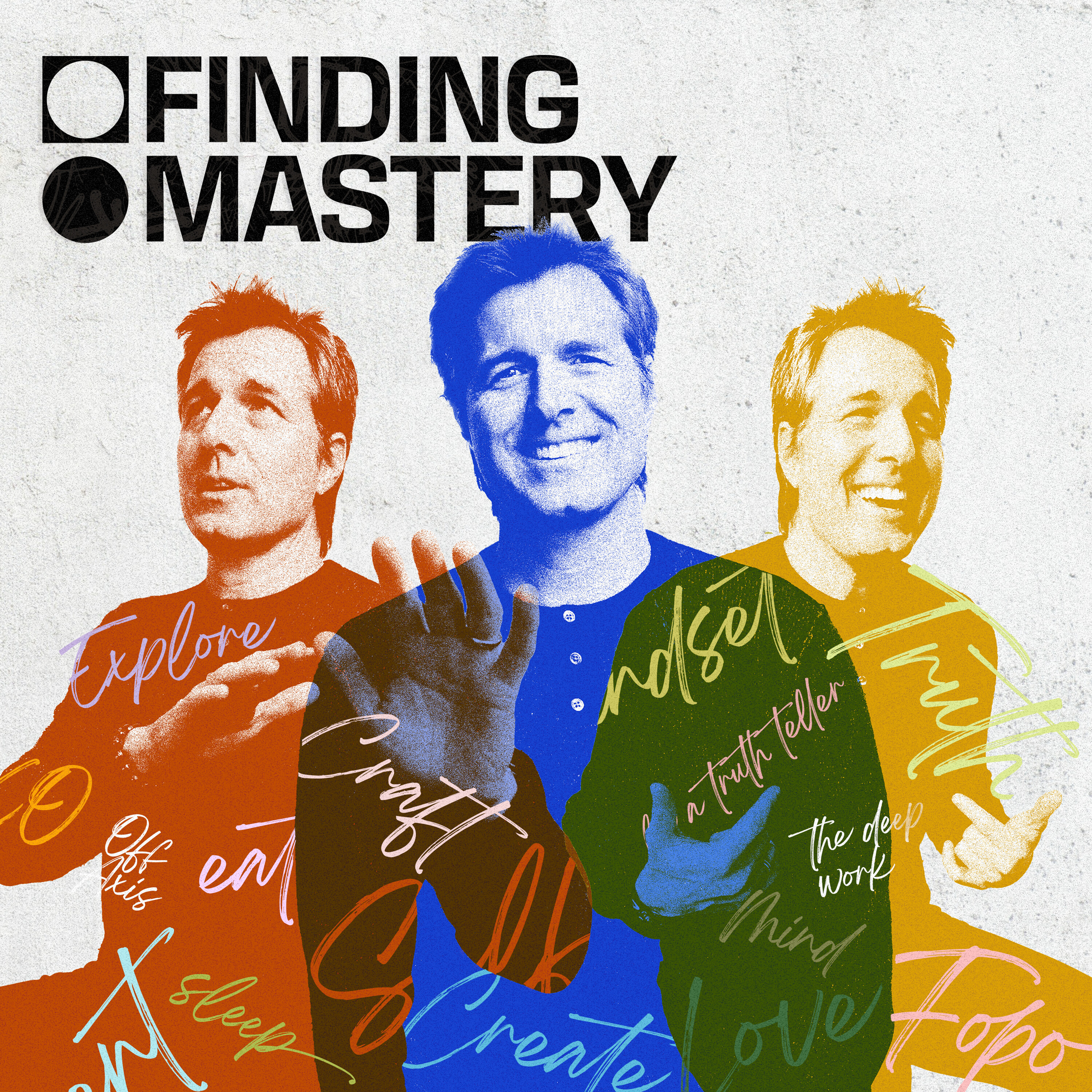
Finding Mastery with Dr. Michael Gervais
Dr. Michael GervaisAudio
- Format:
- Podcast
- New episodes:
- Weekly
- Typical length:
- about 1 hour 10 minutes
- Latest episode:
About this show
Dive into the minds of the world’s greatest athletes, leaders, thinkers, and doers with Dr. Michael Gervais—a high performance psychologist and world-renowned expert on the relationship between high performance and the mind. Dr. Gervais’s client roster includes Super Bowl winning NFL teams, Fortune 50 CEOs, Olympic medalists, internationally acclaimed artists, and more.
On Finding Mastery, Dr. Gervais sits down with the best at what they do, like David Goggins, Brene Brown, Toto Wolff, soccer legend Abby Wambach, neuroscientist Dr. Andrew Huberman, and Microsoft CEO Satya Nadella — translating their life stories, mental skills, and personal practices into applicable tools you can use to unlock your potential.
Walk with us to the edge of human possibility and learn what you are capable of. New episodes every Wednesday.
Covers: sport psychology, mental performance, personal development, mindfulness, neuroscience, high performance, mental health, relationships, pain and recovery, brain health
Show details and episodes come from the publisher's public feed at rss.art19.com. Last updated . Names, artwork and text belong to their publishers.
Recently on this show
Summary of recent episodes, drawn from the publisher's feed.
Finding Mastery is a podcast in which Dr. Michael Gervais talks with top athletes, leaders and thinkers about the mind behind high performance, turning their experiences into practical mental tools. Recent episodes cover Robert Greene on the sublime, Dr Joe Dispenza on change, youth sports, and pain.
Cosmos
Similar in subject
- The Neuro Experience
Both cover: mental performance, brain health, neuroscience - Mind Caddie - Improve Your Mental Golf Game
Both cover: mental performance, sport psychology, mindfulness - EXPANDED Podcast by To Be Magnetic™
Both cover: mindfulness, neuroscience, personal development
Similar shows





Explore more
Episodes
The Psychology Of Parenting | Dr. Dan Siegel
· 1 hr 33 min
What if the most important work of parenting isn’t about your child at all... but about understanding yourself? Dr. Dan Siegel is a Harvard-trained clinical professor of psychiatry at UCLA, a neuroscientist, and one of the leading voices helping us understand how relationships shape the developing mind. He has authored over 20 books, five of them New York Times bestsellers, including co-authoring The Whole-Brain Child and No-Drama Discipline. Trained as a developmental attachment researcher through the National Institute of Mental Health, Dan has spent more than 40 years studying how the adults who care for children influence who those children become. And his interest isn’t only academic. Dan describes his own childhood as decidedly non-optimal... a father who was intrusive and at times terrifying, a mother who was emotionally distant. He carried every non-secure attachment stance into adulthood, and earned security later in life, with the help of a therapist who finally saw him. What he found over those four decades reframes how we think about raising kids. The research is remarkably clear: how a parent has made sense of their own childhood, assessed before their baby is even born, predicts how that child will attach. Children don’t need perfect parents. They need three things... to be seen, to be soothed, and to be safe. When those are reliably present, a fourth emerges: security. And when we inevitably blow it, because every parent does, what matters most is the repair. As Dan puts it, there’s no such thing as perfect parenting. There’s just being present. In this conversation with Dr. Michael Gervais, Dan walks through the science of attachment and why the pop-culture version on social media is quoting a different field entirely, the myth that a mother should be able to do it all alone when children are wired for a village, and the daily Wheel of Awareness practice he uses to start every morning. The two also explore loneliness as the experience of a “partial mind,” the shift from a threat mindset to a challenge mindset that protects against burnout, and what it means to keep the “me” while belonging to a “we.” And Mike opens up about the moment his son was born, when he and his wife wrote down their first principles as parents and landed on two words: kindness and strength. In this conversation, we explore: - Why there’s no such thing as perfect parenting, only being present - The four S’s every child needs: seen, soothed, safe, and secure - How your own childhood story quietly shapes the way you parent - Why repair after a rupture matters more than never rupturing at all - The myth of the lone parent, and why children are wired for a village - Why loneliness may be the experience of a partial mind - The daily Wheel of Awareness practice Dan has done with 77,000 people - How shifting from a threat mindset to a challenge mindset protects against burnout If you’ve ever lost your cool with your kids and worried you’ve done lasting damage, this conversation offers a hopeful, science-backed way to repair... and grow. _____________________ Links & Resources Subscribe to our Youtube Channel for more conversations at the intersection of high performance, leadership, and wellbeing: https://www.youtube.com/c/FindingMastery Get exclusive discounts and support our amazing sponsors! Go to: https://findingmastery.com/sponsors/ Subscribe to the Finding Mastery newsletter for weekly high performance insights: https://www.findingmastery.com/newsletter Download Dr. Mike’s Morning Mindset Routine: findingmastery.com/morningmindset (https://www.findingmastery.com/morningmindset) Follow on YouTube (https://www.youtube.com/findingmastery), Instagram (https://www.instagram.com/findingmastery/?hl=en), LinkedIn (https://www.linkedin.com/in/drmichaelgervais/), and X (https://x.com/michaelgervais) Dr. Dan Siegel’s Books: The Whole-Brain Child, No-Drama Discipline, Parenting from the Inside Out, The Power of Showing Up,…
Not rated yetThe Psychology of Fighting Cancer | Dr Valter Longo
· 58 min
If your body already has powerful systems designed to repair and protect you, are your daily habits helping switch them on... or working against them? Dr. Valter Longo is a professor and director of the Longevity Institute at USC, one of the world’s leading researchers on aging, nutrition, and lifespan, and the author of The Longevity Diet and his latest book, Fasting Cancer. His path into this work is an unusual one. He started as a jazz performance major, chasing rock guitar, and walked away the moment they told him he had to direct a marching band. What pulled him toward aging traces back to being five years old, in the room when his grandfather died, and a question that lodged in him and never left: what if little things can make such a big difference? That question became a career. Longo walks Dr. Michael Gervais through the science of living to 110, a number drawn from two real people he followed personally, and the trade-off at the heart of aging: the body can pour its energy into growth and reproduction, or into protection and repair, but not both at once. From there he challenges one of the loudest narratives in health and performance today, the push for high protein, laying out why he believes most people are eating far more than the research supports, and what a safer balance actually looks like. The conversation moves into the work Longo is best known for: fasting-mimicking diets, why he says fasting on its own doesn’t mean anything, and how cycles of eating less may activate the body’s own repair and regeneration. He and Mike explore what this could mean for cancer, where Longo is careful and precise about what the science does and doesn’t yet show, and they close on what it takes to unlearn a foundational belief when the evidence stops holding up. Mike opens up about how this conversation pushed against a narrative he’d carried his whole life, and why he wanted to have it anyway. In this conversation, we explore: - Why aging and cancer are deeply connected, and what that means for prevention - The trade-off between growth and protection that shapes how we age - Why Longo believes most people eat far too much protein - What a safer, mostly plant-based protein balance looks like - Why fasting on its own is a meaningless word, and what to do instead - How fasting-mimicking cycles may trigger the body’s repair and regeneration - What the science does and doesn’t yet show about food and cancer - What it takes to unlearn a belief when the evidence stops holding up If you’ve ever wondered whether your daily choices are quietly helping or hurting the systems meant to keep you well, this conversation offers a science-backed place to start thinking about your health and lifestyle. A note from the team: This episode doesn’t exist in a vacuum. Over the last several months, Mike has had numerous conversations on health, nutrition with world-renowned experts like Dr. Gabrielle Lyon (https://findingmastery.com/podcasts/gabrielle-lyon-2/), Dr. Jason Fung (https://findingmastery.com/podcasts/jason-fung/), and Dr. Tim Spector (https://findingmastery.com/podcasts/dr-tim-spector/), among others. These are all rich conversations that at times hold conflicting advice and guidance. We encourage you to listen to all of them, and as always, consult your doctor on what practices are best for you. Health, nutrition, and longevity are all deeply intertwined with living a life of full potential, and we’re committed to having these great conversations with world experts on these subjects. Keep commenting with what’s working in your life, keep passing these onto your friends, and as always keep pushing the frontiers of your own performance! Links & Resources Subscribe to our Youtube Channel for more conversations at the intersection of high performance, leadership, and wellbeing: https://www.youtube.com/c/FindingMastery Get exclusive discounts and support our amazing sponsors! Go to: https://findingmastery.com/sponsors/…
Not rated yetThe Psychology Of Winning The Super Bowl | Seattle Seahawks Coach Mike Macdonald
· 1 hr 15 min
What does it take to build a team that trusts each other enough to go through hard things together... not around them? Mike Macdonald is the head coach of the Seattle Seahawks and one of the youngest head coaches in modern NFL history to win a Super Bowl. His path is an unusual one. He grew up with almost no family pipeline into football, a baseball kid in Georgia who fell in love with the strategy of the game watching his dad’s home video of his eighth-grade football games. When an injury ended his playing days in high school, he didn’t walk away. He filmed practice, coached the linebackers his senior year, and discovered the itch that would carry him from the pressure cooker of big-time college football at Georgia to the Baltimore Ravens, and eventually to Seattle. At the center of how he leads is a principle his team lives by: through, not around. Earn what you achieve. No excuses. Work the problem together, and in a way that’s matter of fact rather than personal. Mike tells the story of the biggest adversity of his NFL career, a blown multiple-score lead as Baltimore’s new defensive coordinator, and the decision that followed: no blame game, name himself the common denominator, and square up with the problem alongside his players. When the players felt the coaches were in the fight with them, the buy-in came, and the defense turned. This conversation is also a rare one for Finding Mastery: Dr. Michael Gervais has spent the past year working alongside Coach Mike and the Seahawks, and that shared history opens avenues for discussion most interviews never reach. They dig into why confidence and self-efficacy are trainable skills, even for a Super Bowl winning head coach, why clarity is one of the deepest forms of respect a leader can offer, and the Harvard baseball dream a young Coach Mike let slip because, in his words, he played it too safe. Mike Gervais opens up about recognizing that same story in his own life... the fear of looking like you don’t have what it takes. They close with imposter syndrome on the way to a Super Bowl, a graduation photo full of badges, and what it means to hand the trophy back to the team. In this conversation, we explore: - Why “through, not around” is the foundation of the Seahawks’ culture - How confidence and self-efficacy become trainable skills - Why clarity from leadership is one of the deepest forms of trust - How taking responsibility in front of the room earns buy-in - Why players always know which leaders are authentic - How fear of failure quietly keeps us playing it safe - What imposter syndrome looks like on the way to a Super Bowl If you’ve ever been tempted to go around a hard conversation, a hard problem, or a hard moment, this conversation offers a way to go through it... together. Links & Resources Subscribe to our Youtube Channel for more conversations at the intersection of high performance, leadership, and wellbeing: https://www.youtube.com/c/FindingMastery Get exclusive discounts and support our amazing sponsors! Go to: https://findingmastery.com/sponsors/ Subscribe to the Finding Mastery newsletter for weekly high performance insights: https://www.findingmastery.com/newsletter Download Dr. Mike’s Morning Mindset Routine: findingmastery.com/morningmindset (https://www.findingmastery.com/morningmindset) Follow on YouTube (https://www.youtube.com/findingmastery), Instagram (https://www.instagram.com/findingmastery/?hl=en), LinkedIn (https://www.linkedin.com/in/drmichaelgervais/), and X (https://x.com/michaelgervais) See Privacy Policy at https://art19.com/privacy and California Privacy Notice at https://art19.com/privacy#do-not-sell-my-info.
Not rated yetThe Psychology Of Spirituality | Dr. Lisa Miller
· 1 hr 1 min
What if the reason so many of us are struggling right now isn’t a lack of success… but a lack of connection to something deeper? Dr. Lisa Miller is a clinical psychologist, professor at Columbia University, and author of The Awakened Brain, and her research challenges something many of us have been taught to overlook: that spirituality isn’t optional, and it isn’t just religion… it’s a core part of how we’re wired. Her journey began at 26, on an inpatient psychiatric unit, where she watched the best available treatments fall short for people in their darkest moments. When the unit had no clergy for Yom Kippur, she showed up with her grandmother’s prayer book and led a service in the back hall… and watched patients who had been despairing for months sit up, brighten, and begin to heal. That day set her on a 30-year scientific quest. What she found reframes how we think about mental health. Buried in the back of large national data sets was a single question: how personally important is spirituality or religion to you? When Dr. Miller ran the numbers, a strong personal spirituality, with or without religion, turned out to be 80% protective against addiction and 82% protective against completed suicide — more protective against the diseases of despair than anything else known to the clinical sciences. Twin studies show this capacity is one-third innate and two-thirds environmentally formed, which means every one of us is born with it, and every one of us can strengthen it. Her MRI research, published in JAMA Psychiatry, found that a sustained spiritual life builds cortical thickness across the regions of the awakened brain, protecting against the recurrence of depression. In this conversation with Dr. Michael Gervais, Lisa walks through the difference between achieving awareness and awakened awareness, the three neural circuits behind feeling loved, guided, and never alone, and how parents and leaders can put this science to work. Mike opens up about his own path… the early pull he felt toward a spiritual life, the pendulum swing toward achievement, and the hypocrisy he witnessed as a teenager that nearly cost him his connection to what Lisa calls the flame. In this conversation, we explore: - Why spirituality is an inborn capacity, not a belief - The single research finding that reframes how we think about mental health - The difference between the achieving brain and the awakened brain - The three neural circuits behind feeling loved, guided, and never alone - Why a sustained spiritual life physically strengthens the brain - How parents can support a child’s natural spiritual awareness - Why 90% of leaders made the most important decision of their lives through an awakened form of knowing - How to heal from spiritual injury when a bad messenger breaks your trust If you’ve ever felt successful on paper but disconnected in your life, this conversation offers a science-backed way back to something deeper. Links & Resources This episode is brought to you in part by our partner, Sunlighten (https://findingmastery.com/sunlighten), the company that has pioneered infrared sauna technology. Go to https://findingmastery.com/sunlighten to see how you can save up to $2,100 on their mPulse Intelligent Sauna. Subscribe to our Youtube Channel for more conversations at the intersection of high performance, leadership, and wellbeing: https://www.youtube.com/c/FindingMastery Get exclusive discounts and support our amazing sponsors! Go to: https://findingmastery.com/sponsors/ Subscribe to the Finding Mastery newsletter for weekly high performance insights: https://www.findingmastery.com/newsletter Download Dr. Mike’s Morning Mindset Routine: findingmastery.com/morningmindset (https://www.findingmastery.com/morningmindset) Follow on YouTube (https://www.youtube.com/findingmastery), Instagram (https://www.instagram.com/findingmastery/?hl=en), LinkedIn (https://www.linkedin.com/in/drmichaelgervais/), and X…
Not rated yetThe Psychology of Awareness | Jon Kabat-Zinn
· 1 hr 1 min
What if the real crisis we're facing right now isn't political or technological… but a crisis of attention? Jon Kabat-Zinn is a molecular biologist, professor emeritus of medicine, and the founder of Mindfulness-Based Stress Reduction (MBSR), the program that helped move mindfulness from contemplative tradition into modern medicine, psychology, and high performance. The last time Jon joined Finding Mastery was four years ago, as the war in Ukraine was beginning. Four years on, the world hasn't gotten quieter. The crises have multiplied, AI has accelerated, and the same noise we worried about then has become the air we all breathe. In this conversation with Dr. Michael Gervais, Jon argues that mindfulness is not a calming technique or a productivity tool. He calls it a radical act of sanity. A willingness to stop, drop into the body, and meet life as it actually is rather than the story running on top of it. The shift sounds small. Yet the implications are enormous. Health, relationships, performance, decision-making, and even how we treat each other as a society all live downstream of where our attention is. Jon and Mike also dig into the surprising overlap between elite performance and contemplative practice. Why athletes call it the zone, musicians call it the pocket, and scientists call it flow, and why all of it lives downstream of the same thing: presence. Jon introduces the idea of the "body politic," his framing of nations as organ systems inside a single planetary body, and what it would mean to actually live, lead, and parent from that recognition. He reflects on his grandchildren, on the digital and analog tension shaping the next generation, and on what he wants young people to know in a world that is moving faster than ever. And in his ninth decade, he is still, by his own description, perpetually optimistic. By the end, Jon and Mike land somewhere quietly powerful: presence is not something you achieve. It is something you remember. And remembering, even for one breath, changes the trajectory of the moment you are in. In this conversation, we explore: - Why mindfulness is a radical act of sanity, not a relaxation technique - The difference between being aware and being with awareness - How presence quietly shapes relationships, decisions, and health - Why outcome attachment is one of the great hidden drains on performance - What Jon means by the "body politic," and why it changes how we think about leadership - Why mind wandering is the practice, not a failure - The one instruction Jon hopes people remember: don't take personally what is not personal If you've ever felt scattered, overwhelmed, or quietly disconnected from your own life, this conversation offers a science-backed, deeply human way back in. Links & Resources; This episode is brought to you in part by our partner, Sunlighten (https://findingmastery.com/sunlighten), the company that has pioneered infrared sauna technology. Go to https://findingmastery.com/sunlighten to see how you can save up to $2,100 on their mPulse Intelligent Sauna. Subscribe to our Youtube Channel for more conversations at the intersection of high performance, leadership, and wellbeing: https://www.youtube.com/c/FindingMastery Get exclusive discounts and support our amazing sponsors! Go to: https://findingmastery.com/sponsors/ Subscribe to the Finding Mastery newsletter for weekly high performance insights: https://www.findingmastery.com/newsletter Download Dr. Mike's Morning Mindset Routine: findingmastery.com/morningmindset (http://findingmastery.com/morningmindset) Follow onYouTube (https://www.youtube.com/findingmastery),Instagram (https://www.instagram.com/findingmastery/?hl=en),LinkedIn (https://www.linkedin.com/in/drmichaelgervais/), andX (https://x.com/michaelgervais) Jon Kabat-Zinn's Books: Full Catastrophe Living, Wherever You Go, There You Are, Coming to Our Senses, and many more: https://jonkabat-zinn.com See Privacy Policy at…
Not rated yetThe Psychology Of Not Giving A F*ck | Mark Manson
· 48 min
What if the most important skill of our moment isn't knowing more, but knowing what's actually worth caring about? Mark Manson is the bestselling author of The Subtle Art of Not Giving a F*ck and Everything Is F*cked, with three #1 New York Times bestsellers and tens of millions of readers around the world. The last time Mark joined Finding Mastery was in 2020, mid-COVID, when uncertainty was loud and the world felt strange. Five years on, the world is no less strange... it's just strange differently. The information ecosystem has fractured. Trust is harder to find. And the same noise we worried about five years ago has become the air we all breathe. In this conversation with Dr. Michael Gervais, Mark walks through the three principles he's organized his life and work around: radical ownership, radical honesty, and radical acceptance. He explains why ownership is the foundation under everything, because nothing else really works until you take it. He explains why his bar for honesty is anything "relevant or pertinent to somebody's wellbeing." And he talks about why radical acceptance, the Buddhist part of him, is what allows agency without collapse. The conversation moves into territory both timely and timeless. Mark and Mike dig into why the decline of religion has helped the self-help industry explode, why a spiritual framework remains one of the strongest known protective factors for mental health, and how the comparison machinery in our brains, designed for a tribe of thirty, now buckles under the weight of three hundred million people on Instagram. Mark also opens up about Purpose, the AI app he's built, and what he learned designing it to be intentionally disagreeable. He explains why a yes-man entourage, whether it's people around a star athlete or an AI that agrees with everything you say, quietly untethers people from reality. And he shares the stoic-style practice he uses to stay honest with himself: imagining what would be true if he were the problem, then holding that thought lightly enough to set it back down. By the end, Mark and Mike land on what feels like the heart of the episode... You can be perfect as you are, and you can always be better. Both can be true. In this conversation, we explore: - Why sincerity has become the most valuable signal in a fractured information landscape - The three principles Mark uses to navigate uncertainty: radical ownership, radical honesty, and radical acceptance - How our ancient comparison brain breaks under the weight of social media at scale - Why a spiritual framework remains one of the strongest known protective factors for mental health - The premortem practice that helps Mark stay honest with himself, and why most of us avoid it - Why an AI (or a person) that agrees with everything you say is a slow-motion mental health risk - How to use AI as a thought partner without letting it do your thinking for you - The question that keeps Mark up at night, and might be worth asking yourself If you've ever felt like the noise is winning, or like you've lost the thread on what's worth caring about, this conversation offers a sturdier place to stand. Links & Resources This episode is brought to you in part by our partner, Sunlighten (https://findingmastery.com/sunlighten), the company that has pioneered infrared sauna technology. Go to https://findingmastery.com/sunlighten to see how you can save up to $2,100 on their mPulse Intelligent Sauna. Subscribe to our Youtube Channel for more conversations at the intersection of high performance, leadership, and wellbeing: https://www.youtube.com/c/FindingMastery Get exclusive discounts and support our amazing sponsors! Go to: https://findingmastery.com/sponsors/ Subscribe to the Finding Mastery newsletter for weekly high performance insights: https://www.findingmastery.com/newsletter Download Dr. Mike's Morning Mindset Routine: findingmastery.com/morningmindset (http://findingmastery.com/morningmindset) Follow…
Not rated yetThe Psychology Of Feeling Loved | Dr Sonja Lyubomirsky
· 1 hr 3 min
Why is it that so many of us are loved... and yet don’t actually feel loved? Dr. Sonja Lyubomirsky is a Professor of Psychology at UC Riverside and one of the world’s leading researchers on happiness. Her newest book, How to Feel Loved, co-authored with relationship scientist Harry Reis, lands at a strange moment: a time when more people than ever say they are connected, and more people than ever say they don’t actually feel it. In this conversation with Dr. Michael Gervais, Sonja offers a quietly radical reframe. After 36 years of studying what makes a life happy, she has come to believe the answer lies in this: Feeling loved. And here is where it gets interesting. Sonja’s research is showing that feeling loved is not something we have to wait for. It’s something we can help create. Most of us, when we sense the absence, default to one of two strategies. We try to be more lovable. Or we try to change the person on the other side. Sonja argues that neither one actually works. What changes a relationship is changing the conversation. She walks Mike through the five mindsets at the heart of the book: the sharing mindset, listening to learn, radical curiosity, open heart, and multiplicity. Along the way, they explore why most of us are listening to respond instead of listening to learn, the three words people actually want to hear (hint: it’s not I love you), and why ‘tell me more’ might be one of the most loving phrases in the English language. Sonja shares her foggy glass metaphor for why being known is the prerequisite to being loved, the Michelangelo effect, and a striking line the Dalai Lama once said to her about how we hold each other. The conversation also gets honest about the harder edges. Bridging political divides at the dinner table. Staying curious about a partner of 30 years. Navigating the modern questions around AI companions, monogamy, and what it means to really go deep with another human. And the research on what tiny acts of kindness, including the impact a 10-second compliment can have. If you’ve ever been surrounded by people who love you and still felt unseen, this conversation is a gentle invitation back in. The good news is that feeling loved is under your control, more than you think. Sonja’s research will show you exactly where to start. Most of us are waiting to feel loved. Sonja shows us how to create the conditions for it... starting today. _____________________________________________________ Links & Resources This episode is brought to you in part by our partner Sunlighten (https://findingmastery.com/sunlighten), the company that has pioneered infrared sauna technology. Go to https://findingmastery.com/sunlighten to see how you can save up to $2,200 on their mPulse Intelligent Sauna. Subscribe to our YouTube Channel for more conversations at the intersection of high performance, leadership, and wellbeing: https://www.youtube.com/c/FindingMastery Get exclusive discounts and support our amazing sponsors! Go to: https://findingmastery.com/sponsors/ Subscribe to the Finding Mastery newsletter for weekly high performance insights: https://www.findingmastery.com/newsletter Download Dr. Mike’s Morning Mindset Routine: findingmastery.com/morningmindset (http://findingmastery.com/morningmindset) Follow onYouTube (https://www.youtube.com/findingmastery),Instagram (https://www.instagram.com/findingmastery/?hl=en),LinkedIn (https://www.linkedin.com/in/drmichaelgervais/), andX (https://x.com/michaelgervais) Book: How to Feel Loved by Dr. Sonja Lyubomirsky and Harry Reis. Learn more and take the mindset quiz at howtofeellove.com (http://howtofeellove.com) See Privacy Policy at https://art19.com/privacy and California Privacy Notice at https://art19.com/privacy#do-not-sell-my-info.
Not rated yetThe Psychology of Being a Super Communicator | Charles Duhigg
· 51 min
Why do so many conversations break down, even when both people are trying to connect? Charles Duhigg is a Pulitzer Prize-winning journalist and the bestselling author of The Power of Habit and Supercommunicators. This is his third conversation on Finding Mastery, and the timing matters. The world has shifted since the last time he and Dr. Michael Gervais spoke. Families, friendships, even whole countries are talking past each other. AI has quietly eroded the signals we used to read each other by. And the ability to genuinely connect with another human has gone from useful to essential. The first thing Charles makes clear is that being a great communicator is not a gift reserved for a lucky few. It's a habit. And it starts with noticing something most of us miss in real time: we are all moving through three kinds of conversations every day. The practical, the emotional, and the social. Most of our misunderstandings happen for one simple reason. The person across from us is in one kind of conversation while we're in another. Charles unpacks what he calls the matching principle and one of the most useful questions a teacher ever taught him: do you want to be helped, hugged, or heard? He explains why looping for understanding tends to work when arguing does not, why deep questions invite people to reveal worldviews they didn't even know they had, and why polish and fluency no longer mean what they used to in a world where AI can make any email sound thoughtful. The conversation also gets personal. Mike shares the story of a professor who once interrupted him mid-trauma with a single odd question and walked away, an act of communication so strange it took him years to understand. Charles talks about how he tries to stay genuinely connected to his two teenage sons, how to navigate Thanksgiving with someone you voted against, and the quiet research finding that strangers can become friends in under an hour if the questions are deep enough and the back-and-forth is real. If you've ever walked away from a conversation feeling unseen, struggled to get through to someone you love, or wondered why connection feels harder than it used to, this conversation offers a practical, science-backed way back in. Anyone can be a super communicator. Charles will show you how it actually works. _____________________________________________________ Links & Resources Subscribe to our Youtube Channel for more conversations at the intersection of high performance, leadership, and wellbeing: https://www.youtube.com/c/FindingMastery Get exclusive discounts and support our amazing sponsors! Go to: https://findingmastery.com/sponsors/ Subscribe to the Finding Mastery newsletter for weekly high performance insights: https://www.findingmastery.com/newsletter Download Dr. Mike's Morning Mindset Routine: findingmastery.com/morningmindset (http://findingmastery.com/morningmindset) Follow on YouTube, Instagram, LinkedIn, and X Link: Charles and Mike reference “36 Questions” or the Fast Friends Procedure: https://www.stafforini.com/docs/Aron%20et%20al%20-%20The%20experimental%20generation%20of%20interpersonal%20closeness.pdf Citation: Aron, A., Melinat, E., Aron, E. N., Vallone, R. D., & Bator, R. J. (1997). The Experimental Generation of Interpersonal Closeness: A Procedure and Some Preliminary Findings. Personality and Social Psychology Bulletin, 23(4), 363–377. Link: New York Times Article: “36 Questions That Lead to Love.” https://www.nytimes.com/2015/01/09/style/no-37-big-wedding-or-small.html See Privacy Policy at https://art19.com/privacy and California Privacy Notice at https://art19.com/privacy#do-not-sell-my-info.
Not rated yet5 Questions to Unlock Your Inner Potential | Dr. Mike Gervais - AMA Vol.29
· 59 min
What questions are tugging at you right now, and how might exploring the answers help you live and perform with more clarity? We're back with another special edition of the Finding Mastery podcast: an Ask Me Anything episode, built from the deep and sometimes vulnerable questions submitted by our community. Joining Dr. Michael Gervais again is Jeff Byers, former NFL player, Co-Founder and CEO of Momentous, and a longtime friend of Finding Mastery. Jeff built Momentous (http://www.livemomentous.com)on a foundation of transparency and scientific integrity in an industry that can be full of noise, and he brings that same standard of honest engagement to the questions we explore here. His experience navigating the identity shift from elite athlete to entrepreneur makes him a uniquely grounded co-host for conversations about who we are, what drives us, and how we keep growing when the road ahead isn't clear. The questions we explored: - Navigating a major life transition... how to work through the grief of leaving a sport, the psychology of identity foreclosure, and why transitions are actually an invitation to examine who you are and who you're becoming. - When your life is good but something feels missing... the difference between being stuck and being in the fog, what the biology might be telling you, and how self-efficacy, agency, and your own life history factor into the picture. - Finding your purpose when it hasn't revealed itself yet... the research on purpose as a cornerstone of a thriving life, the three components of a clear purpose, and a practical framework to start building one right now. - What community actually means... why belonging goes deeper than shared interests, what we lose when we slide toward digital connection only, and why community is built on responsibility as much as relationship. - AI and human potential... whether the race toward AI is pulling our attention away from mindfulness and human development, and how to think about this new tool without losing sight of what makes us human. - Who and what shaped us... a personal look at the heroes, idols, and influences that shaped both Mike and Jeff, and what those figures reveal about the values and first principles we carry forward. The questions in this episode came from real people wrestling with real things. If any of them resonate with something you're carrying right now, that's the point. __________________________________ Links & Resources Subscribe to our Youtube Channel for more conversations at the intersection of high performance, leadership, and wellbeing:https://www.youtube.com/c/FindingMastery Get exclusive discounts and support our amazing sponsors! Go to: https://findingmastery.com/sponsors/ Subscribe to the Finding Mastery newsletter for weekly high performance insights: https://www.findingmastery.com/newsletter Download Dr. Mike's Morning Mindset Routine:https://findingmastery.lpages.co/morningmindset2/findingmastery.com/morningmindset (http://findingmastery.com/morningmindset) Follow onYouTube (https://www.youtube.com/findingmastery),Instagram (https://www.instagram.com/findingmastery/?hl=en),LinkedIn (https://www.linkedin.com/in/drmichaelgervais/), andX (https://x.com/michaelgervais) See Privacy Policy at https://art19.com/privacy and California Privacy Notice at https://art19.com/privacy#do-not-sell-my-info.
Not rated yetThe Psychology of Performance Under Pressure |Andrew Whitworth
· 1 hr 25 min
What does it really take to stay at the top for 16 years and still know who you are when it ends? Andrew Whitworth is a Super Bowl champion, four-time Pro Bowler, and the oldest left tackle in NFL history to start a Super Bowl. He spent 16 seasons protecting the most valuable position on the field, finished his career by winning a championship at 40, and walked off in one of the most viral moments in NFL Films history, sitting in a circle with his kids, telling them “that was daddy’s last game.” In this conversation with Dr. Michael Gervais, Andrew pulls back the curtain on what made it all possible, and what almost broke him along the way. The first thing you notice about Andrew is the contradiction. 6'7", 345 pounds, built to dominate. And the engine underneath all of it is empathy. He explains how he prepared for opponents not by lifting more or running more, but by inhabiting them, studying their bodies until he could feel what they were going to do before they did it. “I'm going to study them to a point where we can dance together because I can actually feel everything they're going to try and accomplish before we do it,” he says. That is the offensive line position rendered as jazz. But this conversation goes a lot deeper than craft. Andrew is candid about the anxiety, self-doubt, and self-punishment that shadowed much of his career. He talks about walking home alone in the dark after college games to punish himself for mistakes, about needing to watch tape of the all-time greats failing just to feel okay running out of the tunnel, and about how Sean McVay eventually helped him believe he was “worthy of the light.” He also shares what Nick Saban taught him about process, what Marvin Lewis taught him about consistency, and what fatherhood taught him about everything. In this conversation, we explore: - Why empathy, not size or strength, was Andrew’s greatest competitive advantage - How to study an opponent so deeply you can feel their next move before they make it - Why mastery of self always has to come before mastery of craft - How to hold people accountable in a way that builds rather than breaks - Why vulnerability comes before trust, not the other way around - What changed about how Andrew competed once he became a father - Why telling someone what you see in them may be more powerful than telling them you believe in them Andrew's story is a reminder that empathy can be one of the most powerful tools on the path to mastery. And that the greatest thing you leave with anyone is how you made them feel. _____________________________________________________ Links & Resources Subscribe to our Youtube Channel for more conversations at the intersection of high performance, leadership, and wellbeing:https://www.youtube.com/c/FindingMastery Get exclusive discounts and support our amazing sponsors! Go to: https://findingmastery.com/sponsors/ Subscribe to the Finding Mastery newsletter for weekly high performance insights: https://www.findingmastery.com/newsletter Download Dr. Mike's Morning Mindset Routine:https://findingmastery.lpages.co/morningmindset2/findingmastery.com/morningmindset (http://findingmastery.com/morningmindset) Follow onYouTube (https://www.youtube.com/findingmastery),Instagram (https://www.instagram.com/findingmastery/?hl=en),LinkedIn (https://www.linkedin.com/in/drmichaelgervais/), andX (https://x.com/michaelgervais) See Privacy Policy at https://art19.com/privacy and California Privacy Notice at https://art19.com/privacy#do-not-sell-my-info.
Not rated yetThe Psychology Of Money | Tom Bilyeu
· 1 hr 6 min
Are you playing the game, or being played by it? Tom Bilyeu is an entrepreneur, co-founder of Quest Nutrition, and founder of Impact Theory, one of the most-watched interview platforms in the world. He has spent years studying the systems that shape financial outcomes, and in this conversation with Dr. Michael Gervais, he makes a case that most people find unsettling: the financial system you're working inside was not designed with your interests in mind. Tom argues that the single most important thing most people are missing is not effort or ambition, it's a clear-eyed understanding of how the system actually works. He walks through why inflation is not a natural economic phenomenon but a mechanism that quietly transfers purchasing power from workers to asset owners, why 10% of Americans own 93% of assets, and why the gap between the wealthy and everyone else is not a bug in the system, it's a feature. But this conversation goes well beyond economic critique. It's also about the beliefs and mental models we carry that keep us operating on a map that no longer matches the terrain. Tom introduces the idea that beliefs are not truths, they're interpretations, and that updating them, especially the ones about money, work, and what's possible, is the most leveraged thing a person can do. He also offers a clear-eyed take on AI and why the people who learn to use it as a force multiplier will have an enormous edge over those who don't. In this conversation, we explore: - Why the Federal Reserve system was designed to benefit asset owners and how inflation quietly steals purchasing power - How 10% of Americans came to own 93% of assets, and why it was baked in by design - Why your beliefs are interpretations, not truths, and how to use that insight to your advantage - How to think about investing across 12 to 15 economic forces rather than chasing individual stocks - Why AI is the most important force multiplier available right now, and how to use it without losing your own thinking - What the K-shaped economy is, what it means for the next generation, and what parents need to know Tom's not here to make you feel good about where things stand and where we’re headed. He's here to hand you a better map. What you do with it is up to you. ___________________________________________________ Links & Resources Subscribe to our Youtube Channel for more conversations at the intersection of high performance, leadership, and wellbeing:https://www.youtube.com/c/FindingMastery Get exclusive discounts and support our amazing sponsors! Go to: https://findingmastery.com/sponsors/ Subscribe to the Finding Mastery newsletter for weekly high performance insights: https://www.findingmastery.com/newsletter Download Dr. Mike's Morning Mindset Routine:https://findingmastery.lpages.co/morningmindset2/findingmastery.com/morningmindset (http://findingmastery.com/morningmindset) Follow onYouTube (https://www.youtube.com/findingmastery),Instagram (https://www.instagram.com/findingmastery/?hl=en),LinkedIn (https://www.linkedin.com/in/drmichaelgervais/), andX (https://x.com/michaelgervais) See Privacy Policy at https://art19.com/privacy and California Privacy Notice at https://art19.com/privacy#do-not-sell-my-info.
Not rated yetThe Psychology of Happiness | Dr. Laurie Santos
· 1 hr 12 min
Why do we keep chasing happiness in ways that don't actually work? Dr. Laurie Santos is a cognitive scientist and professor of psychology at Yale, where she created the most popular course in the university's 300-year history, the Science of Well-Being. Since then, that course has reached millions of people around the world, and her podcast, The Happiness Lab, has become one of the most trusted resources on the science of living well. In this conversation with Dr. Michael Gervais, Laurie pulls back the curtain on why our minds so reliably get happiness wrong, and what we can do about it. The conversation starts with a sobering look at the student mental health crisis: more than 40% of college students report being too depressed to function, more than 60% report overwhelming anxiety. Laurie saw it firsthand at Yale, and it launched her on a mission to translate happiness research into practical tools that actually work. She explains why the things we predict will make us happy – more money, more success, more achievement – don't deliver the boost we expect, or the lasting satisfaction we hope for. She digs into the science of social comparison, why our brains default to the comparisons that make us feel worse, and why even the most high-performing people can feel inexplicably stuck. And she outlines the evidence-based habits, social connection, mindset shifts, emotional awareness, that actually move the needle. In this conversation, we explore: - Why our minds are wired to predict happiness incorrectly - How social comparison shapes our experience of achievement, and rarely in our favor - What the research actually says about money, status, and wellbeing - Why social connection is the most underrated predictor of happiness - How to work with your emotions rather than suppress or spiral into them - What leaders and organizations can do to build genuinely happier, higher-performing teams Everyone wants to live a good life. This is one of those rare conversations that might genuinely help you do it. ____________________________________ Links & Resources Subscribe to our Youtube Channel for more conversations at the intersection of high performance, leadership, and wellbeing:https://www.youtube.com/c/FindingMastery Get exclusive discounts and support our amazing sponsors! Go to: https://findingmastery.com/sponsors/ Subscribe to the Finding Mastery newsletter for weekly high performance insights: https://www.findingmastery.com/newsletter Download Dr. Mike's Morning Mindset Routine:https://findingmastery.lpages.co/morningmindset2/findingmastery.com/morningmindset (http://findingmastery.com/morningmindset) Follow onYouTube (https://www.youtube.com/findingmastery),Instagram (https://www.instagram.com/findingmastery/?hl=en),LinkedIn (https://www.linkedin.com/in/drmichaelgervais/), andX (https://x.com/michaelgervais) See Privacy Policy at https://art19.com/privacy and California Privacy Notice at https://art19.com/privacy#do-not-sell-my-info.
Not rated yetThe Psychology of Hunger | Dr Jason Fung
· 1 hr 15 min
Why do diets so often fail... is it discipline or biology? Dr. Jason Fung is a physician, nephrologist, and one of the most influential voices challenging how we understand metabolism, obesity, and chronic disease. He is the bestselling author of The Obesity Code, The Diabetes Code, and his newest book, The Hunger Code, which explores a deceptively powerful question: what is actually driving hunger, and what does the answer tell us about why so many people struggle with their weight? In this conversation with Dr. Michael Gervais, Dr. Fung explains why the standard advice of "eat less and move more" isn't just ineffective, it's missing the point entirely. The real question isn't how much you eat. It's why you eat. And the answer, he argues, is far more complex, and far more interesting, than anyone has told us. At the center of the conversation is Dr. Fung's framework of three distinct types of hunger: homeostatic hunger, driven by hormones and biology; hedonic hunger, driven by pleasure and reward; and conditioned hunger, driven by environment and learned behavior. Each has its own cause, its own pattern, and its own solution. And until we understand which type of hunger we're dealing with, we'll keep solving the wrong problem. Dr. Fung also digs into the science of insulin, explaining why it is the master switch of fat storage and release, why ultra-processed foods are designed to spike it in ways that leave us hungry again almost immediately, and why intermittent fasting can be one of the most powerful tools available for driving insulin down and letting the body do what it's built to do. The conversation covers a lot of ground: the GLP-1 debate, the gender differences in fasting, what perimenopause does to appetite, how food order affects insulin response, why walking after a meal can reduce your insulin spikes, and why the cultural food environments of Italy and Japan offer a compelling blueprint for what sustainable health can actually look like. In this conversation, we explore: - Why "eat less, move more" fails to address the root cause of weight gain - The three types of hunger and how each one requires a different response - How ultra-processed foods hijack biology, behavior, and environment all at once - Why insulin, not calories, is the key metabolic variable to understand - How intermittent fasting works, who it's for, and how to do it well - What perimenopause does to hunger hormones, and what to do about it - Why the Italian and Japanese food environments produce radically different health outcomes Your hunger isn't a character flaw. Learn what's actually behind it. __________________________________ Links & Resources Subscribe to our Youtube Channel for more conversations at the intersection of high performance, leadership, and wellbeing:https://www.youtube.com/c/FindingMastery Get exclusive discounts and support our amazing sponsors! Go to: https://findingmastery.com/sponsors/ Subscribe to the Finding Mastery newsletter for weekly high performance insights: https://www.findingmastery.com/newsletter Download Dr. Mike's Morning Mindset Routine:https://findingmastery.lpages.co/morningmindset2/findingmastery.com/morningmindset (http://findingmastery.com/morningmindset) Follow onYouTube (https://www.youtube.com/findingmastery),Instagram (https://www.instagram.com/findingmastery/?hl=en),LinkedIn (https://www.linkedin.com/in/drmichaelgervais/), andX (https://x.com/michaelgervais) See Privacy Policy at https://art19.com/privacy and California Privacy Notice at https://art19.com/privacy#do-not-sell-my-info.
Not rated yetThe Psychology of Winning | Michael Johnson
· 57 min
What separates the athletes who perform when it matters most from those who don't... and can that difference be trained? Michael Johnson is one of the greatest sprinters in history: four-time Olympic gold medalist, nine-time World Champion, and the former world record holder in both the 200 and 400 meters. He was also, by his own account, one of the most psychologically prepared competitors the sport has ever seen. In this conversation with Dr. Michael Gervais, Michael takes us inside the hidden moments before the race, the call room, the gathering space beneath the stadium where eight finalists wait together in silence (or something far less than silence) before stepping out under the brightest lights in sport. He explains why the call room isn't just a logistical stop before the race. It's where the race is often decided. And he breaks down exactly how he prepared his mind to show up there. At the center of the conversation is a distinction that Michael discovered early in his career: the difference between being nervous and being scared. Nervousness, he came to understand, was fuel, a sign that he wanted it, that he was alive to the moment. Fear was something different. Fear meant he was underprepared. And once he understood that, he could do something about it. Michael shares how he used mental imagery, constantly, automatically, almost without thinking, to rehearse races until every scenario felt familiar. He explains how he learned to control his environment on race day, why Usain Bolt's pre-race routine was the polar opposite of his own (and worked just as well), and what it really means to master the controllables when the world's fastest sprinters are sitting two feet away trying to get into your head. The conversation also moves into the second half of Michael's life. Eight years ago, at age 50, he suffered a stroke that forced him to relearn how to walk. He reflects on how the same mental frameworks that made him a champion, recognizing small improvements, managing what he could control, and staying present in the process, carried him through that recovery. And he opens up about what the experience taught him: how to depend on people, how to let relationships go both ways, and why the things he'd always controlled most tightly weren't the things that mattered most. In this conversation, we explore: - Why the call room is where races are won and lost, and how to navigate it - The difference between nervousness (fuel) and fear (a signal of underpreparation) - How Michael used mental imagery every single day, without structure or schedule - Why self-knowledge is the single most impactful factor in sustained performance - How Usain Bolt's exact opposite approach led to the same outcome, and what that means - What a stroke at 50 taught Michael about control, vulnerability, and relationships The call room is everywhere. Learn how to master it. __________________________________ Links & Resources Subscribe to our Youtube Channel for more conversations at the intersection of high performance, leadership, and wellbeing:https://www.youtube.com/c/FindingMastery Get exclusive discounts and support our amazing sponsors! Go to: https://findingmastery.com/sponsors/ Subscribe to the Finding Mastery newsletter for weekly high performance insights: https://www.findingmastery.com/newsletter Download Dr. Mike's Morning Mindset Routine:https://findingmastery.lpages.co/morningmindset2/findingmastery.com/morningmindset (http://findingmastery.com/morningmindset) Follow onYouTube (https://www.youtube.com/findingmastery),Instagram (https://www.instagram.com/findingmastery/?hl=en),LinkedIn (https://www.linkedin.com/in/drmichaelgervais/), andX (https://x.com/michaelgervais) See Privacy Policy at https://art19.com/privacy and California Privacy Notice at https://art19.com/privacy#do-not-sell-my-info.
Not rated yetThe Psychology of Truth In a World of Lies | Sam Harris
· 1 hr 49 min
There's a version of honesty most of us have never tried. Not brutal honesty. Not radical honesty. Something quieter and more demanding than either: a genuine commitment to saying what is true and useful, and nothing else. That is where this conversation begins. Sam Harris, neuroscientist, philosopher, bestselling author, host of the Making Sense podcast, and creator of the Waking Up app, joins Dr. Michael Gervais for a conversation that moves across truth, consciousness, AI, religion, and the inner mechanics of the mind. What starts as a discussion about lying becomes something much larger: an examination of the hidden forces that shape what we believe, who we trust, and how free we actually are. Sam and Dr. Mike explore what it costs us to keep two sets of books — one for people we care about, one for everyone else. They dig into why high-performing environments depend on truth-telling, how tribalism and dogmatism reliably pull us away from reality, and what it might mean to find solid ground in an era of increasing chaos. And then the conversation turns inward. To thoughts, awareness, and the gap between pain and suffering. To what meditation actually is and what it can do. To the possibility that the freedom most of us are chasing doesn't require changing our circumstances at all. If you are trying to get more honest with yourself and the people around you, this conversation will give you a lot to work with. In this conversation, you'll learn: - Why a commitment to not lying is one of the most clarifying decisions a person can make - How tribalism and dogmatism corrupt our access to truth and keep us divided - What AI and deep fakes may actually do to our relationship with institutions and shared reality - The difference between pain and suffering, and why that gap matters - Why you are not your thoughts, and what opens up when you more fully understand that We’re excited for you to listen. __________________________________ Links & Resources Subscribe to our Youtube Channel for more conversations at the intersection of high performance, leadership, and wellbeing:https://www.youtube.com/c/FindingMastery Get exclusive discounts and support our amazing sponsors! Go to: https://findingmastery.com/sponsors/ Subscribe to the Finding Mastery newsletter for weekly high performance insights: https://www.findingmastery.com/newsletter Download Dr. Mike's Morning Mindset Routine:https://findingmastery.lpages.co/morningmindset2/findingmastery.com/morningmindset (http://findingmastery.com/morningmindset) Follow onYouTube (https://www.youtube.com/findingmastery),Instagram (https://www.instagram.com/findingmastery/?hl=en),LinkedIn (https://www.linkedin.com/in/drmichaelgervais/), andX (https://x.com/michaelgervais) See Privacy Policy at https://art19.com/privacy and California Privacy Notice at https://art19.com/privacy#do-not-sell-my-info.
Not rated yetThe Psychology of Limiting Beliefs | Nir Eyal
· 1 hr 17 min
What if the biggest barrier between you and your potential isn’t talent - but a belief you’ve never questioned? Nir Eyal is a behavioral design expert and the bestselling author of Hooked, Indistractable, and his newest book, Beyond Belief. In this conversation with Dr. Michael Gervais, he explores a deceptively powerful idea: that beliefs operate like the hidden software of the mind, shaping what we notice, what we feel, what we attempt, and what we assume is possible. At the center of the conversation is a problem most of us know very intimately: If we already know what to do, why don’t we do it? Nir argues that motivation is not simply about knowing the right behavior or wanting the right outcome. Holding it all together is belief, the often invisible layer that determines whether we think change is possible, whether our effort is worth it, and whether we believe we are capable of following through. Nir breaks down the difference between facts, faith, and beliefs, and offers a compelling reframing: beliefs are not truths, they are tools. From there, he explores the difference between limiting beliefs and liberating beliefs, why the mind defaults toward safety and passivity, and how small acts of agency can begin to reshape what we think is available to us. Mike and Nir also dig into the relationship between pain and suffering, learned helplessness and hope, and the role interpretation plays in human performance. Along the way, they unpack how beliefs shape our attention, anticipation, and agency, and why changing a belief is often less about finding “the truth” and more about testing perspectives that better serve the life we want to live. This is a conversation about motivation, resilience, and the invisible architecture of our inner life. If you’ve ever felt stuck, frustrated that insight alone isn’t producing change, or curious about the mental filters shaping your performance, this one is for you. __________________________________ Links & Resources Subscribe to our Youtube Channel for more conversations at the intersection of high performance, leadership, and wellbeing:https://www.youtube.com/c/FindingMastery Get exclusive discounts and support our amazing sponsors! Go to: https://findingmastery.com/sponsors/ Subscribe to the Finding Mastery newsletter for weekly high performance insights: https://www.findingmastery.com/newsletter Download Dr. Mike's Morning Mindset Routine:https://findingmastery.lpages.co/morningmindset2/findingmastery.com/morningmindset (http://findingmastery.com/morningmindset) Follow onYouTube (https://www.youtube.com/findingmastery),Instagram (https://www.instagram.com/findingmastery/?hl=en),LinkedIn (https://www.linkedin.com/in/drmichaelgervais/), andX (https://x.com/michaelgervais) See Privacy Policy at https://art19.com/privacy and California Privacy Notice at https://art19.com/privacy#do-not-sell-my-info.
Not rated yetThe Psychology Of YouTube Success | Michelle Khare
· 1 hr 7 min
What does it look like to bet on yourself, embrace reinvention, and build a YouTube channel that reaches millions? Michelle Khare is the creator and host of Challenge Accepted, the award-winning YouTube series where sherains with elite performers, athletes, and professionals to take on some of the world’s toughest stunts and professions. But this conversation goes far beyond spectacle. It’s about the psychology underneath the performance: how Michelle prepares for high-pressure environments, how she thinks about failure, and how she’s built a serious creative business without losing the joy at the center of it. In this conversation, Michelle shares how her path began at the intersection of two demanding worlds: working as a video producer by day while competing as a professional cyclist at night. Out of that tension, she created something new — a format that blends physical challenge, storytelling, and deep iteration. She talks about the early trial-and-error phase of building her channel, the importance of owning her own IP, and why many creators don’t realize they’ve already become entrepreneurs. Michelle also opens up about what it means to fail in public. She explains why growth often depends on being willing to look unpolished in front of other people, how she identifies her “strategic advantages” in unfamiliar environments, and why the low points — not just the polished outcomes — are what actually make a story worth telling. Along the way, she offers a compelling look at how she built a YouTube channel with over 5.4 million loyal subscribers. In this conversation, we explore: - Why courage becomes more useful when it is systematized - How Michelle built Challenge Accepted by blending athletics, storytelling, and business - Why willingness to fail publicly can become a competitive advantage - How to identify your “strategic advantages” in unfamiliar environments - Why relationships, feedback, and team culture are essential to longevity - How to elevate the YouTube creator space into a respected part of the entertainment industry This is a conversation about courage, yes, but also about design. How do you build a life where courage is not occasional, but trainable? How do you stay ambitious without burning out? And how you can keep evolving while staying grounded in the people and principles that matter most. __________________________________ Links & Resources Subscribe to our Youtube Channel for more conversations at the intersection of high performance, leadership, and wellbeing:https://www.youtube.com/c/FindingMastery Get exclusive discounts and support our amazing sponsors! Go to: https://findingmastery.com/sponsors/ Subscribe to the Finding Mastery newsletter for weekly high performance insights: https://www.findingmastery.com/newsletter Download Dr. Mike's Morning Mindset Routine:https://findingmastery.lpages.co/morningmindset2/findingmastery.com/morningmindset (http://findingmastery.com/morningmindset) Follow onYouTube (https://www.youtube.com/findingmastery),Instagram (https://www.instagram.com/findingmastery/?hl=en),LinkedIn (https://www.linkedin.com/in/drmichaelgervais/), andX (https://x.com/michaelgervais) See Privacy Policy at https://art19.com/privacy and California Privacy Notice at https://art19.com/privacy#do-not-sell-my-info.
Not rated yetFive Questions That Matter | Dr Mike Gervais AMA Vol.28
· 59 min
What questions are tugging at you right now, and how might exploring the answers help you live and perform with more clarity? We’re back with a special edition of the Finding Mastery podcast: another Ask Me Anything episode, built from the deep, thoughtful questions submitted by our community. In this AMA, Michael Gervais is joined by Jeff Byers, former NFL player, Co-Founder and CEO of Momentous, and longtime friend of Finding Mastery. Jeff has built something very special with Momentous, a supplement company grounded in transparency and integrity in an industry that can be full of noise and misinformation. He often says trust is earned, and he takes that responsibility personally. His relentless approach to mastery, both for himself and for the team he’s building at Momentous—makes him an ideal co-host to help Mike wrestle with questions across a wide range of topics… how to perform with more clarity, how to work skillfully with strong emotions, and how to build a life that feels aligned with what matters most. Key insights we explored: - Shift from perfection to purpose… why “the constant pursuit of perfectionism” is a setup for burnout, and how purpose changes the whole frame. - Downregulating the nervous system… practical ways to move from sympathetic “on” to parasympathetic “rest and digest,” including breath, gaze, laughter, touch, nature, and intentionally induced recovery. - Anger and emotional skill… how to feel anger without outward harm or inward collapse, and why the goal is to build the capacity to be “unbothered.” - Loneliness and connection… why loneliness can surge when you leave familiar people and routines, and how “time-boxing” the feeling can help you train it instead of letting it bleed through the entire day. - Reflection when life is full… how to build a sustainable rhythm for inner work, from 90-second practices to scheduled retreats, and why scheduling and celebration matter. (https://outlook.office365.com/owa/?ItemID=AAMkAGUzMzg3YzQ3LTM0ZGYtNDE5NC05ZmMzLTk0YjVjNjdiMWE5MABGAAAAAAAbpaHgpyjsQalHeF9YPH58BwC%2flTjujEXaTZ1%2fQIWSW9LpAAAAAAEJAAC%2flTjujEXaTZ1%2fQIWSW9LpAAMFOoM6AAA%3d&exvsurl=1&viewmodel=ReadMessageItem) If you find yourself wrestling with perfectionism, emotional spillover, loneliness, or a life that won’t slow down, this AMA is a strong reminder that mastery is trained—one choice, one practice, one reset at a time. __________________________________ Links & Resources Subscribe to our Youtube Channel for more conversations at the intersection of high performance, leadership, and wellbeing:https://www.youtube.com/c/FindingMastery Get exclusive discounts and support our amazing sponsors! Go to: https://findingmastery.com/sponsors/ Subscribe to the Finding Mastery newsletter for weekly high performance insights: https://www.findingmastery.com/newsletter Download Dr. Mike's Morning Mindset Routine:https://findingmastery.lpages.co/morningmindset2/findingmastery.com/morningmindset (http://findingmastery.com/morningmindset) Follow onYouTube (https://www.youtube.com/findingmastery),Instagram (https://www.instagram.com/findingmastery/?hl=en),LinkedIn (https://www.linkedin.com/in/drmichaelgervais/), andX (https://x.com/michaelgervais) See Privacy Policy at https://art19.com/privacy and California Privacy Notice at https://art19.com/privacy#do-not-sell-my-info.
Not rated yetThe Only Financial Advice You’ll Ever Need | Morgan Housel
· 1 hr 9 min
What if the hardest part of money isn’t earning it, but knowing how to use it well? Morgan Housel, bestselling author of The Psychology of Money, returns to Finding Mastery to explore the core idea behind his newest bestselling book, The Art of Spending Money. In this next chapter of his work, Morgan shifts the conversation away from accumulation and toward a deeper question: after the basics are covered, what role should money actually play in your life? While most financial advice focuses on how to earn and invest, Morgan argues that the more consequential skill is learning how to spend in alignment with your values. The challenge isn’t simply getting rich. It’s defining “enough.” In this conversation, Dr. Michael Gervais and Morgan unpack why money decisions are rarely logical and almost always emotional… shaped by identity, comparison, uncertainty, and the quiet pull of status. They explore the psychological difference between getting rich and staying rich, why uncertainty is a permanent feature of life, and how financial independence — not prestige — may be the real prize. At the center of it all is a powerful reframe: Money is a tool, not a scorecard. In this episode, we explore: - Why money anxiety persists even when you’re “doing fine” on paper - How comparison and status influence spending decisions - What it means to use money in service of “a good life” - Why defining “enough” matters more than earning “more” - How to spend with more intention and fewer regrets If you’re serious about building a life that feels aligned — not just impressive — this conversation offers a grounded, psychologically rigorous lens on how to think about money differently. __________________________________ Links & Resources Subscribe to our Youtube Channel for more conversations at the intersection of high performance, leadership, and wellbeing:https://www.youtube.com/c/FindingMastery Get exclusive discounts and support our amazing sponsors! Go to: https://findingmastery.com/sponsors/ Subscribe to the Finding Mastery newsletter for weekly high performance insights: https://www.findingmastery.com/newsletter Download Dr. Mike's Morning Mindset Routine:https://findingmastery.lpages.co/morningmindset2/findingmastery.com/morningmindset (http://findingmastery.com/morningmindset) Follow onYouTube (https://www.youtube.com/findingmastery),Instagram (https://www.instagram.com/findingmastery/?hl=en),LinkedIn (https://www.linkedin.com/in/drmichaelgervais/), andX (https://x.com/michaelgervais) See Privacy Policy at https://art19.com/privacy and California Privacy Notice at https://art19.com/privacy#do-not-sell-my-info.
Not rated yetWhy Young People Are Struggling | Angela Duckworth
· 56 min
Why are young people today reporting the highest levels of anxiety, depression, loneliness, and despair in modern history? Dr. Angela Duckworth is a professor of psychology at the University of Pennsylvania and one of the world’s leading voices on grit, self-control, and the science of thriving. In this conversation with Dr. Michael Gervais, Angela reflects on how her thinking about grit has evolved, where it’s often misunderstood, and why perseverance without purpose can become harmful instead of helpful. They explore what excellence really looks like behind the scenes. Not the highlight reel, but the long stretch of deliberate practice and repeated effort that most people never see. Angela also reframes passion as something that develops over time, and offers a practical lens for staying committed when enthusiasm fades and outcomes take longer than expected. The conversation expands beyond performance into family life and parenting. They examine the cultural forces shaping today’s youth: the rise of social media, the erosion of in-person connection, the displacement of nature, and the unintended consequences of modern parenting. Angela shares what the data actually shows about the mental health crisis, and what we as parents, educators, and leaders can do about it. In this episode, you’ll learn: - What grit really is, and what it isn’t (https://findingmastery1-my.sharepoint.com/personal/stuart_findingmastery_com/_layouts/15/Doc.aspx?sourcedoc=%7B3C1E6DA4-2687-4DE9-8B7B-33BEAB498D86%7D&file=Angela%20Duckworth%20Intro.docx&action=default&mobileredirect=true&DefaultItemOpen=1) - Why excellence comes from high-quality practice over time - How passion develops slowly, and why it can be treated like a skill - How to stay committed when motivation fades - Why environments shape kids more than pressure does - Why young people’s happiness has sharply declined since 2010 - What the research says about anxiety, depression, and loneliness in Gen Z - How screens and social disconnection may be reshaping well-being - Practical ways parents can create environments where kids can truly thrive ________________________________________________________ Links & Resources Subscribe to our Youtube Channel for more conversations at the intersection of high performance, leadership, and wellbeing:https://www.youtube.com/c/FindingMastery Get exclusive discounts and support our amazing sponsors! Go to: https://findingmastery.com/sponsors/ Subscribe to the Finding Mastery newsletter for weekly high performance insights: https://www.findingmastery.com/newsletter Download Dr. Mike's Morning Mindset Routine:https://findingmastery.lpages.co/morningmindset2/findingmastery.com/morningmindset (http://findingmastery.com/morningmindset) Follow onYouTube (https://www.youtube.com/findingmastery),Instagram (https://www.instagram.com/findingmastery/?hl=en),LinkedIn (https://www.linkedin.com/in/drmichaelgervais/), andX (https://x.com/michaelgervais) David Blanchflower Article: Blanchflower DG, Bryson A, Xu X (2025) “The declining mental health of the young and the global disappearance of the unhappiness hump shape in age.” https://journals.plos.org/plosone/article?id=10.1371/journal.pone.0327858 See Privacy Policy at https://art19.com/privacy and California Privacy Notice at https://art19.com/privacy#do-not-sell-my-info.
Not rated yet