

Drilled: Displaced
Pushkin IndustriesAudio
- Format:
- Podcast
- New episodes:
- Weekly
- Typical length:
- about 40 minutes
- Latest episode:
About this show
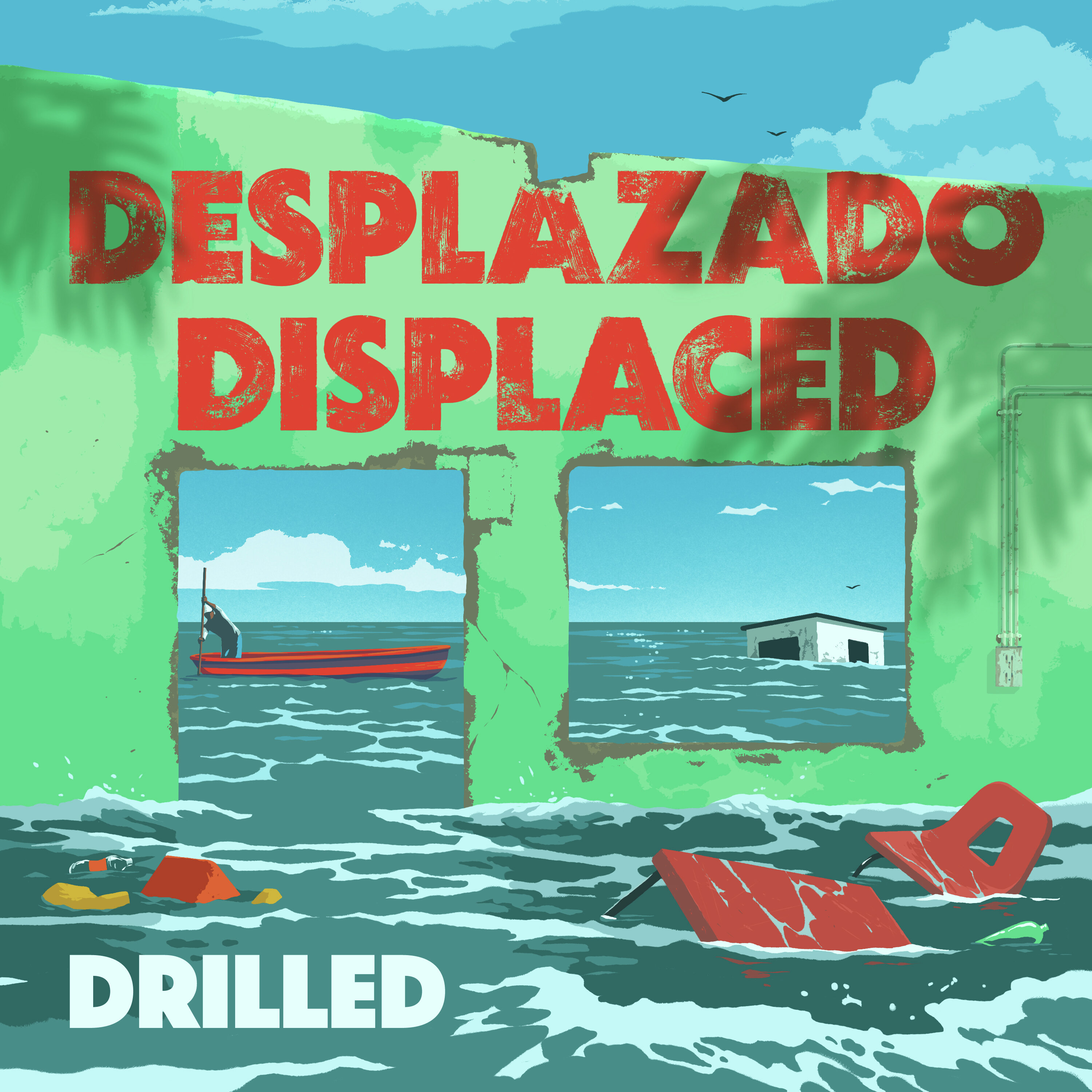
By 2050, one in eight people are expected to have been displaced by climate change, forcing millions of people to leave their hometowns, their countries of origin, and in many cases their identities behind. For communities all over the world, that time has already come. In this three-part mini series, Drilled global climate justice reporter Nina Lakhani takes us to three Latin American communities, each dealing with climate displacement—and the race to save their community—in a different way, to give listeners a window into the complexities of this issue. Imagine if your kid's school was suddenly submerged in the ocean, or if the government gave you a new house but it was 20 miles away and looked like everyone else's, or if the same country that made the drought worse in your village stole your stuff and put you in prison for the crime of trying to feed your family?
Get all episodes of Drilled: Displaced early and ad-free with a Pushkin+ subscription. Find Pushkin+ on the Drilled show page on Apple Podcasts or at pushkin.fm/plus.
Drilled is a true-crime climate change podcast exposing how corporate corruption and political operatives built decades of climate denial and delay. Hosted and reported by award-winning investigative climate journalists and led by Amy Westervelt, each season unravels new evidence of deception, disinformation, and the power structures keeping real climate solutions out of reach.
Show details and episodes come from the publisher's public feed at omnycontent.com. Last updated . Names, artwork and text belong to their publishers.
Cosmos
Similar by topic and creator
- Deep Cover
Shares the topic True Crime and the creator Pushkin Industries. - Cautionary Tales with Tim Harford
Shares the creator Pushkin Industries. - Broken Record with Rick Rubin, Malcolm Gladwell, Bruce Headlam and Justin Richmond
Shares the creator Pushkin Industries.
Episodes
The Corruption of COP: Inside Climate Obstruction at the UN
· 54 min
The United Nations' climate processes were created to drive global climate action, but from the beginning they've faced organized efforts to delay progress. As COP 30 begins, Kari de Pryck (https://www.karidepryck.org/about/) (University of Geneva) and Eduardo Viola (https://ri.fgv.br/en/pessoas/eduardo-viola) (Institute of International Relations, Brazil) join Amy to analyze how COP and the Intergovernmental Panel on Climate Change get hijacked by those opposed to climate action, what it means for global climate policy, and what to expect at this year's COP in Brazil. See omnystudio.com/listener (https://omnystudio.com/listener) for privacy information.
Not rated yetNorway Beyond Oil: Climate, Policy, Society
· 43 min
We look ahead to Norway's future, exploring how the country might begin to loosen oil's grip on its politics and identity. Hear how different voices envision aligning the country's actions with its values, its reputation, and the realities of climate change. Additional resources: Communicating Climate Change (https://communicatingclimatechange.com/the-black-thread) See omnystudio.com/listener (https://omnystudio.com/listener) for privacy information.
Not rated yetHow Climate Obstruction Works at the Local Level
· 34 min
Local governments are a double-edged sword when it comes to climate policy, with the power to either do far more or far less than national governments. They can be an agent of change or an agent of obstruction. Rebecca Bromley-Trujillo (https://cnu.edu/faculty/rebeccabromleytrujillo.html)(Christopher Newport University) and Joshua A. Basseches (https://liberalarts.tulane.edu/political-science/people/faculty-staff/joshua-basseches) (Tulane University) walk us through how subnational governments, like states and municipalities, work and how they engage in climate obstruction.https://megaphone.fm/adchoices See omnystudio.com/listener (https://omnystudio.com/listener) for privacy information.
Not rated yetClimate Obstruction in the Global South
· 54 min
The United States is a global leader of climate obstruction, but it's not the only guilty country. M. Omar Faruque (https://www.unb.ca/faculty-staff/directory/arts-fr-sociology/faruque-omar.html) (Queen’s University, Canada) and Ruth E. McKie (https://www.dmu.ac.uk/about-dmu/academic-staff/health-and-life-sciences/ruth-mckie/ruth-mckie.aspx) (De Montfort University) look at how and why climate obstruction occurs in the Global South, exploring the political, economic, and institutional factors that lead the countries most vulnerable to climate change, and least responsible for emissions, to participate in climate obstruction. See omnystudio.com/listener (https://omnystudio.com/listener) for privacy information.
Not rated yetChallenging the Narratives
· 50 min
Do the facts behind the narratives being told by Norway's fossil fuel industry, and government, add up? We hear experts critique some of the stories that keep Norwegian oil and gas pumping, while industry representatives explain the logic behind the rhetoric. Additional resources: Communicating Climate Change (https://communicatingclimatechange.com/the-black-thread) See omnystudio.com/listener (https://omnystudio.com/listener) for privacy information.
Not rated yetDrilling Deep: Karen House on Saudi Arabia Under Mohammed bin Salman
· 52 min
Pulitzer Prize-winning journalist and former Wall Street Journal publisher Karen Elliott House (https://www.karenelliotthouse.com/), author of The Man Who Would Be King: Mohammed bin Salman and the Transformation of Saudi Arabia (https://www.karenelliotthouse.com/books), joins Adam Lowenstein (https://www.adaml.blog/) to discuss how the crown prince has reshaped Saudi Arabia. They explore if MBS's gamble on economic and social freedoms alongside ciivil and political repression is politically, or environmentally, sustainable and examine how Saudi Arabia's oil and petrochemical industries serve its geopolitical interests. Karen and Adam also discuss the kingdom’s promises about transitioning away from fossil fuels and why it might be a bit less green than climate advocates would hope. See omnystudio.com/listener (https://omnystudio.com/listener) for privacy information.
Not rated yetAbdul El-Sayed on Climate Complexities and Benevolent Masculinity
· 35 min
In this extended conversation, climate policy expert Abdul El-Sayed explores the complexities of the climate crisis and the role of masculinity in shaping how men engage, or fail to engage, with climate solutions. See omnystudio.com/listener (https://omnystudio.com/listener) for privacy information.
Not rated yetPetroganda: How the Oil Industry Is Shaping Norway's Politics and Culture
· 48 min
A growing number of experts and commentators suggest "petroganda"—the pervasive phenomenon of oil industry manipulation—is at work in Norway, influencing the country's politics, culture, and support for the oli industry. We discuss how "petroganda" guides the information that the public receives, or doesn’t receive, about the relationship between oil and climate change and learn how the story of oil in Norway is told. Additional resources: Communicating Climate Change (https://communicatingclimatechange.com/the-black-thread) See omnystudio.com/listener (https://omnystudio.com/listener) for privacy information.
Not rated yetHow the Animal Agriculture Industry Blocks Methane Regulation
· 1 hr 9 min
For decades, the meat and dairy industries avoided scrutiny for the planet-heating emissions they pump into the atmosphere. As governments began considering methane regulation, the animal agriculture sector starting working on efforts to resist such regulations. Siliva Secchi (https://sees.uiowa.edu/people/silvia-secchi) (University of Iowa) and Kathrin Lauber (https://www.sps.ed.ac.uk/staff/kathrin-lauber) (University of Edinburgh) expound the concept of "agricultural exceptionalism" and the strategies the agriculture industry uses to keep climate policy at bay. See omnystudio.com/listener (https://omnystudio.com/listener) for privacy information.
Not rated yetHow the Coal, Utilities, and Transportation Industries Block Climate Policy
· 43 min
The coal, utilities, and transportation industries have all played a major role in stopping governments from regulating emissions or transitioning to cleaner energy. Examining how those effort have taken shape around the world, Jen Schneider (https://www.boisestate.edu/sps-publicpolicy/faculty-and-staff/jen-schneider/) (Boise State University) and Gregory Trencher (https://www.gregorytrencher.net/) (Kyoto University) break down the strategies these industries use to influence policymakers, resist decarbonization, and slow climate action. Additional resources: Climate Obstruction: A Global Assessment (https://global.oup.com/academic/product/climate-obstruction-9780197787151?cc=us&lang=en&) You can now download aFREE copy of the book Climate Obstruction: A Global Survey here! (https://cssn.org/wp-content/uploads/2025/10/web-version-Roberts-et-al-Climate-Obstruction-A-Global-Assessment.pdf) See omnystudio.com/listener (https://omnystudio.com/listener) for privacy information.
Not rated yet