

ELT's INSANE 39m MIRROR! #shorts
From Dr. Becky · · 1 min
The player loads from YouTube only when you click. It uses YouTube's privacy-enhanced mode.
If the video does not play, the owner may have turned off embedding. Watch it on YouTube instead.
Description
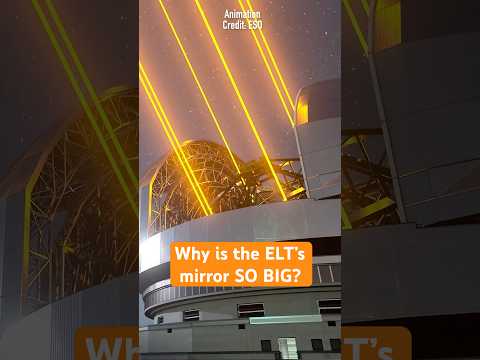
Why do we need a telescope as large as 39m across?
The bigger the telescope you have, the smaller the object you can see. And thanks to ELT’s size and its 6 giant lasers that can correct for the blurring of Earth’s atmosphere, ELT should be able to give us images that are 16 times sharper than Hubble, and 6 times sharper than JWST once it comes online in 2030.
But one single piece of glass 39m wide is not a good idea. It would be so heavy that it would bend under its own weight.
Instead engineers have developed ELT’s primary light collecting mirror to have 798 individual hexagonal segments each measuring 1.4 metres across.
That means installing ELT’s mirror is going to be one very large, nervous jigsaw puzzle.
That’s the job of the segment manipulator.
And to see that, we need to head to the heart of engineering at ESO, and get geared up.
Video filmed on a Sony ⍺7 IV Video edited by Martino Gasparrini: martino.freelance@gmail.com Video produced by Marina Hui & Dr Becky Smethurst
---
📚 My book, "A Brief History of Black Holes", out NOW in hardback, paperback, e-book and audiobook (which I narrated myself!): http://lnk.to/DrBecky
---
👕 My merch, including JWST designs, are available here (with worldwide shipping!): https://dr-becky.teemill.com/
---
🎧 Royal Astronomical Society Podcast that I co-host: podfollow.com/supermassive
---
🔔 Don't forget to subscribe and click the little bell icon to be notified when I post a new video!
---
👩🏽💻 I'm Dr. Becky Smethurst, an astrophysicist at the University of Oxford. I love making videos about science with an unnatural level of enthusiasm. I like to focus on how we know things, not just what we know. And especially, the things we still don't know. If you've ever wondered about something in space and couldn't find an answer online - you can ask me! My day job is to do research into how supermassive black holes can affect the galaxies that they live in. In particular, I look at whether the energy output from the disk of material orbiting around a growing supermassive black hole can stop a galaxy from forming stars.