

How to see the planetary parade in November 2026 #shorts
From Dr. Becky · · 2 min
The player loads from YouTube only when you click. It uses YouTube's privacy-enhanced mode.
If the video does not play, the owner may have turned off embedding. Watch it on YouTube instead.
Description
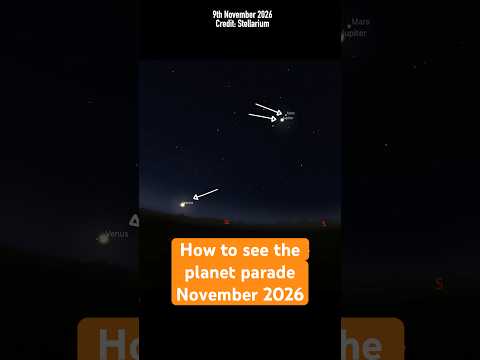
It’s this steady rise of Venus higher in the morning sky through November, and Mercury behind it lower on the sky, that will give us the so-called planet parade.
I’ll warn you now, you’re going to see a lot of hype online about the planet parade, with some people even calling it a planetary alignment and I just want to set expectations.
Because yes it’s incredibly cool that you can see Jupiter, Mars and Venus, and possibly mercury if you have a flat horizon, in the sky at the same time, in the mornings just before sunrise.
And yes they will all roughly be aligned, because the solar system is flat and all the planets orbit in the same plane around the Sun, so all take roughly the same path through the sky.
But Jupiter and Mars will be close together, high in the sky, and then bright Venus nearer the horizon, with fainter Mercury really hard to spot below it. So most people are only going to be able to spot 3 planets. And they won’t look like they’re in a straight line.
You’ll hear most people saying this is going to happen around the 18th November, because that’s when Mercury reaches its highest point, but since most people won’t be able to see Mercury anyway because of trees and buildings in the way, anytime from early November is good for this.
In fact the more mornings you can spot the positions of the planets this month the better, because bright Jupiter and reddish Mars will slowly be getting closer and closer together in the sky from our perspective here on Earth as they move along their orbits.
They reach their closest pass on the 15th November, before they start to move apart again. And their close pass will be fun to see, but it’s also more rewarding if you’ve done your astronomy homework and watched them get closer and closer over the next few weeks.
Video filmed on a Sony ⍺7 IV Video edited by Martino Gasparrini: martino.freelance@gmail.com Video produced by Marina Hui & Dr Becky Smethurst
---
📚 My book, "A Brief History of Black Holes", out NOW in hardback, paperback, e-book and audiobook (which I narrated myself!): http://lnk.to/DrBecky
---
👕 My merch, including JWST designs, are available here (with worldwide shipping!): https://dr-becky.teemill.com/
---
🎧 Royal Astronomical Society Podcast that I co-host: podfollow.com/supermassive
---
🔔 Don't forget to subscribe and click the little bell icon to be notified when I post a new video!
---
👩🏽💻 I'm Dr. Becky Smethurst, an astrophysicist at the University of Oxford. I love making videos about science with an unnatural level of enthusiasm. I like to focus on how we know things, not just what we know. And especially, the things we still don't know. If you've ever wondered about something in space and couldn't find an answer online - you can ask me! My day job is to do research into how supermassive black holes can affect the galaxies that they live in. In particular, I look at whether the energy output from the disk of material orbiting around a growing supermassive black hole can stop a galaxy from forming stars.