

Derivatives of Sine and Cosine
From Derek Banas · · 2 min
The player loads from YouTube only when you click. It uses YouTube's privacy-enhanced mode.
If the video does not play, the owner may have turned off embedding. Watch it on YouTube instead.
Description
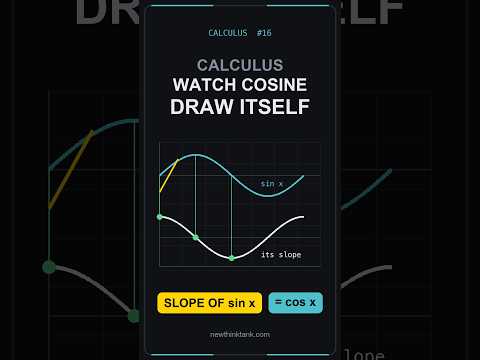
Episode 15 used the derivative of sine without ever proving it. Here's the proof and it's a picture, not algebra.
Sine on top. A tangent slides along it with a live slope readout, and that slope gets plotted in a second panel underneath. Watch what gets drawn. I'm not going to tell you. You'll recognise it.
Three checkpoints you can verify yourself:
At x = 0 sine climbs steepest: slope 1, and cos 0 = 1.
At x = π/2 sine is flat at its peak: slope 0, and cos π/2 = 0.
At x = π sine falls steepest: slope −1, and cos π = −1.
Then the same machine on cosine: the trace comes out as an upside-down sine, so (cos x)′ = −sin x. And the minus isn't arbitrary. Sine leaves zero going UP; cosine leaves one going DOWN. Opposite directions, opposite sign.
The four-cycle: sin → cos → −sin → −cos → back to sin. Differentiate four times and you're home.
And the part almost nobody covers: All of this is false in degrees. The derivative of sin(x) is cos(x) only when x is in radians. In degrees the wave is stretched horizontally by about 57, so its slope is crushed by the same factor — (sin x°)′ = (π/180)·cos x°, about 0.0175. Radians aren't a convention; they're the only unit that makes calculus work.
Worked: sin(3x) → 3cos(3x). x·sin x → sin x + x·cos x. cos(x²) → −2x·sin(x²). sin²x → 2 sin x cos x, which is just sin(2x) by the double-angle formula