

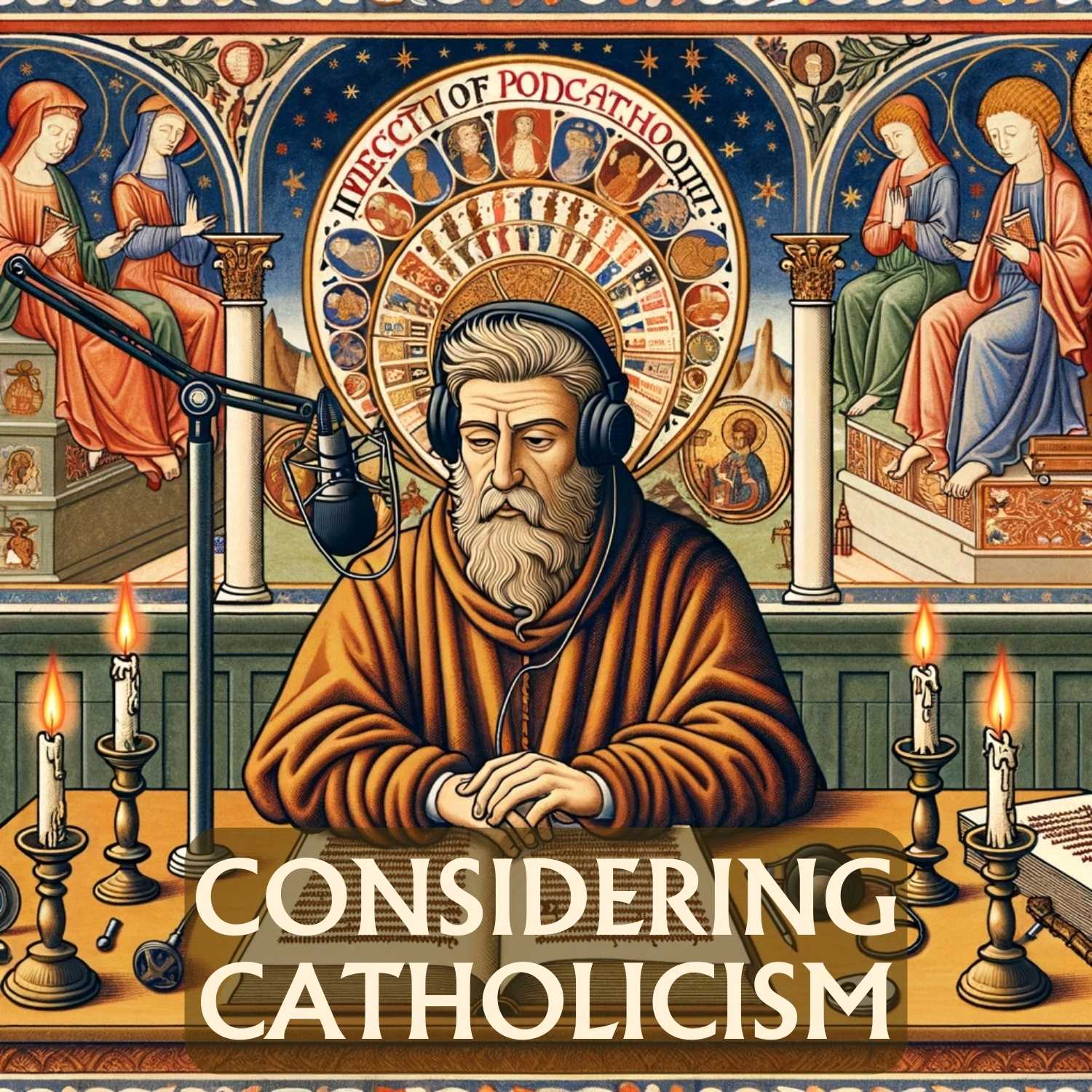
Considering Catholicism
Greg SmithAudio
- Format:
- Podcast
- New episodes:
- Several times a week
- Typical length:
- about 35 minutes
- Latest episode:
About this show
Considering Catholicism explains the beliefs, history, Scripture, and life of the Catholic Church clearly and charitably. It’s for curious Protestants, seekers, people in OCIA, and Catholics who want to know and share their faith. Host Greg Smith spent decades serving across the Protestant world, which gives him an insider’s understanding of the questions people bring. Faithful to the Catechism of the Catholic Church.
Show details and episodes come from the publisher's public feed at feed.podbean.com. Last updated . Names, artwork and text belong to their publishers.
Cosmos
Similar by topic and creator
- Metaphysical
Shares the topics History and Society. - Absolute History
Shares the topics History and Society. - Academy of Ideas
Shares the topics History and Society.
Similar shows





Explore more
Episodes
Why Don't We Just Dedicate Babies? (#476)
· 39 min
Why don’t Catholics just dedicate babies the way so many evangelical churches do? In this episode we look carefully at the difference between a sincere baby dedication and the Catholic sacrament of baptism. Dedication is a beautiful public commitment by parents and the church to raise a child in the faith—but it leaves the child’s spiritual state unchanged. Catholic baptism claims something more: that Christ acts first, remitting original sin, conferring sanctifying grace, and incorporating the child into His Body before the child can answer for himself. We examine the theology that produces dedication, the scriptural and historical reasons the Church has always baptized infants, and why the order of God’s action matters for both the child and the parents. SUPPORT THIS SHOW Considering Catholicism is free and ad-free for everyone, thanks to listeners like you. Become a patron for a Q&A video every other week, the Podcast Albums (50 topical playlists), Deep Dive courses, and a monthly live session: https://patreon.com/consideringcatholicism Or give a one-time or recurring gift with PayPal: https://www.paypal.com/donate/?hosted_button_id=5LGR5E89Z7Y2Y CONNECT WITH US • Website & contact form: https://consideringcatholicism.com (https://consideringcatholicism.com/) • Email: consideringcatholicism@gmail.com • Leave a comment on Patreon (I read every one!) RATE & REVIEW If you enjoy the show, please leave a rating (and even better, a review) on Apple Podcasts, Spotify, or wherever you listen — it really helps new listeners find us. SHARE THE SHOW Know someone who’s curious about Catholicism? Send them a link or share an episode on social media. Thank you! Christus vincit, Christus regnat, Christus imperat.
Not rated yet"Dear Doubting Thomas..." Part 7: The Church on Paper vs. the Church in the Pews (#475)
· 42 min
Thomas named a frustration many people feel when they look seriously at Catholicism: on paper and in history the Church looks strong, bold, and majestic, yet in many ordinary parishes and contemporary voices it can feel soft, embarrassed by its own doctrine, and eager to concede to the spirit of the age. In this final episode of the series, Greg takes that dissonance seriously. He distinguishes it from the usual “Church of sinners” cliché, places Vatican II and its aftermath in the much longer pattern of how ecumenical councils actually work across centuries, and points to signs that the Church is slowly rejecting both extremes while the center of gravity reasserts continuity. The series ends where it began—with the question of trust, and the decision to stay in the boat Peter was told to stay in. SUPPORT THIS SHOW Considering Catholicism is free and ad-free for everyone, thanks to listeners like you. Become a patron for a Q&A video every other week, the Podcast Albums (50 topical playlists), Deep Dive courses, and a monthly live session: https://patreon.com/consideringcatholicism Or give a one-time or recurring gift with PayPal: https://www.paypal.com/donate/?hosted_button_id=5LGR5E89Z7Y2Y CONNECT WITH US • Website & contact form: https://consideringcatholicism.com (https://consideringcatholicism.com/) • Email: consideringcatholicism@gmail.com • Leave a comment on Patreon (I read every one!) RATE & REVIEW If you enjoy the show, please leave a rating (and even better, a review) on Apple Podcasts, Spotify, or wherever you listen — it really helps new listeners find us. SHARE THE SHOW Know someone who’s curious about Catholicism? Send them a link or share an episode on social media. Thank you! Christus vincit, Christus regnat, Christus imperat.
Not rated yet"Dear Doubting Thomas..." Part 6: Why Should I Trust Your Pope? (#474)
· 42 min
Thomas named the papacy as one of the biggest speed bumps on the Road to Rome. The questions are familiar: Who made a man in Rome the boss of Christianity? What about the corrupt popes? Can he just make things up? In this episode Greg takes those questions head-on, beginning with Jesus’ words to Peter in Matthew 16 and the early Church’s recognition of that office. He looks honestly at the mixed historical record of the men who have sat in the chair, explains the real (and limited) nature of papal authority, and asks the deeper question: if not the papacy, then what? For anyone who feels the weight of imperfect leaders yet still senses that Christ left His Church a visible center of unity, this episode is for you. SUPPORT THIS SHOW Considering Catholicism is free and ad-free for everyone, thanks to listeners like you. Become a patron for a Q&A video every other week, the Podcast Albums (50 topical playlists), Deep Dive courses, and a monthly live session: https://patreon.com/consideringcatholicism Or give a one-time or recurring gift with PayPal: https://www.paypal.com/donate/?hosted_button_id=5LGR5E89Z7Y2Y CONNECT WITH US • Website & contact form: https://consideringcatholicism.com (https://consideringcatholicism.com/) • Email: consideringcatholicism@gmail.com • Leave a comment on Patreon (I read every one!) RATE & REVIEW If you enjoy the show, please leave a rating (and even better, a review) on Apple Podcasts, Spotify, or wherever you listen — it really helps new listeners find us. SHARE THE SHOW Know someone who’s curious about Catholicism? Send them a link or share an episode on social media. Thank you! Christus vincit, Christus regnat, Christus imperat.
Not rated yet"Dear Doubting Thomas..." Part 5: What Happens on the Altar in the Eucharist? (#473)
· 31 min
Thomas raised two related difficulties with the Mass: what the Catholic Church actually claims is happening on the altar, and how underwhelming or casual many ordinary parish celebrations can feel. In this episode Greg stays focused on the first question. Drawing on Scripture, the early Church, and the Church’s precise language of transubstantiation, he explains why Catholics insist that the whole Christ — body, blood, soul, and divinity — is truly present under the appearances of bread and wine. He contrasts this with the more limited role communion usually plays in evangelical Protestantism and shows why the Church has always treated the Eucharist as the source and summit of the Christian life. The gap between the extraordinary claim and everyday parish practice is real, but it is a separate question for another time. SUPPORT THIS SHOW Considering Catholicism is free and ad-free for everyone, thanks to listeners like you. Become a patron for a Q&A video every other week, the Podcast Albums (50 topical playlists), Deep Dive courses, and a monthly live session: https://patreon.com/consideringcatholicism Or give a one-time or recurring gift with PayPal: https://www.paypal.com/donate/?hosted_button_id=5LGR5E89Z7Y2Y CONNECT WITH US • Website & contact form: https://consideringcatholicism.com (https://consideringcatholicism.com/) • Email: consideringcatholicism@gmail.com • Leave a comment on Patreon (I read every one!) RATE & REVIEW If you enjoy the show, please leave a rating (and even better, a review) on Apple Podcasts, Spotify, or wherever you listen — it really helps new listeners find us. SHARE THE SHOW Know someone who’s curious about Catholicism? Send them a link or share an episode on social media. Thank you! Christus vincit, Christus regnat, Christus imperat.
Not rated yet"Dear Doubting Thomas..." Part 4: Why Would We Need Purgatory? (#472)
· 23 min
Thomas asked the natural follow-up question to the “broken window”: if forgiveness cancels the debt but the damage remains, what happens to that remaining damage after we die? In this episode Greg takes up the common Protestant objection that any further purification after death seems to add something to the finished work of the Cross. Drawing on the Catechism, Scripture, and the Church’s long practice of praying for the dead, he explains that everyone in purgatory is already saved and will reach heaven. Purgatory is not a second chance or a third eternal destination; it is the final, merciful purification of those who die in God’s friendship but are still imperfectly ready to stand before Him. If you have ever felt the tension between being forgiven and still knowing you are not yet whole, this episode is for you. SUPPORT THIS SHOW Considering Catholicism is free and ad-free for everyone, thanks to listeners like you. Become a patron for a Q&A video every other week, the Podcast Albums (50 topical playlists), Deep Dive courses, and a monthly live session: https://patreon.com/consideringcatholicism Or give a one-time or recurring gift with PayPal: https://www.paypal.com/donate/?hosted_button_id=5LGR5E89Z7Y2Y CONNECT WITH US • Website & contact form: https://consideringcatholicism.com (https://consideringcatholicism.com/) • Email: consideringcatholicism@gmail.com • Leave a comment on Patreon (I read every one!) RATE & REVIEW If you enjoy the show, please leave a rating (and even better, a review) on Apple Podcasts, Spotify, or wherever you listen — it really helps new listeners find us. SHARE THE SHOW Know someone who’s curious about Catholicism? Send them a link or share an episode on social media. Thank you! Christus vincit, Christus regnat, Christus imperat.
Not rated yet"Dear Doubting Thomas..." Part 3: Why Do Penance if Christ Already Paid the Price? (#471)
· 29 min
Thomas asked a question that a lot of people carry quietly: if Christ has already paid the full price for our sins, why does the Catholic Church still talk about penance, temporal punishment, and making satisfaction? In this third episode of the Dear Doubting Thomas series, Greg takes up the “broken window” image Thomas used and the common Protestant retort that any further “doing” after forgiveness seems to add to the finished work of the Cross. Drawing on the Church’s careful distinctions between justification and sanctification, and on the difference between the lift that gets the plane off the ground and the journey that actually takes us somewhere, he shows why the call to cooperate in healing the remaining effects of sin is not a second invoice but a gift of mercy ordered to real transformation. If you’ve ever felt stuck between the anxiety of never knowing whether you’re fully forgiven and the casual sense that nothing more is required, this episode is for you. SUPPORT THIS SHOW Considering Catholicism is free and ad-free for everyone, thanks to listeners like you. Become a patron for a Q&A video every other week, the Podcast Albums (50 topical playlists), Deep Dive courses, and a monthly live session: https://patreon.com/consideringcatholicism Or give a one-time or recurring gift with PayPal: https://www.paypal.com/donate/?hosted_button_id=5LGR5E89Z7Y2Y CONNECT WITH US • Website & contact form: https://consideringcatholicism.com (https://consideringcatholicism.com/) • Email: consideringcatholicism@gmail.com • Leave a comment on Patreon (I read every one!) RATE & REVIEW If you enjoy the show, please leave a rating (and even better, a review) on Apple Podcasts, Spotify, or wherever you listen — it really helps new listeners find us. SHARE THE SHOW Know someone who’s curious about Catholicism? Send them a link or share an episode on social media. Thank you! Christus vincit, Christus regnat, Christus imperat.
Not rated yet"Dear Doubting Thomas..." Part 2: Why Confess to a Priest? (#470)
· 26 min
Thomas wrestled with a very practical and painful question: Why does the Church insist we confess our sins to a priest when we can just tell God directly? In this episode Greg addresses the deeper anxiety underneath that objection—the fear that we’ll never really know if we’re forgiven, and the two common dead-ends many people fall into: anxious uncertainty or a shrugging casualness toward sin. Drawing on Scripture, the early Church, and his own experience, he explains why the Sacrament of Reconciliation is not a barrier but a gift of mercy that gives us something we can’t get anywhere else: the audible words of absolution and a structured path for real growth in holiness. Whether you’re blocked from the sacraments right now or simply wondering why “just tell God” has never quite been enough, this episode offers clarity and hope. SUPPORT THIS SHOW Considering Catholicism is free and ad-free for everyone, thanks to listeners like you. Become a patron for a Q&A video every other week, the Podcast Albums (50 topical playlists), Deep Dive courses, and a monthly live session: https://patreon.com/consideringcatholicism Or give a one-time or recurring gift with PayPal: https://www.paypal.com/donate/?hosted_button_id=5LGR5E89Z7Y2Y CONNECT WITH US • Website & contact form: https://consideringcatholicism.com (https://consideringcatholicism.com/) • Email: consideringcatholicism@gmail.com • Leave a comment on Patreon (I read every one!) RATE & REVIEW If you enjoy the show, please leave a rating (and even better, a review) on Apple Podcasts, Spotify, or wherever you listen — it really helps new listeners find us. SHARE THE SHOW Know someone who’s curious about Catholicism? Send them a link or share an episode on social media. Thank you! Christus vincit, Christus regnat, Christus imperat.
Not rated yet"Dear Doubting Thomas,..." Part 1: Is the Catholic Church for Real? (#469b)
· 27 min
Thomas wrote with a question that sits underneath almost everything else: Can the Catholic Church really be trusted with its extraordinary claims? In this first episode of the series, Greg responds personally and honestly to that foundational doubt. Drawing from his own long journey out of self-selected Christianity and into the Church, he explores why there’s no comfortable middle ground, why the visible imperfections of the Church can feel like cold water on genuine inspiration, and what finally led him to make the deliberate choice to trust the Barque of Peter anyway. If you’ve ever felt the tension between the beauty that draws you toward Catholicism and the very human failures that make you hesitate, this conversation is for you. SUPPORT THIS SHOW Considering Catholicism is free and ad-free for everyone, thanks to listeners like you. Become a patron for a Q&A video every other week, the Podcast Albums (50 topical playlists), Deep Dive courses, and a monthly live session: https://patreon.com/consideringcatholicism Or give a one-time or recurring gift with PayPal: https://www.paypal.com/donate/?hosted_button_id=5LGR5E89Z7Y2Y CONNECT WITH US • Website & contact form: https://consideringcatholicism.com (https://consideringcatholicism.com/) • Email: consideringcatholicism@gmail.com • Leave a comment on Patreon (I read every one!) RATE & REVIEW If you enjoy the show, please leave a rating (and even better, a review) on Apple Podcasts, Spotify, or wherever you listen — it really helps new listeners find us. SHARE THE SHOW Know someone who’s curious about Catholicism? Send them a link or share an episode on social media. Thank you! Christus vincit, Christus regnat, Christus imperat.
Not rated yetMary in the Dock, Part 7: Her Bodily Assumption into Heaven (#469)
· 29 min
In this final episode of the Mary in the Dock series, we examine the Assumption of Mary — the solemn teaching that, at the end of her earthly life, the Immaculate Mother of God was taken up body and soul into heavenly glory. Many Protestants find this doctrine especially challenging, arguing that it lacks any biblical foundation and was simply invented by the pope when it was defined in 1950. We give those objections a full and fair hearing, including the complete silence of the New Testament, the absence of clear early patristic testimony, and the apparent difference between the Catholic understanding and the Eastern Orthodox celebration of the Dormition. We then present the Catholic case: the biblical precedent of God assuming other holy figures, the ancient and widespread liturgical tradition in both East and West, and the deep theological fittingness of Mary’s bodily glorification as the New Eve and the New Ark. Whether you’re wrestling with this teaching or simply want to understand why the Church holds it with such conviction, this episode brings the entire series to a coherent and Christ-centered conclusion. SUPPORT THIS SHOW Considering Catholicism is free and ad-free for everyone, thanks to listeners like you. Become a patron for a Q&A video every other week, the Podcast Albums (50 topical playlists), Deep Dive courses, and a monthly live session: https://patreon.com/consideringcatholicism Or give a one-time or recurring gift with PayPal: https://www.paypal.com/donate/?hosted_button_id=5LGR5E89Z7Y2Y CONNECT WITH US • Website & contact form: https://consideringcatholicism.com (https://consideringcatholicism.com/) • Email: consideringcatholicism@gmail.com • Leave a comment on Patreon (I read every one!) RATE & REVIEW If you enjoy the show, please leave a rating (and even better, a review) on Apple Podcasts, Spotify, or wherever you listen — it really helps new listeners find us. SHARE THE SHOW Know someone who’s curious about Catholicism? Send them a link or share an episode on social media. Thank you! Christus vincit, Christus regnat, Christus imperat.
Not rated yetMary in the Dock, Part 6: Her Perpetual Virginity (#468)
· 37 min
In this installment of Mary in the Dock, we put the claim of Mary’s perpetual virginity on trial. Many Protestants see the “brothers of Jesus” mentioned in the Gospels and the word “until” in Matthew 1:25 as decisive proof that Mary and Joseph had a normal married life after Jesus’ birth. We examine those objections carefully and then explore the Catholic response — from the broader biblical and Jewish use of the word “brother,” to the idiomatic meaning of “until,” to the early and unanimous witness of the Church Fathers. Far from being a late ascetic invention, the perpetual virginity of Mary emerges as a profoundly fitting expression of her unique role as the New Ark and the Mother of God. Whether you’re wrestling with this teaching or simply want to understand why the Church has always held it, this episode offers a clear and Scripture-centered defense. SUPPORT THIS SHOW Considering Catholicism is free and ad-free for everyone, thanks to listeners like you. Become a patron for a Q&A video every other week, the Podcast Albums (50 topical playlists), Deep Dive courses, and a monthly live session: https://patreon.com/consideringcatholicism Or give a one-time or recurring gift with PayPal: https://www.paypal.com/donate/?hosted_button_id=5LGR5E89Z7Y2Y CONNECT WITH US • Website & contact form: https://consideringcatholicism.com (https://consideringcatholicism.com/) • Email: consideringcatholicism@gmail.com • Leave a comment on Patreon (I read every one!) RATE & REVIEW If you enjoy the show, please leave a rating (and even better, a review) on Apple Podcasts, Spotify, or wherever you listen — it really helps new listeners find us. SHARE THE SHOW Know someone who’s curious about Catholicism? Send them a link or share an episode on social media. Thank you! Christus vincit, Christus regnat, Christus imperat.
Not rated yetHow Do Altar Rails Make You Feel? (#467)
· 41 min
In recent years, a number of dioceses have moved to remove or ban altar rails, even as some younger priests have begun reinstalling them. These disputes often follow a familiar pattern: one side appeals to history and theology, while the actual arguments on the ground tend to revolve around how a practice makes people feel. This episode steps back from the usual arguments to examine why the language of feelings so often dominates discussions about the liturgy — and why that creates problems on more than one side. Drawing a parallel to the common Bible study question “What does this passage mean to you?”, it argues that both Scripture and the Mass are better approached as a search for what is actually true rather than what feels meaningful in the moment. The result is a call to move beyond generational instincts and cultural assumptions toward a deeper, more consistent engagement with the Church’s tradition. SUPPORT THIS SHOW Considering Catholicism is free and ad-free for everyone, thanks to listeners like you. Become a patron for a Q&A video every other week, the Podcast Albums (50 topical playlists), Deep Dive courses, and a monthly live session: https://patreon.com/consideringcatholicism Or give a one-time or recurring gift with PayPal: https://www.paypal.com/donate/?hosted_button_id=5LGR5E89Z7Y2Y CONNECT WITH US • Website & contact form: https://consideringcatholicism.com (https://consideringcatholicism.com/) • Email: consideringcatholicism@gmail.com • Leave a comment on Patreon (I read every one!) RATE & REVIEW If you enjoy the show, please leave a rating (and even better, a review) on Apple Podcasts, Spotify, or wherever you listen — it really helps new listeners find us. SHARE THE SHOW Know someone who’s curious about Catholicism? Send them a link or share an episode on social media. Thank you! Christus vincit, Christus regnat, Christus imperat.
Not rated yetWho Is a "Christian?" (#466)
· 40 min
In the wake of the Pentagon’s recent effort to simplify its religious affiliation codes — and the resulting controversy when The Church of Jesus Christ of Latter-day Saints was initially listed separately from other Christian groups — Utah senators Mike Lee and John Curtis publicly pushed back, insisting that Latter-day Saints are unequivocally Christian. The online debate that followed highlighted a much larger and older question: In a culture where anyone can claim any label, what does the word “Christian” actually mean? What are the historical and theological criteria, and who has the authority to define them? Building on our previous episode about the visible criterion for orthodoxy, we trace how the early Church clarified the boundaries of authentic faith amid heresies, through the creeds, councils, and the role of Peter’s successor in safeguarding unity. We examine why self-identification, while sincere, has never been sufficient on its own — and why the same logic that leads some to say “anyone who feels like a Christian is a Christian” creates the same problems we see when words like “woman” are detached from objective reality. Along the way we look honestly at specific groups: mainline and evangelical Protestants (real but imperfect communion), Mormons (self-identified Christians with a fundamentally different understanding of God and the Trinity), Jehovah’s Witnesses, Unitarians, and various progressive re-interpretations that retain the label while redefining core doctrines. We also address the common pushback that “Mormons are some of the nicest, most moral people you’ll meet” — and why that, while true and praiseworthy, doesn’t settle the theological question (just as being baptized and confirmed Catholic doesn’t automatically make someone a good or moral person). If you’ve ever wondered how the Church distinguishes between orthodoxy and heresy, or why the Catholic Church doesn’t simply accept every sincere group’s self-definition, this episode offers clear, historically grounded answers with pastoral warmth. The goal isn’t exclusion for its own sake, but clarity — so that the faith Christ actually revealed can be known, guarded, and handed on intact. SUPPORT THIS SHOW Considering Catholicism is free and ad-free for everyone, thanks to listeners like you. Become a patron for a Q&A video every other week, the Podcast Albums (50 topical playlists), Deep Dive courses, and a monthly live session: https://patreon.com/consideringcatholicism Or give a one-time or recurring gift with PayPal: https://www.paypal.com/donate/?hosted_button_id=5LGR5E89Z7Y2Y CONNECT WITH US • Website & contact form: https://consideringcatholicism.com (https://consideringcatholicism.com/) • Email: consideringcatholicism@gmail.com • Leave a comment on Patreon (I read every one!) RATE & REVIEW If you enjoy the show, please leave a rating (and even better, a review) on Apple Podcasts, Spotify, or wherever you listen — it really helps new listeners find us. SHARE THE SHOW Know someone who’s curious about Catholicism? Send them a link or share an episode on social media. Thank you! Christus vincit, Christus regnat, Christus imperat.
Not rated yetWhere Peter Is (#465)
· 31 min
In a world flooded with thousands of competing voices — each claiming to represent “biblical Christianity” with their favorite proof texts — how do you actually tell authentic, orthodox Christianity from heresy? From the Gnostics and Arians of the early centuries to today’s endless online teachers and influencers, the problem is as old as the Church itself. In this episode we explore one of the clearest and most reliable answers the Church has ever had: the ancient principle captured by St. Ambrose — “Where Peter is, there is the Church.” We unpack Jesus’ own words to Peter in Matthew 16, the witness of the Church Fathers, and the crucial distinction between the individual pope and the papacy itself. Along the way we address how this visible criterion for orthodoxy played out in history — from anti-popes to the East-West split — and why it still matters in our age of doctrinal noise and personal brands. Popes fall on a bell curve like the rest of us, but the office Christ established remains the living anchor that keeps the faith one. If the question of authority and the pope has been the final hurdle in your journey toward the Catholic Church, this conversation offers honest clarity and genuine encouragement. The same Peter who denied Christ three times was still entrusted with the keys — a reminder that the Church has always been God’s mercy at work through imperfect instruments. SUPPORT THIS SHOW Considering Catholicism is free and ad-free for everyone, thanks to listeners like you. Become a patron for a Q&A video every other week, the Podcast Albums (50 topical playlists), Deep Dive courses, and a monthly live session: https://patreon.com/consideringcatholicism Or give a one-time or recurring gift with PayPal: https://www.paypal.com/donate/?hosted_button_id=5LGR5E89Z7Y2Y CONNECT WITH US • Website & contact form: https://consideringcatholicism.com (https://consideringcatholicism.com/) • Email: consideringcatholicism@gmail.com • Leave a comment on Patreon (I read every one!) RATE & REVIEW If you enjoy the show, please leave a rating (and even better, a review) on Apple Podcasts, Spotify, or wherever you listen — it really helps new listeners find us. SHARE THE SHOW Know someone who’s curious about Catholicism? Send them a link or share an episode on social media. Thank you! Christus vincit, Christus regnat, Christus imperat.
Not rated yetMary in the Dock, Part 5: The Immaculate Conception (#464b)
· 21 min
In Episode 5 of the series Mary in the Dock: Ordinary or Extraordinary?, Greg Smith puts the doctrine of the Immaculate Conception on trial. Protestants often object that it has no clear biblical basis, appears to contradict “all have sinned” in Romans 3:23, and was a late invention that elevates Mary in ways that compete with Christ. Greg gives these objections a full and fair hearing before delivering a sharp, in-depth Catholic defense centered on the angel’s greeting to Mary in Luke 1:28 with the Greek word kecharitomene (perfect passive participle meaning “you who have been and remain fully graced”), paired with the total enmity of Genesis 3:15. Far from diminishing Christ, this teaching reveals the extraordinary power of His redemption: a preventive grace that preserved His mother from original sin from the first moment of her conception in view of the merits of the Cross. It flows naturally from Mary as the New Eve and New Ark, showing her as the first and most perfect fruit of Christ’s victory over sin. Listeners serve as the jury in this engaging courtroom discussion. Perfect for curious non-Catholics, Protestant pastors on the journey, and cradle Catholics rediscovering the depths of the faith. SUPPORT THIS SHOW Considering Catholicism is free and ad-free for everyone, thanks to listeners like you. Become a patron for a Q&A video every other week, the Podcast Albums (50 topical playlists), Deep Dive courses, and a monthly live session: https://patreon.com/consideringcatholicism Or give a one-time or recurring gift with PayPal: https://www.paypal.com/donate/?hosted_button_id=5LGR5E89Z7Y2Y CONNECT WITH US • Website & contact form: https://consideringcatholicism.com (https://consideringcatholicism.com/) • Email: consideringcatholicism@gmail.com • Leave a comment on Patreon (I read every one!) RATE & REVIEW If you enjoy the show, please leave a rating (and even better, a review) on Apple Podcasts, Spotify, or wherever you listen — it really helps new listeners find us. SHARE THE SHOW Know someone who’s curious about Catholicism? Send them a link or share an episode on social media. Thank you! Christus vincit, Christus regnat, Christus imperat.
Not rated yetMary in the Dock, Part 4: The Ark of the New Covenant (#463b)
· 26 min
In Episode 4 of the series Mary in the Dock: Ordinary or Extraordinary?, host Greg Smith puts the Catholic doctrine of Mary as the New Ark of the Covenant on trial. Protestants often charge that this is fabricated typology with no explicit New Testament warrant, that it’s eisegesis used to justify later Marian dogmas, and that it risks over-elevating Mary in ways that compete with Christ. Greg gives these objections a full, fair hearing before delivering a robust Catholic defense rooted in rich biblical typology, including a detailed “constellation” of parallels between the Old Testament Ark and Mary: the Word of God, the manna, Aaron’s rod, the overshadowing by the Holy Spirit (using the exact same Greek verb ἐπισκιάζω in both Exodus 40 and Luke 1:35), the three-month stay, David’s dance vs. John the Baptist’s leap, and more. Early Church Fathers like Hippolytus, Athanasius, and Ephraim the Syrian affirmed this long before Constantine, and the teaching is thoroughly Christocentric—Mary as the pure vessel who brings God’s presence to his people. Listeners serve as the jury in this engaging courtroom discussion that builds directly on the New Eve episode. Whether you’re a curious non-Catholic, a Protestant pastor investigating the faith, or a cradle Catholic rediscovering these treasures, this episode will challenge you to decide: is Mary simply an ordinary woman, or the extraordinary New Ark the Church has always proclaimed? SUPPORT THIS SHOW Considering Catholicism is free and ad-free for everyone, thanks to listeners like you. Become a patron for a Q&A video every other week, the Podcast Albums (50 topical playlists), Deep Dive courses, and a monthly live session: https://patreon.com/consideringcatholicism Or give a one-time or recurring gift with PayPal: https://www.paypal.com/donate/?hosted_button_id=5LGR5E89Z7Y2Y CONNECT WITH US • Website & contact form: https://consideringcatholicism.com (https://consideringcatholicism.com/) • Email: consideringcatholicism@gmail.com • Leave a comment on Patreon (I read every one!) RATE & REVIEW If you enjoy the show, please leave a rating (and even better, a review) on Apple Podcasts, Spotify, or wherever you listen — it really helps new listeners find us. SHARE THE SHOW Know someone who’s curious about Catholicism? Send them a link or share an episode on social media. Thank you! Christus vincit, Christus regnat, Christus imperat.
Not rated yetDevelopment of Doctrine in Real Time: Live Debates and Clear Boundaries (#462b)
· 41 min
The Acorn and the Oak: Development of Doctrine, Part 2 Picking up right where Part 1 left off, Greg and Cory apply the principles of authentic development to some of today’s most contested questions. They examine recent papal teaching on capital punishment and just war as examples still unfolding in the life of the Church, then look at three proposals (female ordination, Communion for those in irregular marriages, and same-sex unions) that the Church has consistently resisted. Along the way they show why these do not meet Newman’s criteria for genuine development and how the Magisterium, guided by the Holy Spirit, discerns growth from corruption. Honest, hopeful, and pastorally grounded—this episode models how faithful Catholics can engage difficult topics without anxiety or compromise. SUPPORT THIS SHOW Considering Catholicism is free and ad-free for everyone, thanks to listeners like you. Become a patron for a Q&A video every other week, the Podcast Albums (50 topical playlists), Deep Dive courses, and a monthly live session: https://patreon.com/consideringcatholicism Or give a one-time or recurring gift with PayPal: https://www.paypal.com/donate/?hosted_button_id=5LGR5E89Z7Y2Y CONNECT WITH US • Website & contact form: https://consideringcatholicism.com (https://consideringcatholicism.com/) • Email: consideringcatholicism@gmail.com • Leave a comment on Patreon (I read every one!) RATE & REVIEW If you enjoy the show, please leave a rating (and even better, a review) on Apple Podcasts, Spotify, or wherever you listen — it really helps new listeners find us. SHARE THE SHOW Know someone who’s curious about Catholicism? Send them a link or share an episode on social media. Thank you! Christus vincit, Christus regnat, Christus imperat.
Not rated yetWhat Development of Doctrine Really Is (And Isn’t) (#461b)
· 33 min
The Acorn and the Oak: Development of Doctrine, Part 1. In this first part of our conversation with Cory, we explore the beautiful Catholic understanding of how doctrine develops. Far from “making things up” or changing with the culture, the Church deepens her grasp of the unchanging deposit of faith handed on by the apostles. Greg and Cory unpack Saint John Henry Newman’s classic idea, trace its roots to the early Church, and walk through clear, non-controversial examples like the Trinity, Christ’s two natures, sacramental theology, and the Marian dogmas. Using the acorn-to-oak image and Newman’s seven notes, they show how the faith stays the same while growing richer and more articulate over time. Perfect for Protestants wondering about “Catholic additions” and anyone wanting to understand how the Church avoids both fundamentalism and fluidity. SUPPORT THIS SHOW Considering Catholicism is free and ad-free for everyone, thanks to listeners like you. Become a patron for a Q&A video every other week, the Podcast Albums (50 topical playlists), Deep Dive courses, and a monthly live session: https://patreon.com/consideringcatholicism Or give a one-time or recurring gift with PayPal: https://www.paypal.com/donate/?hosted_button_id=5LGR5E89Z7Y2Y CONNECT WITH US • Website & contact form: https://consideringcatholicism.com (https://consideringcatholicism.com/) • Email: consideringcatholicism@gmail.com • Leave a comment on Patreon (I read every one!) RATE & REVIEW If you enjoy the show, please leave a rating (and even better, a review) on Apple Podcasts, Spotify, or wherever you listen — it really helps new listeners find us. SHARE THE SHOW Know someone who’s curious about Catholicism? Send them a link or share an episode on social media. Thank you! Christus vincit, Christus regnat, Christus imperat.
Not rated yetMary in the Dock, Part 3: Is Mary the New Eve? (#460b)
· 32 min
In Episode 3 of the series Mary in the Dock: Ordinary or Extraordinary?, host Greg Smith puts the Catholic doctrine of Mary as the New Eve on trial. Protestants often object that it’s typology overreach with no explicit New Testament warrant, risks elevating Mary at Christ’s expense, and developed too late under possible pagan influence. Greg gives the strongest objections a full, fair hearing, then delivers a robust Catholic defense rooted in Genesis 3:15 (the protoevangelium of total enmity between the woman and the serpent), the Annunciation in Luke 1 (Mary’s fiat of obedience undoing Eve’s disobedience), and the clear teaching of the early Church Fathers like Justin Martyr and Irenaeus writing already in the second century. Far from competing with Christ, the New Eve doctrine is thoroughly Christocentric—it magnifies the redemption won by the New Adam and sets the stage for every other Marian teaching. Listeners serve as the jury in this conversational courtroom discussion that asks the key question: is Mary simply an ordinary woman God used for a moment, or the extraordinary New Eve the Church has proclaimed since the apostolic age? Perfect for curious non-Catholics, Protestant pastors investigating Catholicism, and cradle Catholics deepening their faith. SUPPORT THIS SHOW Considering Catholicism is free and ad-free for everyone, thanks to listeners like you. Become a patron for a Q&A video every other week, the Podcast Albums (50 topical playlists), Deep Dive courses, and a monthly live session: https://patreon.com/consideringcatholicism Or give a one-time or recurring gift with PayPal: https://www.paypal.com/donate/?hosted_button_id=5LGR5E89Z7Y2Y CONNECT WITH US • Website & contact form: https://consideringcatholicism.com (https://consideringcatholicism.com/) • Email: consideringcatholicism@gmail.com • Leave a comment on Patreon (I read every one!) RATE & REVIEW If you enjoy the show, please leave a rating (and even better, a review) on Apple Podcasts, Spotify, or wherever you listen — it really helps new listeners find us. SHARE THE SHOW Know someone who’s curious about Catholicism? Send them a link or share an episode on social media. Thank you! Christus vincit, Christus regnat, Christus imperat.
Not rated yetMary in the Dock, Part 2: Mother of God — Blasphemy or Biblical Truth? (#459b)
· 30 min
In Episode 2 of the series Mary in the Dock: Ordinary or Extraordinary?, host Greg Smith puts the Catholic doctrine of Mary as Mother of God (Theotokos) on trial. Many modern evangelicals recoil at the title, calling it blasphemous or idolatrous and unknowingly echoing the ancient Nestorian heresy that split Christ in two. Greg gives the strongest Protestant objections a full, fair hearing — the lack of an explicit Bible verse, the risk of deifying Mary, and the historical cautions from Calvin — then delivers a robust Catholic defense rooted in Luke 1:43 (“mother of my Lord”), the Council of Ephesus (431 AD), and the affirmations of classical Reformers like Luther (“she is rightly called… the Mother of God”), Zwingli, and the Anglican Articles. Far from Marian excess, the doctrine safeguards the full reality of the Incarnation and the infinite value of Christ’s atonement. Listeners serve as the jury in this conversational yet intellectually sharp courtroom discussion that asks the key question: is Mary simply an ordinary woman God used for a moment, or the extraordinary God-bearer the Church has proclaimed for two thousand years? Perfect for curious non-Catholics, Protestant pastors investigating Catholicism, and cradle Catholics deepening their faith. SUPPORT THIS SHOW Considering Catholicism is free and ad-free for everyone, thanks to listeners like you. Become a patron for a Q&A video every other week, the Podcast Albums (50 topical playlists), Deep Dive courses, and a monthly live session: https://patreon.com/consideringcatholicism Or give a one-time or recurring gift with PayPal: https://www.paypal.com/donate/?hosted_button_id=5LGR5E89Z7Y2Y CONNECT WITH US • Website & contact form: https://consideringcatholicism.com (https://consideringcatholicism.com/) • Email: consideringcatholicism@gmail.com • Leave a comment on Patreon (I read every one!) RATE & REVIEW If you enjoy the show, please leave a rating (and even better, a review) on Apple Podcasts, Spotify, or wherever you listen — it really helps new listeners find us. SHARE THE SHOW Know someone who’s curious about Catholicism? Send them a link or share an episode on social media. Thank you! Christus vincit, Christus regnat, Christus imperat.
Not rated yetMary in the Dock, Part 1: Is Devotion to Her Idolatry? (#458)
· 34 min
In the powerful opening episode of the new series Mary in the Dock: Ordinary or Extraordinary?, host Greg Smith puts the Catholic practice of Marian devotion on trial. Are prayers like the Hail Mary and the Rosary, asking for Mary’s intercession, and venerating her images really idolatry — or are they biblical, Christ-centered honor for the Mother of our Lord? Greg gives the strongest Protestant objections a full, fair hearing (sola scriptura, the one-mediator objection, and claims of late pagan corruption), then delivers a robust Catholic defense rooted in Scripture, the Greek of the New Testament, and the earliest Church Fathers — including evidence of Marian prayers from the third century, long before Constantine. Listeners serve as the jury in this conversational yet intellectually sharp courtroom-style discussion that tackles one of the most common stumbling blocks for Protestants investigating Catholicism. Whether you’re a curious non-Catholic, a Protestant pastor wrestling with these issues, or a cradle Catholic wanting to explain the faith more clearly, this episode will challenge you to decide: is Mary simply an ordinary woman, or the extraordinary New Eve the Church has always proclaimed? SUPPORT THIS SHOW Considering Catholicism is free and ad-free for everyone, thanks to listeners like you. Become a patron for a Q&A video every other week, the Podcast Albums (50 topical playlists), Deep Dive courses, and a monthly live session: https://patreon.com/consideringcatholicism Or give a one-time or recurring gift with PayPal: https://www.paypal.com/donate/?hosted_button_id=5LGR5E89Z7Y2Y CONNECT WITH US • Website & contact form: https://consideringcatholicism.com (https://consideringcatholicism.com/) • Email: consideringcatholicism@gmail.com • Leave a comment on Patreon (I read every one!) RATE & REVIEW If you enjoy the show, please leave a rating (and even better, a review) on Apple Podcasts, Spotify, or wherever you listen — it really helps new listeners find us. SHARE THE SHOW Know someone who’s curious about Catholicism? Send them a link or share an episode on social media. Thank you! Christus vincit, Christus regnat, Christus imperat.
Not rated yet