

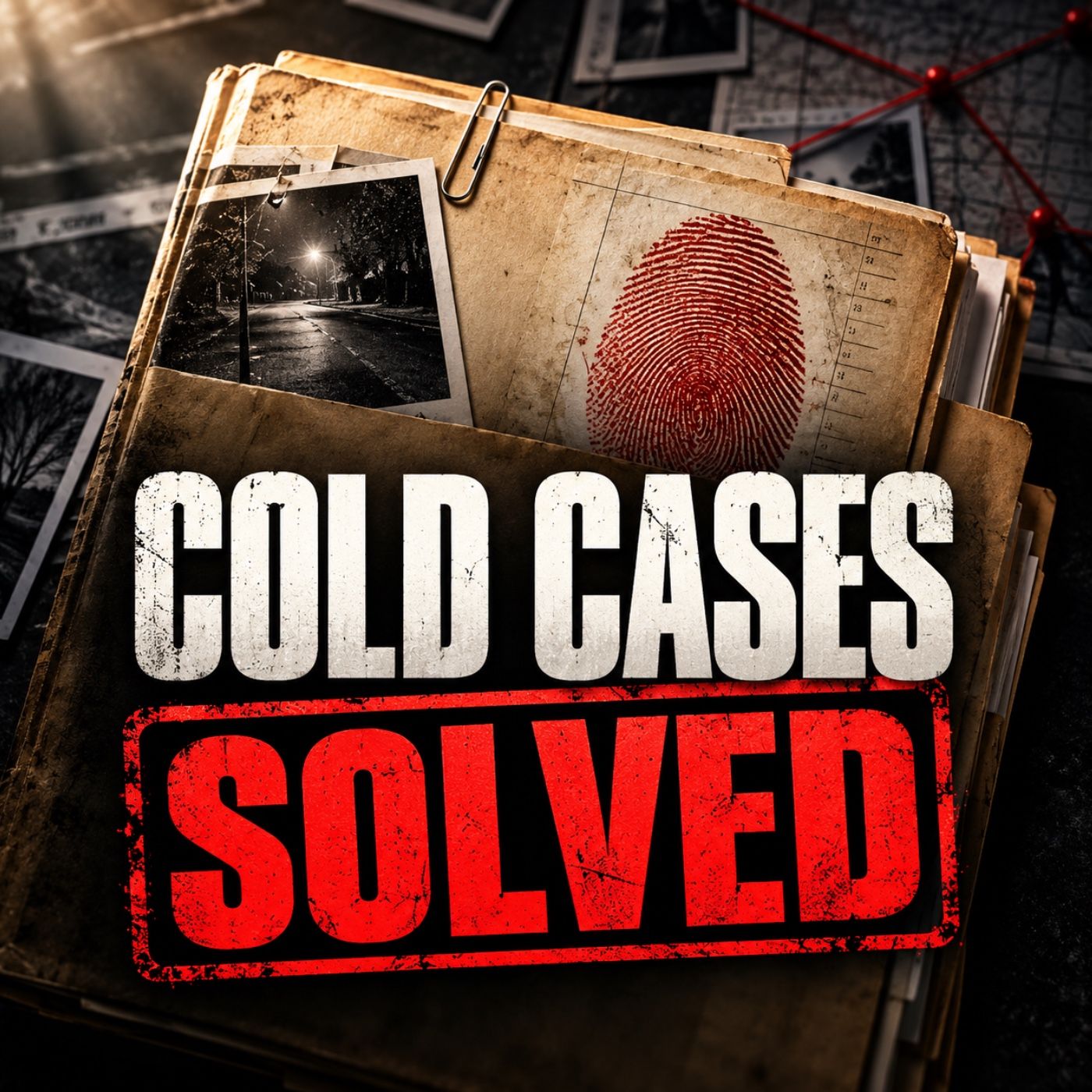
COLD CASES SOLVED
Circle Of Insight ProductionsAudio
- Format:
- Podcast
- New episodes:
- Several times a week
- Typical length:
- about 3 minutes
- Latest episode:
About this show
The publisher has not written a description.
Show details and episodes come from the publisher's public feed at spreaker.com. Last updated . Names, artwork and text belong to their publishers.
Cosmos
Similar by topic and creator
- CRAZY COP STORIES
Shares the topic True Crime and the creator Circle Of Insight Productions. - Covert Operations and National Security
Shares the creator Circle Of Insight Productions. - This Escalated Quickly
Shares the topic True Crime.
Similar shows





Explore more
Episodes
The Envelope That Broke a 40-Year-Old Murder Case: The Mary Ann Turner Investigation
· 2 min
In 1986, Mary Ann Turner was murdered in Spokane, Washington, leaving investigators with biological evidence but no identified killer. Nearly four decades later, forensic genetic genealogy narrowed the investigation to three brothers. Detectives then reportedly used an unusual strategy: sending a potential suspect a letter and recovering the envelope he returned. This episode examines how decades-old DNA evidence, modern genealogy, and a carefully planned investigative technique led to an arrest in October 2026.
Not rated yetThe Murder of Faith Hedgepeth: Fourteen Years to a Verdict
· 3 min
In September 2012, 19-year-old University of North Carolina student Faith Hedgepeth was found murdered in her off-campus apartment in Chapel Hill. For years, investigators pursued DNA evidence, examined a mysterious voicemail, and searched for the person responsible. In October 2026, the case reportedly reached a major turning point with a first-degree murder conviction. This episode examines the original investigation, the forensic breakthroughs, and the long road from an unsolved homicide to a courtroom verdict.
Not rated yetWho Killed Angie Buck? Thirty-One Years of Unanswered Questions
· 3 min
In August 1995, two hunters discovered Angela Buck’s body beside a rural Iowa creek. Investigators examined her final movements, potential witnesses, and a possible connection to drug-related suspicions, but the homicide remained unresolved for more than three decades. This episode reconstructs the original investigation, the allegations surrounding Buck’s final hours, and the questions that remained unanswered until two men were charged in October 2026.
Not rated yetThe Evidence Beneath the Water: Can Submerged Weapons Help Solve Cold Cases?
· 3 min
Rivers, lakes, and oceans have long served as hiding places for discarded murder weapons. But recovering a firearm months or years later does not necessarily mean every forensic opportunity has disappeared. This episode examines how fingerprint recovery, firearms examination, and other forensic methods may generate new investigative leads from submerged evidence, while exploring the challenges of interpreting evidence that has spent extended periods underwater.
Not rated yetNo Body, No Confession: The Christopher Jarvis Murder and the Former Police Officer
· 3 min
In 2006, Christopher Jarvis disappeared near Warrnambool, Victoria, Australia, leaving behind a mystery that would remain unresolved for nearly two decades. Investigators eventually focused on his landlord, former police officer Steven Frederick Johnson, whose financial dispute with Jarvis became central to the prosecution’s case. Despite the absence of a body, a murder weapon, or a confession, an Australian jury found Johnson guilty in October 2026. This episode examines how investigators reconstructed a murder without recovering the victim’s remains and how circumstantial evidence can establish guilt beyond a reasonable doubt.
Not rated yetThe Crimes Before the Murders: The Evidence Investigators Missed
· 3 min
A serial offender is identified decades after the original crimes. Investigators then revisit old burglary reports, suspicious encounters, and sexual assaults that were never connected. This episode explores how cold-case detectives reconstruct criminal histories, identify links between investigations, and use modern forensic methods to resolve longstanding cases.
Not rated yetFive Victims, One Survivor, No Arrest: Why the Lane Bryant Murders Remain Unsolved
· 3 min
A suburban clothing store became the scene of a devastating multiple homicide in February 2008. Investigators had a surviving eyewitness, physical evidence, and thousands of leads, yet the gunman remained unidentified. What makes some investigations extraordinarily difficult even when police possess seemingly valuable evidence? This episode examines the investigative obstacles surrounding the Lane Bryant murders, the challenges of evaluating competing leads, and the forensic developments that might eventually help resolve a case that has remained open for nearly two decades.
Not rated yetWhy Innocent People Confess: The Psychology Behind the Austin Yogurt Shop Investigation
· 4 min
Confessions are among the most persuasive forms of evidence in criminal investigations, yet psychological research has demonstrated that people sometimes admit to crimes they did not commit. The Austin Yogurt Shop Murders became a prominent example of the controversy surrounding interrogation methods and disputed confessions. This episode examines psychological pressure, suggestibility, compliance, memory distrust, and the conditions under which unreliable confessions can emerge. We explore why investigators, jurors, and even defendants themselves may struggle to distinguish an authentic admission from one produced through psychological pressure.
Not rated yetThe Boston Strangler DNA Breakthrough: A Murder Mystery Revisited After 50 Years
· 3 min
For decades, uncertainty surrounded the identity of the Boston Strangler and the murders attributed to him. In 2013, DNA evidence linked Albert DeSalvo to the 1964 murder of Mary Brown, also known as Beverly Brown, correcting a common confusion in case accounts. This episode examines the forensic breakthrough, its significance, and why one confirmed DNA link does not establish responsibility for every murder attributed to the Boston Strangler.
Not rated yetThe Murder of Edric Hinton: Unearthing the Truth Behind a Lansing Cold Case
· 3 min
On a summer night in 2009, nineteen-year-old Edric Hinton was senselessly gunned down outside a Lansing apartment complex in a tragedy that haunted his family and community for seventeen years. With the perpetrators unidentified and the murder weapon nowhere to be found, local investigators refused to let the case go cold, pursuing fragmented leads across nearly two decades. A critical breakthrough finally emerged when a confidential informant directed detectives to a shotgun buried underground, providing the physical link that forensic scientists matched directly to the fatal crime scene. This investigative triumph—supported by multi-agency forensic support, federal firearms tracking protocols, and dedicated cold-case detectives—finally unmasked Esteban Reyes Jr. and Lee Anthony Lynn, delivering long-sought answers even beyond the grave.
Not rated yetThe Murder of April Tinsley: The Taunting Trail and the DNA That Broke a 30-Year Mystery
· 2 min
When eight-year-old April Tinsley vanished from a Fort Wayne neighborhood in 1988, a community was plunged into a decades-long nightmare marked by sinister, handwritten threats. For thirty years, local detectives and federal profilers pursued a phantom who taunted investigators while leaving behind vital biological clues. The deadlock finally shattered in 2018 when advanced investigative genetic genealogy traced the killer’s DNA through public family trees straight to a quiet mobile home. This case highlights how pioneering forensic science and relentless interagency persistence unmasked John D. Miller, permanently transforming the pursuit of cold cases.
Not rated yetThe Woman Who Vanished After Appearing on The People’s Court
· 3 min
In November 2011, 33-year-old Florida mother Michelle Parker disappeared on the same day an episode of The People’s Court aired featuring a dispute with her former fiancé, Dale Smith Jr. For nearly 15 years, investigators searched for answers, but Michelle’s body was never recovered. In October 2026, Orlando police arrested Smith and charged him with second-degree murder following a renewed investigation that included a review of digital evidence. This episode examines the disappearance, the unusual television connection, and how investigators can build a homicide case even when the victim’s remains have never been found.
Not rated yetThe Cigarette Butts That Solved a 64-Year-Old Double Murder
· 3 min
In 1962, Charles Hale and Lester McCollum were murdered near Battle Ground, Washington, leaving investigators with a mystery that would remain unresolved for more than six decades. Despite the passage of time, two seemingly insignificant pieces of evidence, cigarette butts and twine, would eventually help investigators identify two suspects. In October 2026, the Clark County Sheriff’s Office announced that modern DNA analysis pointed to Barton Stebbins and Walter Stain, both teenagers at the time of the murders. This episode examines how forensic technology brought new answers to a 64-year-old double homicide and why the suspects will never face trial.
Not rated yetThe Detective Who Was the Killer: A 65-Year-Old Chicago Murder Mystery Finally Solved
· 3 min
In 1960, eight-year-old Gloria Kowalewicz was abducted and murdered in Chicago, leaving investigators with a mystery that would endure for more than six decades. In October 2026, police announced that modern forensic techniques had identified their suspect, a former Chicago homicide detective named Thomas McInerney. Preserved evidence, DNA analysis, and decades of investigative work helped expose a secret that remained hidden long after the suspect’s death. This episode explores how investigators reopened the case, the forensic breakthroughs that brought answers, and the disturbing questions raised when a murder suspect once wore a police badge.
Not rated yetThe Evidence Left Behind: Can Forensic Science Identify Mexico's Missing?
· 3 min
When remains are too badly damaged for visual identification — burned, skeletonized, or decomposed beyond recognition — the work of putting a name to them falls to forensic anthropology. This episode examines how specialists reconstruct identity from what little is left: estimating age, sex, and stature from bone structure, and extracting usable DNA from material that fire or time has severely compromised. We look at how dental records and forensic odontology provide another critical point of comparison when bones alone can’t tell the full story. Finally, we explore why matching unidentified remains to missing-person databases remains one of the most persistent challenges in forensic science, from incomplete records to the sheer scale of unsolved cases nationwide.
Not rated yetThe St. Valentine’s Day Massacre: The Case That Remains Open in History
· 3 min
n 1929, seven men were murdered in a Chicago garage, and suspicion fell on Al Capone’s organization. Forensic ballistics provided important investigative leads, but the perpetrators were never convicted. Explore what investigators established and why the historical case remains unresolved.
Not rated yetThe Crew Cut Killer: A 57-Year-Old Murder Mystery and the Girl Finally Identified
· 2 min
In 1969, a 16-year-old girl was murdered in California, leaving investigators with a mystery that would span more than half a century. Decades later, renewed investigative work helped identify Joanne Yvonne Burdick and brought attention to a suspect known as the Crew Cut Killer. This episode explores how old evidence, criminal profiling, and persistent detective work can revive a case long believed to be beyond resolution.
Not rated yetThe Boy in the Box: How Philadelphia Finally Gave a Name to Joseph Augustus Zarelli
· 2 min
For more than six decades, he was known only as the “Boy in the Box,” one of America’s most haunting unidentified murder victims. His battered body was discovered outside Philadelphia in 1957, but despite thousands of leads, investigators could not determine who he was. Generations of detectives worked the case, while advances in DNA technology slowly created possibilities that investigators in the 1950s could never have imagined. In 2022, forensic genetic genealogy finally gave the child something investigators had been searching for for 65 years: his name, Joseph Augustus Zarelli. But identifying Joseph solved only one mystery, because the question of who killed him remains unanswered.
Not rated yetThe DNA That Waited 39 Years: The Teresa Ann Houck Cold Case
· 2 min
In October 1986, 23-year-old Teresa Ann Houck left the Baltimore club where she worked and was never seen alive again. Hours later, she was found shot to death in Druid Hill Park, leaving investigators with evidence but no identified killer. Nearly four decades later, a routine DNA database search produced the match prosecutors say finally gave the cold case a name.
Not rated yetThe Murder Solved by a Family Tree: How Genetic Genealogy Changed Cold Cases
· 3 min
For decades, investigators could possess a killer’s DNA yet have no suspect to compare it against. Investigative genetic genealogy changed that equation by allowing investigators to search for relatives rather than only exact database matches. The identification of the Golden State Killer demonstrated how a decades-old biological clue could suddenly become the beginning of an investigation rather than the end.
Not rated yet