

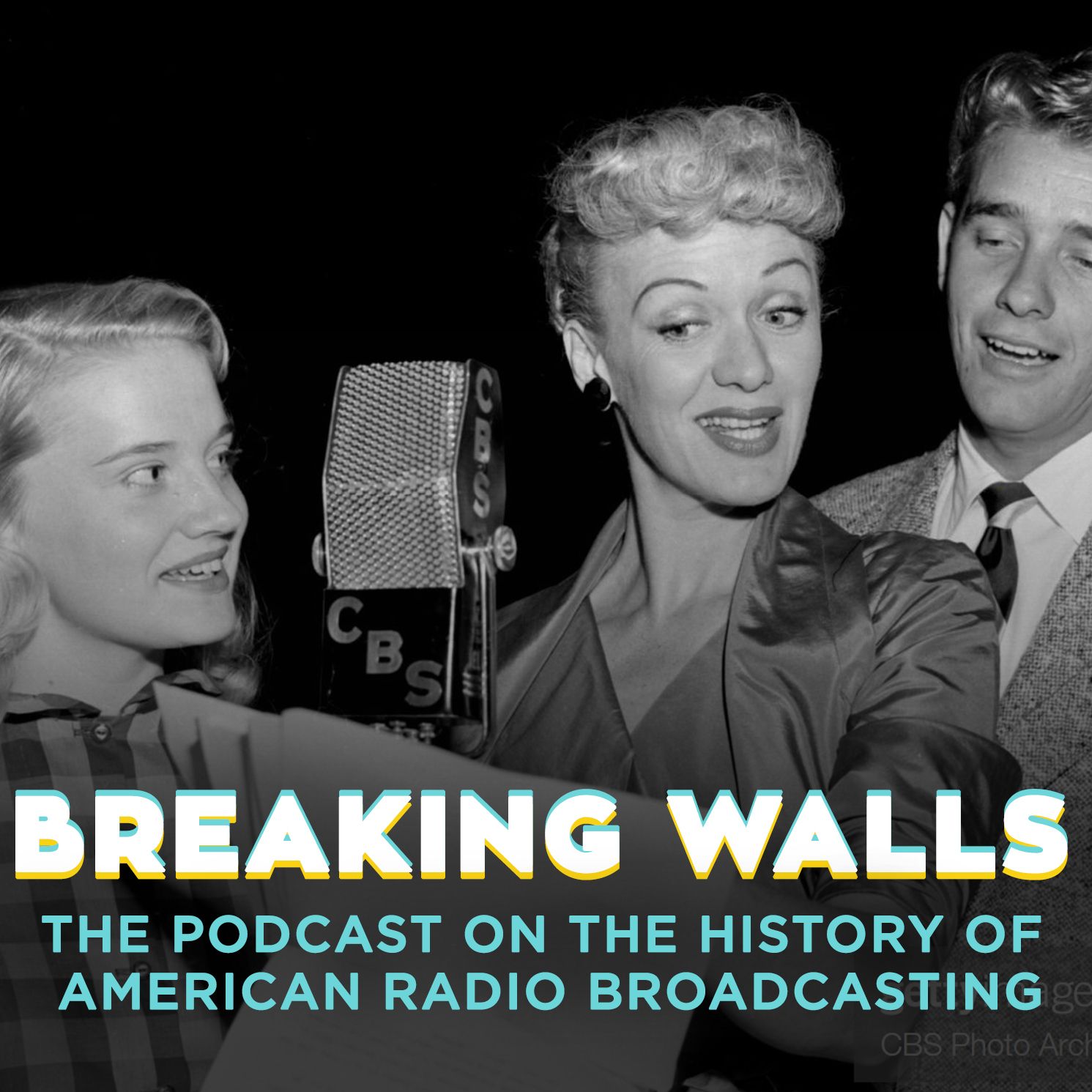
Breaking Walls
James ScullyAudio
- Format:
- Podcast
- New episodes:
- Every two weeks
- Typical length:
- about 3 hours
- Latest episode:
About this show
Breaking Walls: The Podcast on the History of American Network Radio Broadcasting.
Show details and episodes come from the publisher's public feed at feeds.soundcloud.com. Last updated . Names, artwork and text belong to their publishers.
Cosmos
Similar by topic and creator
- Cautionary Tales of History
Shares the topic History. - Hardcore Stories
Shares the topic History. - History: Hits and Stories
Shares the topic History.
Similar shows




Explore more
Episodes
BW - EP93: Radio And The New York City Subway (1941 - 1975) [Rewind]
· 3 hr 5 min
This episode was originally released on 7/1/2019. While new episodes of Breaking Walls are on hiatus I'll be going back and posting the older episodes. ____________ In Breaking Walls episode 93 we ride the rails with some of the most famous stars in radio history. During radio’s golden age, there were three main production hubs: New York, Chicago, and Los Angeles. With so much daily content to produce, radio’s greatest minds developed programs and episodes centered around every recognizable theme, like the New York city subway. While this episode will take place in or around New York’s public transportation system, we’ll focus just as much on the relationships forged by radio’s legends on both coasts. Highlights: • Mercedes McCambridge, Himan Brown, and Grand Central Station • How Bill Spier influenced the careers of his wife June Havoc and his protégé Elliott Lewis • From Suspense to Broadway is My Beat, Elliott Lewis shines • Jack Benny stars on Suspense • Cathy Lewis: Mrs Radio • Mandel Kramer, Jan Miner, and Subway Soaps from New York • Byron Kane and Subways Are For Sleeping • William N. Robson, Shirley Mitchell, Virginia Gregg and Jack Kruschen on radio in the 1950s • Bob and Ray head down into the Subway • Himan Brown brings dramatic radio back to life in the 1970s • Next Stop: The Soda Shop The WallBreakers: thewallbreakers.com Subscribe to Breaking Walls everywhere you get your podcasts. To support the show: patreon.com/TheWallBreakers The reading material used in today’s episode was: • On The Air - By John Dunning • The CBS Radio Mystery Theater Handbook - by Gordon Payton & Martin Grams Jr. • Network Radio Ratings, 1932-53 - by Jim Ramsburg • The Museum of Broadcast Communications Encyclopedia of Radio - by Christopher H. Sterling as well as articles from: • Broadcasting Magazine - November 3rd, 1947 • And Billboard Magazine - May 1st, 1948 On the interview front: • Himan Brown, June Havoc, Mandel Kramer, Elliott Lewis, E.G. Marshall, Jan Miner, William Spier and William N. Robson were with Dick Bertel and Ed Corcoran for WTIC’s The Golden Age of Radio. These interview can be heard at GoldenAge-WTIC.org. • Ralph Bell, Himan Brown, Lawrence Dobkin, Betty Lou Gerson and Byron Kane, were with SPERDVAC. For more information, please go to S-P-E-R-D-V-A-C.com. • Himan Brown, Virginia Gregg, Elliott Lewis, Mercedees McCambridge, Shirley Mitchell and Alan Reed were interviewed by Chuck Schaden. Hear their full chats and many others from Chuck’s over thirty-nine year career and SpeakingofRadio.com. • Ellott Lewis was with John Dunning on May 23rd, 1982. • Jack Kruschen, Shirley Mitchell, and George Walsh were with Jim Bohannon on September 12, 1987. • And Morton Fine was with Dan Haefele on August 9th, 1988. Selected music featured in today’s episode was: • It’s been a Long, Long Time - by Keely Smith • Smoke Gets in Your Eyes - by the Mallet Men • The Big Heist and Salute to Charlie Christian - by Barney Kessel • Atlantis and Roller Coaster - by Les Baxter • I’ll Take Manhattan - by Blossom Dearie • And Fly Me To the Moon - by Julie London
Not rated yetThursday 7.17.2025 — A New Webinar: Orson Welles' Career, From Boy Wonder To Trouble Maker
· 1 min
Hey everyone, James Scully here, producer and host of Breaking Walls, the docu-podcast on the history of US Network Radio Broadcasting. I wanted to let you know about a new webinar I’m doing this Thursday July 17th, at 7PM on Orson Welles' early career of Orson Welles through the end of 1941. If you can't make it live this Thursday July 17th at 7PM, don't worry, I’ll be emailing every person who registers a video of the webinar once it's over. Here's a link to register: https://www.eventbrite.com/e/orson-welles-career-part-1-from-boy-wonder-to-trouble-maker-webinar-tickets-1445315741289?aff=oddtdtcreator Some more information: Throughout the last one-hundred years of American entertainment, few people have gotten as strong a reaction as Orson Welles. A rare quadruple threat: writer, director, actor, producer, Welles found immense success on stage, in films, on television, and in radio. In fact, he took center stage in the United States on more than one occasion… and not always to a positive reaction, but always with pushing the creative envelope in mind. Welles managed to alienate the newspaper industry, the Hollywood studio system, and occasionally even the broadcasting networks, but he rarely had a door closed in his face. Welles was known to work himself to the bone, and party even harder. He had romances with some of the most famous and attractive women in the country, including Virginia Nicholson, Dolores del Rio, and Rita Hayworth. He was hailed as a genius, a charlatan, a magician, an incredible friend, an a***hole, a hard-driver, a steady worker, and a man who drank too much. Welles liked to joke that he began his career on top and spent the rest of his life working his way down. Such a strong-willed, creative person deserves an in-depth look. In Part 1: From Boy Wonder To Trouble Maker (1931-1941) we’ll explore Welles’ early life, through his explosion of success in the 1930s all the way to the end of 1941, complete with audio clips and highlights including: • Beginnings in Illinois and China — How they helped shape Orson • The Todd Seminary School — His first exposure to theater and Radio • Connections and Early Breaks — How his mentor Roger Hill, Thornton Wilder, Alexander Woollcott, and Katharine Cornell helped Orson get to Broadway • Orson meets John Houseman and Archibald MacLeish, and first appears on the March of Time • 1935-1937 — From the March of Time to the Columbia Workshop, and how Irvin Reis taught Orson how to create for radio • How the US Government shaped the opportunity for Orson to write, direct, and star in Les Misérables on the Mutual Broadcasting System in 1937 • The Shadow Knows! — Agnes Moorehead and Orson Welles’ one season on The Shadow • The birth of the Mercury Theater on the Air as First Person singular. How its success led to the most infamous night in radio in October of 1938 • Mainstream success with Campbell’s Soups • Orson goes to Hollywood, and signs the greatest autonomous film contract in history at 24 • Citizen Kane — How William Randolph Hearst and RKO shaped the film • Lady Esther Presents — Orson comes back to radio in the autumn of 1941 • Pearl Harbor Day and collaborating with Norman Corwin • How Joseph Cotton introduced Orson to Rita Hayworth Afterward, I’ll do a Q&A — any and all questions are welcomed and encouraged! Can't attend live? Not to worry! I'll be recording the event and sending the video out to all guests who register so you can watch it later. See you (virtually) there!
Not rated yetBW - EP92: Radio And Coney Island (1906 - 1960) [Rewind]
· 2 hr 25 min
This episode was originally released on 6/1/2019. While new episodes of Breaking Walls are on hiatus I'll be going back and posting the older episodes. ____________ In Breaking Walls episode 92 we open the summer season with a trip to Coney Island, Brooklyn. The New York city summer locale was frequented in radio programs and by radio performers. It was also, in the days of wireless telegraphy, an important station location for Guglielmo Marconi. Highlights: • Marconi’s last link • André Baruch Gets His Radio Start at Coney Island • Allen’s Alley Opens the Summer • Connee Boswell Sings • The Crime Club Uncovers a Coney Island Murder • Irma and Jane Go To the Beach • Broadway Is My Beat • Vincent Price in Coney Island • Jean Shepherd Stops By • We Take the Subway Home The WallBreakers: thewallbreakers.com Subscribe to Breaking Walls everywhere you get your podcasts. To support the show: patreon.com/TheWallBreakers The reading material used in today’s episode was: On The Air: The Encyclopedia of Old-Time Radio - by John Dunning Network Radio Ratings, 1932-53 - by Jim Ramsburg As well three tremendous internet resources: Charles Denson's History Project at ConeyIslandHistory.org David Sullivan’s Heart of ConeyIsland.com Jeff Stanton’s research at Westland.net/ConeyIsland On the interview front: • André Baruch, Larry Dobkin, Lou Krugman, and Herb Vigran, were with SPERDVAC. For more information, please go to SPERDVAC.com • Hans Conried, June Havoc, Vincent Price, and William N. Robson were with Dick Bertel and Ed Corcoran for WTIC’s The Golden Age of Radio. These interview can be heard at GoldenAge-WTIC.org. • Elliott Lewis and E. Jack Neuman were with John Dunning for his 1980s 71KNUS program from Denver. • Vincent Price and Allen Reed spoke to Chuck Schaden. Hear their full chats at SpeakingofRadio.com. • Fred Allen was a guest of Tex and Jinx on November 24th, 1954. • Connee Boswell was interviewed by Lee Phillip in 1963. • And Morton Fine was with Dan Haefele on August 9th, 1988. Selected music featured in today’s episode was: • Under the Boardwalk - by the Drifters • And Shine on Harvest Moon - by Joan Morris & William Bolcom
Not rated yetBW - EP91: The Hollywood Radio Western Renaissance (1954 - 1980) [Rewind]
· 3 hr 6 min
This episode was originally released on 5/1/2019. While new episodes of Breaking Walls are on hiatus I'll be going back and posting the older episodes. ____________ In Breaking Walls episode 91, we finish the adult western trilogy with a focus on the period after television decimated radio’s listening audience, forever altering the broadcasting landscape. Dramatic radio’s time as America’s number one entertainment genre was over, but it was far from dead. Our story won’t conclude on that fabled date of September 30th, 1962 when radio drama supposedly ended forever. We’ll push down the trail through the 1960s, 70s, and 80s as dramatic radio continued to avoid the hangman’s noose. Highlights: • Dirty Saturdays • Gunsmoke Finds Sponsorship. • Gunsmoke’s TV launch • NBC and Dr. Sixgun • Norman Macdonnell and CBS bring a new Western to the Air • J.B. Kendall, Luke Slaughter, & Paladin • The End of Gunsmoke • Horizon’s West and One Last Gasp • Elliott Lewis—Young At Heart • Riding off Into the Sunset The WallBreakers: thewallbreakers.com Subscribe to Breaking Walls everywhere you get your podcasts. To support the show: patreon.com/TheWallBreakers The reading material used in today’s episode was: • On The Air: The Encyclopedia of Old-Time Radio - by John Dunning • Radio Rides The Range: A Reference Guide to Western Drama on the Air, 1929 - 1967 by Jack French and David S. Siegel • Network Radio Ratings, 1932-1953 - by Jim Ramsburg • As well as numerous passages from Broadcast Magazine On the Interview Front: • Lilian Buyeff, John Dehner, Lawrence Dobkin, Herb Ellis, Virginia Gregg, Elliott Lewis, Vic Perrin, and Herb Vigran, were with SPERDVAC, the Society to Preserve and Encourage Radio Drama, Variety, and Comedy. For more information, please go to SPERDVAC.com • Parley Baer, William Conrad, John Dehner, Rex Koury, and Norman Macdonnell were with John Hickman. Mr. Hickman was the longtime host of WAMU’s Recollections. Today, this program is heard each Sunday evening as The Big Broadcast. For more information, please go to WAMU.org • William N Robson was with Dick Bertel and Ed Corcoran for WTIC’s The Golden Age of Radio. This interview can be heard at GoldenAge-WTIC.org. • Parley Baer was with Chuck Schaden. Hear their full chat at SpeakingofRadio.com. •John Dehner was also heard with Neil Ross for KMPC on March 23rd, 1982. While Elliott Lewis was with John Dunning for his 1980s 71KNUS program from Denver. And Raymond Burr was with Jack Webster in 1963. Selected Music Featured in Today’s Episode Was: • The Theme to A Summer Place - by Percy Faith • Mr. Sandman - by The Chordettes • Young At Heart - by Frank Sinatra • And Come Down My Evening Star - by Joan Morris & William Bolcom
Not rated yetBW - EP90: The Hollywood People Behind Radio’s Baby Boomer Boom (1945 - 1954) [Rewind]
· 3 hr 54 min
This episode was originally released on 4/1/2019. While new episodes of Breaking Walls are on hiatus I'll be going back and posting the older episodes. ____________ In Breaking Walls episode 90 and on the second part of our western trilogy, dramatic radio goes from boom to bust in a nine year period after World War II, as a group of actors become radio legends, while the radio western grows up. Highlights: • William S. Paley’s Plan to Overtake NBC • The West-Coast Hollywood Actors • Robson, Yarborough, Lewis, and Hawk Larabee • Escape Moves the Western Forward • The Life and Death of Jeff Chandler • CBS Becomes Number 1 • NBC Fires Back with New Western Shows • Elliott Lewis, Suspense, On Stage, and Crime Classics • The Birth of Gunsmoke • Jack Johnstone, Jimmy Stewart, and The Six Shooter • The Networks Pull the Plug in 1954 • What’s Next The WallBreakers: http://thewallbreakers.com Subscribe to Breaking Walls everywhere you get your podcasts. To support the show: http://patreon.com/TheWallBreakers The reading material used in today’s episode was: • On The Air: The Encyclopedia of Old-Time Radio - by John Dunning • Radio Rides The Range: A Reference Guide to Western Drama on the Air, 1929 - 1967 by Jack French and David S. Siegel • Network Radio Ratings, 1932-1953 - by Jim Ramsburg As well as passages from • Broadcast Magazine — 12/22/1947, 2/16/1948, 3/1/1948 • Sponsor Magazine — 10/1/1951 On the Interview Front: • Parley Baer, Harry Bartell, Lillian Buyeff, Mary Jane Croft, John Dehner, Lawrence Dobkin, Sam Edwards, Herb Ellis, Virginia Gregg, Jack Johnstone, Byron Kane, Elliott Lewis, Jeanette Nolan, and Herb Vigran were with SPERDVAC, the Society to Preserve and Encourage Radio Drama, Variety, and Comedy. For more information, please go to SPERDVAC.com • Hans Conried, Howard Duff, and Elliott Lewis with Dick Bertel and Ed Corcoran for WTIC’s The Golden Age of Radio. The full interviews can be heard at GoldenAge-WTIC.org • Jack Benny, Hans Conried, Betty Lou Gerson, Elliott Lewis, and Lurene Tuttle were with Chuck Schaden. Chuck’s interviews from an over 39-year career can be listened to for free at SpeakingofRadio.com • Eve Arden, Elliott Lewis, and E. Jack Neuman were with John Dunning for his 1980s 71KNUS Radio program from Denver. Some of his interviews can be found at OTRRLibrary.org • William Conrad, John Dehner, Rex Koury, Norman Macdonnell, John Meston, William N. Robson, and George Walsh were John Hickman of WAMU for his Gunsmoke documentary. • Mr. Hickman was the longtime host of “Recollections.” A modern version of this program is heard each Sunday evening as “The Big Broadcast.” For more information, please go to WAMU.org • William Conrad was also with collector Chris Lambesis for a December 15th, 1969 interview • Jimmy Stewart was with Larry King in 1986 • And William S. Paley and Frank Stanton were interviewed for CBS’s 50th Anniversary program in 1977. Selected Music Featured in Today’s Episode Was: • I’ve Got the World on a String - by Frank Sinatra • Pyramid of the Sun & Voodoo Dreams - by Les Baxter • I’ll Be Seeing You - by The Harry James Orchestra • Route 66 - by Nat King Cole
Not rated yetMonday 6.30.2025 — A New Webinar: The CBS Talent Raids, Part 2 — The Early TV Era
· 2 min
Hey everyone, James Scully here, producer and host of Breaking Walls, the docu-podcast on the history of US Network Radio Broadcasting. I wanted to let you know about a new webinar I’m doing on Monday June 30th, 2025 at 7PM. It’s Part 2 of the CBS Talent Raids on the early Television era. This webinar focuses on the rise of TV throughout the 1940s and early 1950s as the CBS Talent Raids took hold. If you missed Part 1, don’t worry, when you register for Part 2 I’ll email you a video of the webinar for Part 1. And if you’re interested in this Part 2 webinar and can’t make it live on Monday, June 30th at 7PM, don’t worry I’ll be emailing every person who registers a video of Part 2’s webinar as soon as it’s done. Here's a link to register — https://www.eventbrite.com/e/the-cbs-talent-raids-part-2-the-early-television-era-webinar-tickets-1419361692029?aff=oddtdtcreator Here's an overview of the webinar below: When David Sarnoff officially launched network television at the 1939 World's Fair in New York City, he intended to have TV sets in everyone's homes by the early 1940s. World War II interrupted his plans. Meanwhile network radio soared in popularity throughout the 1940s. By the fall of 1948, three of the four major radio networks — ABC, CBS, and NBC — were funneling their soaring radio profits into the burgeoning television side of their businesses. And because all individual U.S. citizens were taxed 77% on all income over $70k (roughly $907k today), big stars of the day like Jack Benny, Bing Crosby, and Freeman Gosden had the idea to incorporate their popular shows as businesses in order to qualify for significant breaks under capital gains tax laws. What happened when David Sarnoff and RCA, the parent company of NBC, the nation's #1 network at the time, refused to make this deal with its stars? It's time to uncover how a smart bet by CBS helped it overtake its main rival during the golden age of radio and exactly how this affected the early years of television. Join James Scully — Radio historian and producer/host of Breaking Walls, the docu-podcast on the history of U.S. network radio broadcasting for the second part of this two-part series that explores the events surrounding the CBS Talent Raids of 1948, and the many men and women who benefited from this monumental period in entertainment. In Part Two: Early Network Television, we'll focus on the rise of TV throughout the 1940s and early 1950s as the CBS Talent Raids took hold, including: • From Farnsworth to the 1939 World’s Fair — Early TV History and How World War II slowed TV’s oncoming growth • How NBC, CBS, and ABC Launched into TV while siphoning radio profits into their TV networks • The Dumont Network and Pro Rasslin’ — Could the network have lasted longer? • Berle, Godfrey, Sullivan and The TV ratings landscape as we enter the 1950 • I Love Lucy Launches, forever altering Television viewing • How Television’s explosive growth in the early 1950s changed America’s way of life • TV’s profits are radio’s losses Afterward, I’ll do a Q&A — any and all questions are welcomed and encouraged!Can't attend live? Not to worry! I'll be recording the event and sending the video out to all guests who register so you can watch it later. See you (virtually) there!
Not rated yetBW - EP89: The Birth of The Adult Radio Western (1929 - 1945) [Rewind]
· 2 hr 20 min
This episode was originally released on 3/1/2019. While new episodes of Breaking Walls are on hiatus I'll be going back and posting the older episodes. ____________ In Breaking Walls episode 89, we explore the birth of the dramatic radio western show, specifically targeted to adult audiences. This is the first of a three-part mini-series on adult western radio shows. Highlights: • Back to the Very Beginning • What is a Western Show? • The Birth of Western Dramatic Radio Shows • Empire Builders • Death Valley Days • The Western show on local stations • ...And in syndication • Lux Presents Hollywood • The Triumph and Tragedy of Buck Jones • Americana and the Cavalcade of America • Howard McNear and Romance of the Ranchos • The First Western Soap Opera • The War Ends and the Western show grows up • What’s Next? The WallBreakers: http://thewallbreakers.com Subscribe to Breaking Walls everywhere you get your podcasts. To support the show: http://patreon.com/TheWallBreakers The reading material used in today’s episode was: • On The Air: The Encyclopedia of Old-Time Radio - by John Dunning • Radio Rides The Range: A Reference Guide to Western Drama on the Air, 1929 - 1967 by Jack French and David S. Siegel • Network Radio Ratings, 1932-1953 - by Jim Ramsburg • Hello Everybody! The Dawn of American Radio by Anthony Rudel & • The Network by Scott Woolley On the interview front: • Don Ameche, Joan Fontaine, Hans Conried, Rudy Vallée were with Dick Bertel and Ed Corcoran for WTIC’s The Golden Age of Radio. The full interviews can be heard at GoldenAge-WTIC.org • Agnes Moorehead and Anne Seymour were with Chuck Schaden. Chuck’s interviews from an over 39-year career can be listened to for free at SpeakingofRadio.com • John Dunkel and William N. Robson were with John Hickman for his WAMU program “Recollections.” A modern version of this program is heard each Sunday evening as “The Big Broadcast.” For more information, please go to WAMU.org • Ruth Woodman was with Ida Blackburn in 1961 for KOCO. The full video clip can be seen on the Oklahoma Historical Society's Youtube page - https://www.youtube.com/channel/UCOnsye8K4SEsY9Ssi8EzzHg • and journalist Robert Bendiner was with Westinghouse for their 1970 50th Anniversary program. Selected music featured in today’s episode was: • The Colorado Trail Opus 28 by Elizabeth Hainen - http://www.elizabethhainen.com • The Last Rose of Summer by Tom Waits • Morning Prayer by Kenneth Little Hawk • All Mortal Flesh Be Silent by Deirdre Fay • Across the Wide Missouri, by Mathias Gohl, Molly Mason, Jay Unger, and Andy Stein • Jefferson and Liberty by John Owen Lardinois • Amazing Grace by Leta Rector • Across the Alley from the Alamo by the Mills Brothers I’d also like to thank Walden Hughes and John and Larry Gassman. Listen to their shows on the Yesterday USA radio network. WallBreakers Links: Patreon - patreon.com/thewallbreakers Social Media - @TheWallBreakers URL - thewallbreakers.com Online Store - jamesthewallbreaker.com/shop/
Not rated yetBW - EP88: I Can't Stand Jack Benny—The Story Behind His 1945-46 Season [Rewind]
· 3 hr 17 min
This episode was originally released on 2/1/2019. While new episodes of Breaking Walls are on hiatus I'll be going back and posting the older episodes. ____________ In Breaking Walls episode 88, we spotlight the 1945-46 season of The Jack Benny Program. This season introduced characters like telephone operators Gertrude and Mabel, press agent Steve Bradley, hot dog vendor Mr. Kitzel, and Ronald and Benita Colman. This season featured guest appearances from Ingrid Bergman, Isaac Stern, Van Johnson, Ray Milland, Peter Lorre, Louella Parsons, Fred Allen, Ed Sullivan and others. It also was the season in which Dennis Day returned from the Navy and one of the most ingenious marketing campaigns in entertainment history took place: The “I Can’t Stand Jack Benny” Contest. Highlights: • Jack’s slipping ratings • Problems with General Foods • Jack changes sponsors • The War ends and a new season begins • Mabel Flapsaddle & Gertrude Gearshift • Steve Bradley and his big ideas • $10,000 and $646,000 • Jack gets robbed • The Contest • Mail pours in • The Colmans can’t stand Jack Benny • Jack’s ratings soar • Christmas of 1945 & The Rose Bowl • Fred Allen and the end of the Contest • Isaac Stern • Palm Springs • Van Jackson • Ed Sullivan and the end of the season • King for a Day The WallBreakers: http://thewallbreakers.com Subscribe to Breaking Walls everywhere you get your podcasts. To support the show: http://patreon.com/TheWallBreakers The reading material used in today’s episode was: • Sunday Nights at Seven - by Jack and Joan Benny • On The Air: The Encyclopedia of Old-Time Radio - by John Dunning • Network Radio Ratings, 1932-1953 - by Jim Ramsburg • As well as articles from Radio Life on January 27th and February 3rd, 1946 On the interview front: •Jack Benny, Ezra Stone, Kate Smith, Don Wilson, Eliott Lewis, Phil Harris, Frank Nelson and Dennis Day were with Chuck Schaden. Chuck’s interviews from an over 39-year career can be listened to for free at SpeakingofRadio.com • Vincent Price and Mel Blanc were with Dick Bertel and Ed Corcoran for WTIC’s The Golden Age of Radio. The full interviews can be heard at GoldenAge-WTIC.org • Dennis Day was also with John Dunning for his 1980s 71KNUS Radio program from Denver. Some of his interviews can be found at OTRRLibrary.org • And Finally Jack Benny, Dennis Day, Phil Harris, Frank Nelson, Don Wilson and Mel Blanc were also with Jack Carney for his early 1980s Comedy Program. Much of this audio was originally taken from a 1972 PBS Documentary on Great Radio Comedians. Thank you Goodmond Danielson for supplying me with the audio. Selected music featured in today’s episode was: • Love in Bloom by Bing Crosby • It’s Been a Long, Long, Time by the Harry James Orchestra • Chickery Chick by Sammy Kaye with Billy Williams & Nancy Norman • Manhattan Serenade by the Tommy Dorsey Orchestra with Jo Stafford • It Might as Well Be Spring by Larry Stephens • Danny Boy by Dennis Day • Along the Navajo Trail by Bing Crosby and the Andrews Sisters WallBreakers Links: Patreon - patreon.com/thewallbreakers Social Media - @TheWallBreakers URL - thewallbreakers.com Online Store - jamesthewallbreaker.com/shop/
Not rated yetBW - EP87: New Year's Day On the Air (1946 - 1956) [Rewind]
· 1 hr 52 min
This episode was originally released on 1/1/2019. While new episodes of Breaking Walls are on hiatus I'll be going back and posting the older episodes. ____________ In Breaking Walls episode 87, we spotlight some New Year’s Day radio programming from the Golden Age of radio, specifically beginning in 1946 after the end of World War II and television's post-war rise. Highlights: • Skelton • Casey Crime Photographer and the Invasion of TV • Radio City Playhouse and Our Miss Brooks • The Railroad Hour and NBC’s Monday Night of Music • Memories from the 1939-40 World’s Fair • On Stage with Mr. and Mrs. Radio • The Greatest Western • Radio Drama’s Demise The WallBreakers: thewallbreakers.com Subscribe to Breaking Walls everywhere you get your podcasts. To support the show: patreon.com/TheWallBreakers The reading material used in today’s episode was: • On The Air: The Encyclopedia of Old-Time Radio - by John Dunning • Network Radio Ratings, 1932-1953 - by Jim Ramsburg • And Edison Research’s June 2018 Podcast Consumer Statistics www.podcastinsights.com/podcast-statistics/ On the interview front: • John Gibson, Tony Marvin and Jan Miner were with Dick Bertel and Ed Corcoran for WTIC’s The Golden Age of Radio. The full interviews can be heard at GoldenAge-WTIC.org • Jack Benny, Harriet Nelson, Elliott Lewis, Eve Arden, and Parley Baer were with Chuck Schaden. His interviews from an over 39-year career can be listened to at SpeakingofRadio.com • Elliott Lewis, E. Jack Neuman, and Eve Arden were with John Dunning for his 1980s 71K Newstalk Radio program from Denver. Some of his interviews can be found at OTRRLibrary.org • Al Lewis was with SPERDVAC’s Larry Gassman in 1998. For more information, please go to SPERDVAC.com • And Norman Macdonnell, Bill Conrad, and WIlliam N. Robson were interviewed for a 5-part audio documentary on Gunsmoke in the early 1970s. Selected music featured in today’s episode was: • Voodoo Dreams, and Pyramid of the Sun by Les Baxter • Exotique Bossa Nova by Martin Denny • I’ll Be Seeing You, by Harry James • Auld Lang Syne by the Manhattan Strings • And Catch a Falling Star by Perry Como
Not rated yetMonday 6.16.2025 — A New Webinar: The CBS Talent Raids, Part 1 — The Post-War Radio Era
· 1 min
Hey everyone, James Scully here. I've got a new webinar on Monday June 16th at 7PM that I'm very excited about on the story behind the CBS Talent Raids of the late 1940s and how it altered the radio landscape just as the TV era began. Here's a link for tickets and more info and if you can't make it live, don't worry I'll be emailing everyone who registers a video of it once it's over — https://www.eventbrite.com/e/the-cbs-talent-raids-part-1-the-post-war-radio-era-webinar-tickets-1389789390479?aff=oddtdtcreator Here's an overview of the webinar below: In the fall of 1948, three of the four major radio networks — ABC, CBS, and NBC — were funneling their soaring radio profits into the burgeoning television side of their businesses. And because all individual U.S. citizens were taxed 77% on all income over $70k (roughly $907k today), big stars of the day like Jack Benny, Bing Crosby, and Freeman Gosden had the idea to incorporate their popular shows as businesses in order to qualify for significant breaks under capital gains tax laws. What happened when the parent company of NBC, the nation's #1 network at the time, refused to make this deal? It's time to uncover how a smart bet by CBS helped it overtake its main rival during the golden age of radio and early television. Join James Scully — Radio historian and producer/host of Breaking Walls, the docu-podcast on the history of U.S. network radio broadcasting for a two-part series that explores the events surrounding the CBS Talent Raids of 1948, and the many men and women who benefited from this monumental period in entertainment. In Part One: Post-War Radio Era, we'll focus on how a tax code and the country's top comedian helped shift Network superiority from NBC to CBS right as the TV era began, including: • An overview of the radio and TV networks in the late 1940s, from how the radio industry grew from wireless telegraphy in the 1910s to one of the largest businesses in the United States • A look at the biggest stars of the day and their programs like Jack Benny, George Burns, Gracie Allen, Eve Arden, and Lucille Ball • Some of the big news stories of that era, including why the United States experienced so much labor turmoil as the baby boomer era began following the end of World War II • A play-by-play of the CBS Talent Raid, including why CBS head William S. Paley happily agreed to these capital gains deals when NBC's David Sarnoff was vehemently opposed; and which yet unknown stars benefited the most • How and why this deal changed the balance of power in the entertainment industry leading into the Television era Afterward, I’ll do a Q&A — any and all questions are welcomed and encouraged! Can't attend live? Not to worry! I'll be recording the event and sending the video out to all guests who register so you can watch it later. See you (virtually) there! Part 2 on the early Television era will be presented at a later date.
Not rated yet