

BRAINLAND
Ken BarrettAudio
- Format:
- Podcast
- New episodes:
- Weekly
- Typical length:
- about 50 minutes
- Latest episode:
About this show
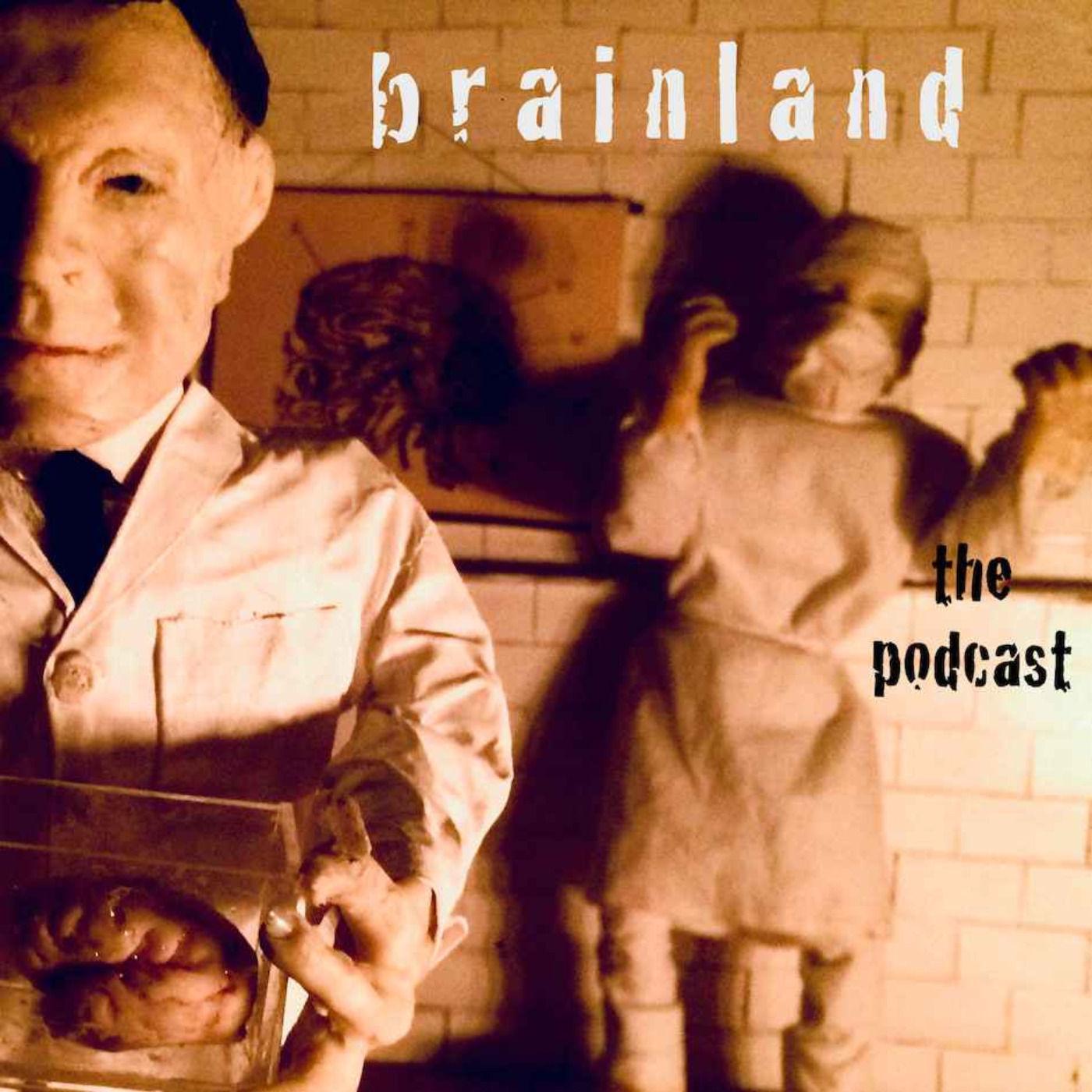
Brainland the podcast navigates the boundary between neuroscience, the arts and humanities with the occasional wander off piste. It began as a neuro-historical exploration of the background to the Brainland the opera but quickly spread its wings. A Brainland Collective production. Hosted on Acast. See acast.com/privacy (https://acast.com/privacy) for more information.
Covers: neuroscience, cognitive science, psychology history, neuroaesthetics, autism, cybernetics, Greek tragedy, chess, folk music, language
Show details and episodes come from the publisher's public feed at feeds.acast.com. Last updated . Names, artwork and text belong to their publishers.
Recently on this show
Summary of recent episodes, drawn from the publisher's feed.
Brainland is a podcast on neuroscience, the arts and humanities, with occasional detours. It began as background to an opera about the brain. Recent episodes cover folk music, Manchester property entrepreneurship, Michel de Montaigne, cybernetics, and Neuromancer.
Cosmos
Similar in subject
- Giants Shoulder
Both cover: cognitive science, neuroscience - Stanford Psychology Podcast
Both cover: cognitive science, neuroscience
Similar shows



Explore more
Episodes
DANTE, DOPAMINE AND ME: Neuro-poetic and other explorations into language.
· 49 min
In this podcast Kimberly Campanello, a poet, novelist and academic, talks frankly about her early onset Parkinson's disease and how this lead her to pursue her Italian roots in Puglia. On a visit there, to her great grandmother's village, she literally discovered Dante's 'Comedia', which she is currently 'reversioning' - a method that involves processing the original Italian, a range of translations and commentaries, plus her life experience, coloured by her condition. She discussed making creative use of the effects of Parkinson's and the beneficial effects of her writing on her motor function, similar to the benefits of walking on irregular surfaces. We discuss the recent remarkable finding that, not only does PD influence movement, but also use of language, and especially verbs (see the link to the paper below). Along the way Kimberly reads one of her poems based on a canto from Dante and extracts from her published and recently finished novel. We end with a reading from her current poetry collection. This is 'Brainland'! Grreat conversation. Participants: Kimberly Campanello, Poet, novelist and Professor of Poetry, University of Leeds. https://www.kimberlycampanello.com/ Ken Barrett, artist, writer and retired neuropsychiatrist. http://www.kenbarrettstudio.co.uk/ Kimberly’s published canti from her Dante versioning: https://www.stillpointldn.com/articles/kimberly-campanello-two-cantos-from-this-knot/ https://www.pamenarpress.com/post/kimberly-campanello https://blackboxmanifold.sites.sheffield.ac.uk/ https://www.poetryireland.ie/publications/poetry-ireland-review/back-issues/issue-144 The books discussed [Use the Words You Have (novel) & An Interesting Detail (poetry collection)]: https://somesuch.co/shop/use-the-words-you-have-by-kimberly-campanello https://www.bloomsbury.com/uk/interesting-detail-9781526690616/ Kimberly's recent and really interesting Parkinson's disease inspired poem 'Moving Nowhere Here' is here: https://www.youtube.com/watch?v=SzRJTZ2lHgU Read Paradoxical Kinesia (short prose): https://checkout.somesuch.co/products/somesuch-stories-7 A paper on Parkinson's disease and use of language:file:///Users/kenbarrett/Downloads/Words_in_motion_Motor-language_coupling_in_Parkins-1.pd Opening and closing music: Prelude to 'Brainland', the opera by Stephen Brown. Brainland the opera website: www.brainlandtheopera.co.uk (http://www.brainlandtheopera.co.uk/) Follow us us on Instagram:#brainlandcollective #brainlandthepodcast Portraitsketch by KB. Hosted on Acast. See acast.com/privacy (https://acast.com/privacy) for more information.
Not rated yet'THE BURDEN': The life and times of the Burden Neurological Institute and Hospital.
· 56 min
The Burden Neurological Institute (and Hospital) opened its' doors in 1939 and closed in 2000. In this wide ranging conversation, Jonathan Bird and Ken Barrett, neuropsychiatric alumni, chew the fat about the history of 'The Burden', the research home of Grey Walter who featured in the last Brainland episode. We discuss the unusual origin, Frederick Golla, the first director, the impact of the war, a wide range of characters who worked there and the work they did. A bit niche? Absolutely, but hey, that's Brainland! Participants: Jonathan Bird, Retired Consultant Neuropsychiatrist, Bristol. Ken Barrett, artist, writer and retired neuropsychiatrist. .http://www.kenbarrettstudio.co.uk/ Opening and closing music: Prelude to 'Brainland', the opera by Stephen Brown. Brainland the opera website: www.brainlandtheopera.co.uk (http://www.brainlandtheopera.co.uk/) Follow us us on Instagram:#brainlandcollective #brainlandthepodcast Portrait sketch by KB. Hosted on Acast. See acast.com/privacy (https://acast.com/privacy) for more information.
Not rated yetGREY WALTER: Maverick genius of cybernetics and the EEG
· 1 hr 2 min
Grey Walter was an important figure in mid-20th century neurophysiology and cybernetics and this episode brings together professors of history of science and AI to discuss his life and work. We talk about his early personal and academic life, moving on to his work as a pioneer of the clinical applications of the EEG, particularly at the Burden Neurological Institute in Bristol. After setting the scene, we discuss his creation of the earliest EEG frequency analyser and brain mapper (the toposcope) before moving onto his influential book 'The Living Brain' and, in Cornelius's phrase, the 'vital abstraction' paradigm . We discuss his creation of a simple robot, in the late 1940s, the reason why he is revered in cybernetics circles, and later his experiments on brain computer interfacing. We touch on his controvertial personal life, a possible reason why he was never invited to become a Royal Society member, before talking about his legacy. A great conversation about an important figure form 20th century brain science. Participants: Cornelius Borck, Professor and Director of the Institute for History of Medicine and Science Studies, Lübeck University, Germany. https://www.imgwf.uni-luebeck.de/ Phil Husbands, Emeritus Professor of Artificial Intelligence at the University of Sussex ( https://profiles.sussex.ac.uk/p1334-phil-husbands/about) Ken Barrett, artist, writer and retired neuropsychiatrist. .http://www.kenbarrettstudio.co.uk/ More on William Grey Walter:https://collection.sciencemuseumgroup.org.uk/people/ap28659/walter-william-grey https://en.wikipedia.org/wiki/William_Grey_Walter His robotic tortoises:https://www.youtube.com/watch?v=lLULRlmXkKo His book 'The Living Brain': https://wwnorton.com/books/The-Living-Brain/ Grey Walter's novel 'Further Outlook' (published as 'The curve of the snowflake' in the US): https://openlibrary.org/books/OL6200854M/The_curve_of_the_snowflake. Ken's recent paper on the first forensic use of the EEG:https://www.cambridge.org/core/journals/bjpsych-bulletin/article/first-appearance-of-eeg-evidence-in-a-uk-court-of-law-a-cautionary-tale/9D97D5564586762599DBA680D61C994D Music: Stephen Brown’s prologue to the opera 'Brainland' Sketch by KB. Brainland the opera website: www.brainlandtheopera.co.uk (http://www.brainlandtheopera.co.uk) Hosted on Acast. See acast.com/privacy (https://acast.com/privacy) for more information.
Not rated yetCIRCLING AROUND EXPLICITNESS: Adventures in the 'thatosphere'.
· 36 min
In this conversation philospher Raymond Tallis talks about his new book 'Circling Around Explicitness: The heart of human being'. Ray's book opens with a quote from German philosopher Friedrich Schelling ‘Uniquely within us nature opens her eyes and sees that she exists.’ What follows is an exploration of the meaning of 'thatness', his attempt to, in his words, 'eff the uneffed'. Our circling alights on a number of thinkers who he believes oversimplify misrepresent being, how 'the blob and the brain' become 'the bloke' . Donald Hoffman, Phillip K. Dick and Martin Buber get a mention, not all favourable, as does the 'autocidal tendency in contemproary philosophy', as we work through the four section of his book. To close he reads the closing paragraphs and gives us a peek at what is coming next. Great conversation. Participants: Raymond Tallis, philosopher and former professor of geriatric medicine,http://www.raymondtallis.co.uk/pages/home.html Ken Barrett, visual artist, writer and retired neuropsychiatrist: http://www.kenbarrettstudio.co.uk Ray's books: Circling around explicitness:https://cup.columbia.edu/book/circling-round-explicitness/9781788217903/ Black mirror:https://www.waterstones.com/book/the-black-mirror/raymond-tallis/9781848871298 Also discussed: Martin Buber: https://en.wikipedia.org/wiki/I_and_Thou Opening and closing music: Prelude to the opera Brainland, composed by Stephen Brown. Brainland the opera website: www.brainlandtheopera.co.uk (http://www.brainlandtheopera.co.uk) Sketch by KB. Hosted on Acast. See acast.com/privacy (https://acast.com/privacy) for more information.
Not rated yetMONTALE'S CRUCIBLE: The life, loves and poetry of an Italian Nobel Laureate.
· 34 min
Earlier this season we recorded an episode on poetry and neuroscience in which Eugen Wassiliwitzki pointed out that in German the grammar produces many more internal rhymes and rhythms. This is perhaps even more true of Italian. The leading Italian poet of the last century is probably Nobel Prize winner Eugenio Montale. Jonathan Galassi has been reading, researching and translating Montale for decades. In this podcast he talks about Montale's background, influences, politics, religion and love-life. Jonathan reads one of his most famous poems in Italian and in his translation and one of his own from his collection 'North Street'. We touch on his antipathy for fellow poet and film director Pasolini before concluding with a brief discussion of Italian poetry after Montale. Participants: Jonathan Galassi, poet, novelist, translator and publisher.https://en.wikipedia.org/wiki/Jonathan_Galassi Ken Barrett, visual artist, writer and retired neuropsychiatrist: http://www.kenbarrettstudio.co.uk Jonathan's translations of Montale:http://www.everymanslibrary.co.uk/pocket-poets-author.aspx?letter=m&search=&firstname=Eugenio&surname=Montale The poem Jonathan reads, 'In limine' read in Italian by Montale:https://www.youtube.com/watch?v=e6-JXcllsIw A sung version of the Montale poem 'Meriggiare pallido e assorto':https://open.spotify.com/artist/61zXi10WbO8ZCyCy9CyW0n?si=Upq_coi3TVq1TdOwR1sT-A Examples of Jonathan's own poetry:https://www.poetryfoundation.org/poets/jonathan-galassi Opening and closing music: Prelude to the opera Brainland, composed by Stephen Brown. Brainland the opera website: www.brainlandtheopera.co.uk (http://www.brainlandtheopera.co.uk) Sketch by KB. Hosted on Acast. See acast.com/privacy (https://acast.com/privacy) for more information.
Not rated yetCHANGING HOW WE CHOOSE: The new science of morality.
· 53 min
How can current thinking in psychology and neuroscience, about how we make decisions, inform our understanding of moral questions and make for a better society? That question is central to David Redish's book 'Changing How We Choose'. In this podcast David defines neuroeconomics and explains why applying science and engineering models to moral questions is useful, 'engineering' relating to applying what is learned from science to the real world situations. He talks through 'deliberative', 'procedura'l and 'instinctual' decision making systems, underpinned by different neural structures. He explains two key games that help inform his discipline, the 'prisoner's dilemma' and the 'assurance game' with real world examples. David also explains 'asabiya', an Arabic term that denotes an important concept relating to collaboration. We conclude with a discussion of how the optimistic tone of his book, and this approach, stands up to the world as it has evolved since his book was released in 2022. Participants: A David Redish, Distinguished McKnight University Professor, Department of Neuroscience, University of Minnesota. https://med.umn.edu/bio/david-redish Ken Barrett, visual artist, writer and retired neuropsychiatrist: http://www.kenbarrettstudio.co.uk David's book, 'Changing How We Choose: The new science of morality': https://mitpress.mit.edu/9780262047364/changing-how-we-choose/ An episode of 'Golden Balls', a game show discussed: https://www.youtube.com/results?search_query=golden+balls+split+or+steal+100+000 'The prisoner's dilemma' briefly explained: https://www.youtube.com/watch?v=NdITTDl5coE Opening and closing music: Prelude to the opera Brainland, composed by Stephen Brown. Brainland the opera website: www.brainlandtheopera.co.uk (http://www.brainlandtheopera.co.uk) Sketch by KB. Hosted on Acast. See acast.com/privacy (https://acast.com/privacy) for more information.
Not rated yetOH FOR THE WINGS OF A DOVE: From choirboy to Operatic Maestro.
· 1 hr 7 min
In this specially extended episode of the podcast we speak with Jonathan Dove, one of the most performed contemporary opera/classical composers working today. He talks about his first steps in music, making up tunes on the piano well before taking formal lessons, his organ playing in church, often improvising, and the great contribution of London schools' music provision to his education. Jonathan tells us of his years he worked as an accompanist and arranger, particularly for operas, before focussing on composing in his late '20s. He shares aspects of his composition practice, including creating a mood or affective tone before adding tunes. There are diversions into Karl Marx's chaotic home life (the subject of a comic opera), Covid and the climate crisis, the latter a subject that has helped fuel several compositions, including his most recent community opera, 'Uprising'. We conclude by talking about the works currently on Jonathan's desk desk. An extraordinary look into a successful composer's mind and creative practice. Participants: Jonathan Dove, composer, https://www.jonathandove.com/ Ken Barrett, visual artist, writer and retired neuropsychiatrist: http://www.kenbarrettstudio.co.uk Andy Platman, writer, musicophile, retired physician. Some of the pieces discussed: Uprising: https://www.jonathandove.com/news/new-community-opera-uprising Pinocchio: https://www.jonathandove.com/the-adventures-of-pinocchio.html Tobias and the angel: https://www.jonathandove.com/tobias-and-the-angel.html Marx in London: https://www.jonathandove.com/marx-in-london.html Gaia Theory: https://www.wisemusicclassical.com/work/68312/Gaia-Theory--Jonathan-Dove/ 'On the streets and iin the sky' string quartet: https://open.spotify.com/album/0yXaKLDTOx5BWvy6NbpKb3?si=O0Wgu3epScG0xVDMwTWx9A Opening and closing music: Prelude to the opera Brainland, composed by Stephen Brown. Brainland the opera website: www.brainlandtheopera.co.uk (http://www.brainlandtheopera.co.uk) Sketch by KB based on an image from Marshall Light Studio. Hosted on Acast. See acast.com/privacy (https://acast.com/privacy) for more information.
Not rated yetRE-ANIMATING FREUD: Sigmund at the movies
· 51 min
In this podcast we talk about the way Freud has been depicted in the movies, particularly the 1962 John Houston film 'Freud: The Secret Passion'. Ian discusses Houston's complicated relationship with the star, Montgomery Clift, Sartre's early involvement with the script, the film's 'film noir' feel, Jerry Goldsmith's music, with a detour into avant garde composers work on horror films. Ian characteries the film as a big game movie about the unconscious and we go on to discuss the 2011 David Cronenberg film 'A Dangerous Method' about Freud's rift with Jung, and the struggle of Jung's patient and subsequent lover to forger her own career in psychoanalysis. This leads to the 2023 film Freud's last session that includes Freud's daughter Anna and is based on an imagined conversation with CS Lewis, which lead to a conversation about Atenborough's film about Lewis, 'Shadowlands. To conclude, we discuss three movies inspired by ideas from psychoanalysis, 'Secrets of the Soul' (Pabst, 1926), Spellbound (1945) and particularly 'Under Capricorm' (1948), the latter two from Hitchcock. Ian discusses Freud's unwillingness to advise on movies, before concluding with a consideration of Fellini's use of his dreams as a source of movies. Great conversation. Participants: Ian Christie, Professor of Film and Media History, Birckbeck, University of London. www.ianchristie.org (http://www.ianchristie.org) Ken Barrett, visual artist, writer and retired neuropsychiatrist: http://www.kenbarrettstudio.co.uk The movies: Freud: The Secret Passion(1962): https://www.imdb.com/title/tt0055998/ A Dangerous Method(2011):https://www.imdb.com/title/tt1571222/ Freud's Last Session (2023): https://www.imdb.com/title/tt20420628/?ref_=fn_all_ttl_1 Under Capricorn (1948): https://www.imdb.com/title/tt0042004/?ref_=fn_all_ttl_1 The Dali designed Spellbound dream sequence from 'Spelbound': https://www.youtube.com/watch?v=8ITPLLIcPSM GW Pabst's 'Secrets of the Soul' (1926): https://www.youtube.com/watch?v=aYoXy3bYD1k The Italian movie podcast mentioned: 'Capolavoro!: https://open.acast.com/networks/6452b6516dd22500113dc7d2/shows/67ab6f20c6f97f89d80e2d26/episodes/681cbfbe5acb8b715f1b5b17 Brainland the podcast website: https://shows.acast.com/brainland Opening and closing music: Prelude to the opera Brainland, composed by Stephen Brown. Brainland the opera website: www.brainlandtheopera.co.uk (http://www.brainlandtheopera.co.uk) Sketch by KB. Hosted on Acast. See acast.com/privacy (https://acast.com/privacy) for more information.
Not rated yetNEUROCINEMATIC EXPLORATIONS: Cinema creators in the act of creation.
· 48 min
Finnish film director Pia Tikka began studying the psychology and later the neuroscience of film making 25 years ago and is currently studying the experience and process of cinematographers and film editors.she talks about how writings of Soviet film maker and theorist Sergei Eisenstein has been particularly influential, particularly following his later interactions with neuropsychologist Luria, Gestalt psychologists and developmental psychologist Vigotsky. Pia talks about her concept of 'enactive cinema' and describes her current five year project studying cinematographers and film editors using microphenomenological and other methods. We also talk about the importance of narrative and the way stories work on us. After the main podcast I asked pia to talk about a contemporary multimedia art project invovling multi screen projection modified by psychophysical readings taken from the viewer, followed by a little more discussion of Eisenstein so stay listening for that... Participants: Pia Tikka, Research Professor, CINEMATIC MINDS, Baltic Film, Media, Arts and Communication School (BFM (https://www.tlu.ee/en/Baltic-Film-Media-Arts-and-Communication-School)) Centre of Excellence in Media Innovation and Digital Culture (MEDIT (http://medit.tlu.ee/)) Tallinn University, Estonia. Ken Barrett, visual artist, writer and retired neuropsychiatrist: http://www.kenbarrettstudio.co.uk To learn more about microphenomenolgy: https://www.microphenomenology.com/home Opening and closing music: Prelude to the opera Brainland, composed by Stephen Brown. Brainland the opera website: www.brainlandtheopera.co.uk (http://www.brainlandtheopera.co.uk) Sketch by KB. Hosted on Acast. See acast.com/privacy (https://acast.com/privacy) for more information.
Not rated yetWHILE THE MUSIC LASTS: Life, loss and musicology.
· 41 min
In this podcast, Emily talks about how she came to write 'While the music lasts', her very personal account of her response to the death of her father, one of the key inspirations for her career choice. Her book documents how for several months after his death she avoided music as it made her angry and how eventually her musicologist training helped her navigate that period. This included an in depth look at the musical Boulanger sisters, the younger of whom died at 24. Emily talks about her father and their relationship and how going through his overloaded music stand (he was a guitarist) and creating the Spotify playlist that accompanies the book, was another way to adjust to his absence and bring him to mind. We briefly detour into grief dogs and the male bias over centuries of classical music and music academia before talking about Emily's trip to Cadiz, a journey her father suggested making with her, a week before he died. She made the trip alone and stayed a friend who was also grieving - a postive conclusion to her story.. Participants: Emily MacGregor, musicologist and cultural historian, broadcaster; Research Fellow in Music, King's College London; Classical music Editor-at-large, Faber andd Faber. https://emilymacgregor.co.uk/ Ken Barrett, visual artist, writer and retired neuropsychiatrist: http://www.kenbarrettstudio.co.uk Emily's book: https://www.welbooks.co.uk/shop/p/while-the-music-lasts-a-memoir-of-music-grief-and-joy-by-emily-macgregor Emily's playlist: https://open.spotify.com/playlist/3FV5NJxh2jgQ9JcgYt4pqG?si=4c710734a5e14446 Opening and closing music: Prelude to the opera Brainland, composed by Stephen Brown. Brainland the opera website: www.brainlandtheopera.co.uk (http://www.brainlandtheopera.co.uk) Sketch by KB. Hosted on Acast. See acast.com/privacy (https://acast.com/privacy) for more information.
Not rated yet