

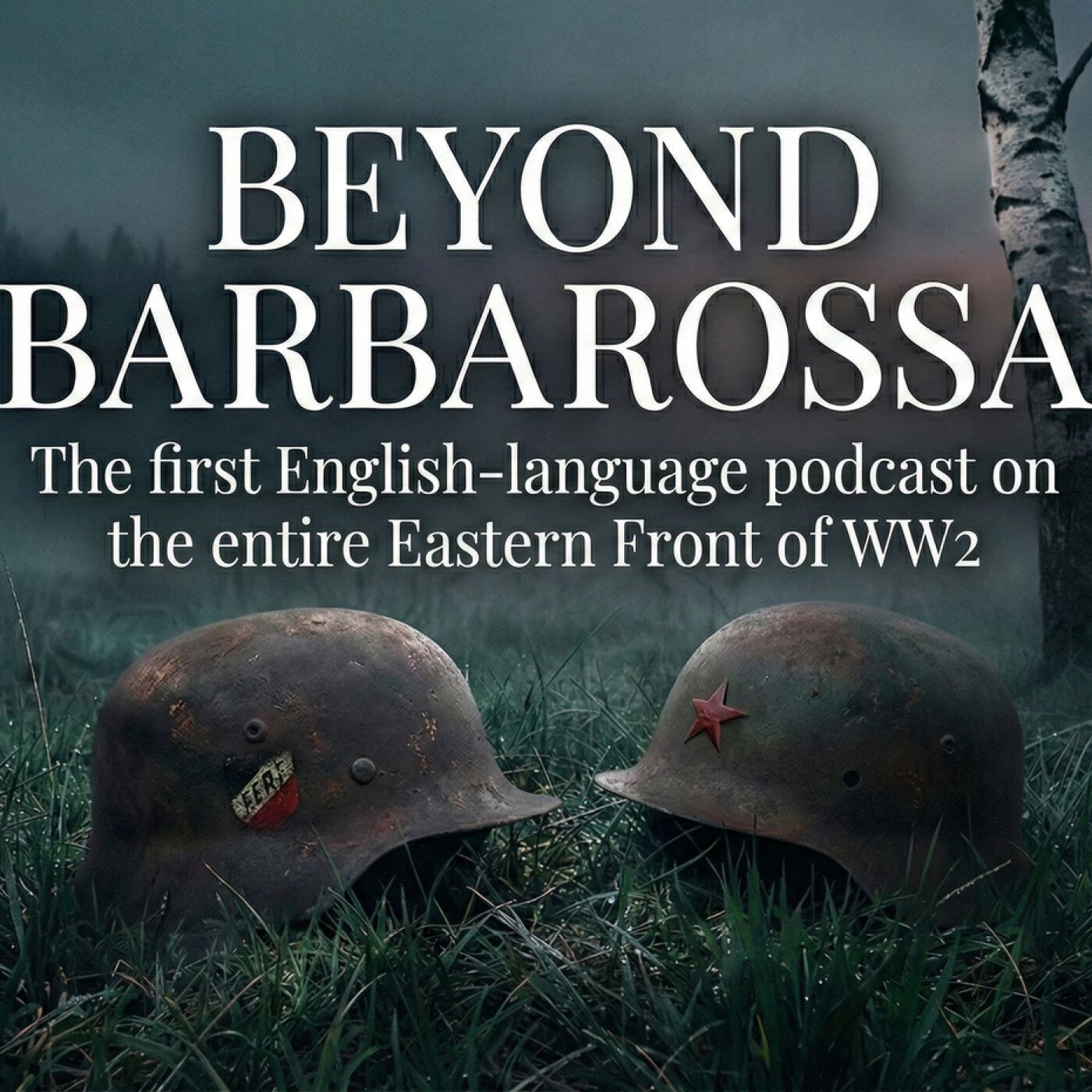
Beyond Barbarossa: The Eastern Front of World War 2
Beyond Barbarossa: The Eastern Front of World War 2Audio
- Format:
- Podcast
- New episodes:
- Every two weeks
- Typical length:
- about 40 minutes
- Latest episode:
About this show
You know about Stalingrad, the siege of Leningrad, maybe Kursk. But how well do you know the history of the ”Russian front” of the Second World War? Join this detailed description of the largest part of WW2 in Europe, the titanic clash between tyrants Hitler and Stalin. Hosted on Audioboom. See Privacy Policy (https://audioboom.com/about/privacy) (https://audioboom.com/about/privacy) for more information.
Covers: world war ii, eastern front, military history, cold war, norwegian resistance, post-war occupation, soviet union, nazi germany, WWII naval operations
Show details and episodes come from the publisher's public feed at audioboom.com. Last updated . Names, artwork and text belong to their publishers.
Recently on this show
Summary of recent episodes, drawn from the publisher's feed.
Beyond Barbarossa is a podcast offering a detailed look at the Second World War's Eastern Front, the clash between Hitler and Stalin. Recent episodes cover Germany's occupation after 1945, the Shetland Bus route to Norway, the Soviet Union against Japan in 1945, and the Potsdam conference.
Cosmos
Similar in subject
- The History Book Buffs
Both cover: soviet union, nazi germany, cold war - WWII Untold Archives
Both cover: soviet union, nazi germany, cold war - The History of the Twentieth Century
Both cover: eastern front, nazi germany, world war ii
Similar shows




Explore more
Episodes
- Not rated yet
S5 Ep110: Tables turned: The occupation of Germany after 1945—Episode 110
· 44 min
What happened after the end of the fighting in the war, and the occupation of Germany by the Allies. Link: Graham Chandler, "The Happiest Prisoners," Legion magazine, 15 March 2012 https://legionmagazine.com/the-happiest-prisoners Sources Anonymous (Marta Hillers), A Woman in Berlin: Eight Weeks in the Conquered City, A Diary. Berlin: Die Andere Bibliothek, 2011. Harald Jahner, Aftermath: Life in the Fallout of the Third Reich, 1945—1955. New York, USA: Borzoi Books published by Alfred A. Knopf, 2021. Paul Roland, Life After the Third Reich: The Struggle to Rise from the Nazi Ruins. London, UK: Arcturus Publishing Limited, 2018.
Not rated yetS5 Ep109: The Shetland Bus to liberate Norway—Episode 109
· 37 min
From 1940 to 1945, steady traffic across the North Sea from the Shetland Islands to the west coast of Norway evacuated civilians and brought in agents, weapons, arms and intelligence. Author J.L. Oakley joins the podcast again to describe this under-appreciated part of World War 2. Map: The Shetland Bus route Links Books - Hearts Across the Sea video about the Shetland Bus (https://www.youtube.com/watch?v=3JxK2AeagH8&t=162s&pp=ygUVaGVhcnRzIGFjcm9zcyB0aGUgc2Vh0gcJCT8MAYcqIYzv) - Operation Rype (https://www.amazon.com/Operation-Rype-Railway-Sabotage-Mission/dp/1636241344/) - The Jossing Affair (https://www.amazon.com/J%C3%B8ssing-Affair-J-L-Oakley/dp/0997323701/) - The Quisling Factor (https://www.amazon.ca/Quisling-Factor-J-L-Oakley-ebook/dp/B08CD6GGJ8/) - The Brisling Code (https://www.amazon.ca/Brisling-Code-J-L-Oakley-ebook/dp/B0CH1C7PWF/) The Scalloway Museum (https://www.scallowaymuseum.org/) Historical photos: See the web page for this episode. The Scalloway Museum, Shetland Is. Shetland Bus exhibit in the Scalloway Museum Typical Norwegian fishing boat in the Shetland Bus system. Bill Moore of the Scalloway Museum (left) with model of boat and modeler Tron Hvilding. Lunna House, Shetland Bomlo Is. and Shetland Is. Bliya monument Submarine chaser Vigra, 1943 Wreck of the Hitra Hitra restored Lief "Shetlands" Larsen Below: Norwegian liberation day Hosted on Audioboom. See Beyond Barbarossa’s privacy policy (https://beyondbarbarossa.ca/?page_id=3)for more information.
Not rated yetS5 Ep108: Norway occupied: Concentration camps + resistance—Episode 108
· 43 min
The nazis thought they would find a brethren Nordic race in Norway. The people's resistance to their occupation brought about an even more brutal occupation. Part 2 of the conversation with author J.L. Oakley Hosted on Audioboom. See Beyond Barbarossa’s privacy policy (https://beyondbarbarossa.ca/?page_id=3)for more information.
Not rated yetS5 Ep107: World War 2 in Norway: A conversation with author J.L. Oakley—Episode 107
· 37 min
A conversation with J.L. Oakley, author of three historical novels set in Norway during the German occupation of 1940 to 1945 Like the Eastern Front, Norway’s experience during the Second World War is not well known in the English-speaking world. Author Janet Oakley is helping correct that. Books mentioned By J.L. Oakley (https://www.jloakleyauthor.com/): - The Jossing Affair (https://www.amazon.com/J%C3%B8ssing-Affair-J-L-Oakley-ebook/dp/B01D8XL7PM/) - The Quisling Factor (https://www.amazon.com/Quisling-Factor-J-L-Oakley-ebook/dp/B08CD6GGJ8/) - The Brisling Code (https://www.amazon.com/dp/B0CH1C7PWF) Hitler's Northern Utopia (https://www.amazon.com/Hitlers-Northern-Utopia-Building-Occupied/dp/0691198217/) by Dispina Stratigakos Gold Run (https://www.amazon.com/Gold-Run-Rescue-Norways-Bullion-ebook/dp/B0141LZHT2/) by Robert Pearson Snow Treasure (https://www.amazon.com/Snow-Treasure-Marie-McSwigan/dp/0142402249/) by Marie McSwigan Hosted on Audioboom. See Beyond Barbarossa’s privacy policy (https://beyondbarbarossa.ca/?page_id=3)for more information.
Not rated yetS5: Special episode: The Cold War anniversary
· 41 min
In this special episode of the podcast on the Eastern Front of World War Two, we go beyond Beyond Barbarossa and beyond the end of the Second World War. 80 years ago to the day of this publication a handsome young man approached Canadian media and officials with proof that the Soviet Union was spying on its allies. The Cold War was on. Former Soviet cypher clerk Igor Gouzenko, hooded to protect his identity, being interviewed by Associated Press reporter Saul Pett in Montreal in 1954. The Gouzenkos’ apartment building on Somerset Street in central Ottawa. There is no plaque commemorating Igor Gouzenko. (Photo by Scott Bury, 2025.) Igor Gouzenko in Canada, 1946. Sources Winston Churchill, “The Sinews of Peace,” speech given at Westminster College, Fulton, Missouri, U.S.A., 5 March 1946. https://www.americanrhetoric.com/speeches/winstonchurchillsinewsofpeace.htm J.L. Granatstein and David Stafford, Spy Wars: Espionage and Canada from Gouzenko to Glasnost. Toronto: Key Porter Books, 1990. John Sawatsky, Gouzenko: The Untold Story. Toronto: Macmillan of Canada, 1984 Wikipedia, Gouzenko Affair. https://en.wikipedia.org/wiki/Gouzenko_Affair Wondery Podcasts, “The Spy Who, Season 7: The Spy Who Started the Cold War” https://wondery.com/shows/the-spy-who/season/7/ Hosted on Audioboom. See Beyond Barbarossa’s privacy policy (https://beyondbarbarossa.ca/?page_id=3)for more information.
Not rated yetS5 Ep106: The USSR vs. Japan, 1945: A conversation with James Scott
· 59 min
Historian and author of Empire of Ashes: Truman, Hirohito and the Descent into Total War James Scott’s latest book, Empire of Ashes, describes in detail the flights that brought nuclear bombs to Japan in August 1945. It also draws intimate portraits of the two leading antagonists on those days, U.S. President Harry Truman and Japanese Emperor Hirohito, from their earliest days through the personal transformations that ushered in a new era of warfare. Hosted on Audioboom. See Beyond Barbarossa’s privacy policy (https://beyondbarbarossa.ca/?page_id=3)for more information.
Not rated yetS5 Ep2: Potsdam: The Big Three decide the new world order—Episode 105
· 36 min
In July and August, the leaders and delegations from the “Big Three” victors of the Second World War reshape the borders of Europe and set up a new world order. Hosted on Audioboom. See Beyond Barbarossa’s privacy policy (https://beyondbarbarossa.ca/?page_id=3)for more information.
Not rated yetS5 Ep1: Potsdam: The Victors debate—Episode 104
· 33 min
The USA, UK and USSR have defeated nazi Germany. The Allies control Europe. In July 1945, the leaders Harry Truman, Winston Churchill and Josef Stalin meet outside Berlin to decide what to do with it. Go to Hosted on Audioboom. See Beyond Barbarossa’s privacy policy (https://beyondbarbarossa.ca/?page_id=3)for more information.
Not rated yetS4 Ep7: Barbarossa returns—episode 103
· 27 min
For the 85th anniversary of the launch of the Eastern Front of World War 2, a replay of the first episode of Beyond Barbarossa. Video, graphics and maps now available to all! https://youtu.be/rrnoEgVcRvE Hosted on Audioboom. See Beyond Barbarossa’s privacy policy (https://beyondbarbarossa.ca/?page_id=3)for more information.
Not rated yetS4 Ep6: Peace in Europe? Episode 102
· 44 min
The fighting has ended in Europe—but with millions of displaced people surging in all directions across Europe, it cannot be called peace. While millions of POWs look forward to going home, forced labourers and people of eastern Europe know they have no home to return to. And try to escape the communist yoke. Hosted on Audioboom. See Beyond Barbarossa’s privacy policy (https://beyondbarbarossa.ca/?page_id=3)for more information.
Not rated yetS4 Ep5: After the Fall of Berlin: Episode 101
· 33 min
When Berlin surrendered, the war in Europe continued for another week—in Czechoslovakia and its capital, Prague. Sources Antony Beevor, The Fall of Berlin 1945. New York, NY, USA: Penguin Random House, 2002. Antony Beevor, The Second World War. New York, NY, USA: Little, Brown and Company, 2012. Evan Mawdsley, Thunder in the East: The Nazi-Soviet War, 1941–1945. London: Bloomsbury Academic, 2016. Morse code by Thane Brown Music composed and recorded by Nicolas Bury Hosted on Audioboom. See Beyond Barbarossa’s privacy policy (https://beyondbarbarossa.ca/?page_id=3)for more information.
Not rated yetS4 Ep2: The Fall of Berlin
· 1 hr 2 min
David Sumner of the Europe at War podcast joins to provide deeper insight into the last major battle in the European Theatre of the Second World War. Two huge Red Army fronts, the 1st Belorussian and the 1st Ukrainian, crush the nazi capital between them, and bring an end to the Second World War in Europe. Hosted on Audioboom. See our privacy policy (https://beyondbarbarossa.ca/?page_id=3) for more information.
Not rated yetS4 Ep13: Surrounding Berlin: Episode 99
· 39 min
In the 99th episode of the first English-language podcast that focuses on the full story of the Eastern Front of World War 2, Stalin’s top Marshals, Georgy Zhukov and Ivan Konev, race to be the first to raise the Red Banner over the Reichstag. Who will get there first? Maps Map 1: The Red Army’s Vistula to Oder operation Hosted on Audioboom. See our privacy policy (https://beyondbarbarossa.ca/?page_id=3) for more information.
Not rated yetS4 Ep12: The Great Race Begins
· 31 min
"From the moment Stalin heard that the Americans were across the Rhine, he knew that the race for Berlin was on.”—Antony Beevor. WIth the Allies on the Elbe, and the Red Army on the Oder, nazi Germany was being terminally squeezed by April 1945. But before they can drive on the prize, Berlin, the Red Army must take Vienna. Map 1: The Red Army’s advance, 1944–1945 Map 2: The Red Army on the Oder and Niesse Map 3: Advance into Vienna Map 4a: European front line, 1 April 1945 Map 4b: European front line, 15 April 1945 Historical photos Georgy Zhukov, Marshal of 1st Belorussian Front Ivan Konev, Marshal, 1st Ukrainian Front Rodion Malinovsky, Marshal, 2nd Ukrainian Front Fyodor Tolbukhin, Marshal, 3rd Ukrainian Front Hosted on Audioboom. See Beyond Barbarossa’s privacy policy (https://beyondbarbarossa.ca/?page_id=3)for more information.
Not rated yetS4 Ep11: Spring Awakening and Upper Silesia: Episode 97
· 41 min
The #6 Top World War 2 podcast continues following the Red Army’s advance into Hungary and Germany—and the expensive failure of the German Operation Spring Awakening. Hosted on Audioboom. See Beyond Barbarossa’s privacy policy (https://beyondbarbarossa.ca/?page_id=3)for more information.
Not rated yetS4 Ep10: Silesia, Part 1—Episode 96
· 36 min
The Red Army penetrates deep into Germany, leading to the redrawing of eastern European borders after. Map 1: The Oder offensive–March 1945 Map 2: The Lower Silesian Offensive Map 3: The East Pomeranian Offensive Map 4a: European fronts, 15 February 1945 Map 4b: European fronts, 15 March 1945 Photos Marshal Ivan Konev, Commander of the 1st Ukrainian Front General Walther Wencke, chief of staff, Army Group Vistula, February 1945 Child soldiers in the wehrmacht: Hitler Youth in Breslau (Wroclaw), February 1945 Breslau (Wroclaw) in fighting, 1945 Hosted on Audioboom. See Beyond Barbarossa’s privacy policy (https://beyondbarbarossa.ca/?page_id=3)for more information.
Not rated yetS4 Ep9: The Impossible Alliance, Part 2: Episode 95
· 42 min
Why did the Yalta Conference end the way it did? Why did Churchill try an end-run around Roosevelt? Why did Roosevelt try to curry Stalin’s favour? What would this mean to post-war history? Author Giles Milton joins to discuss some of the Second World War’s most perplexing questions. People Author Giles Milton His latest book, The Stalin Affair: The impossible alliance that won the war The Big Three: Soviet Premier Josef Stalin, U.S. President Franklin Delano Roosevelt, and U.K. Prime Minister Winston Churchill Kathleen “Kathy” or “Puff” Harriman, daughter of Roosevelt’s right hand and Ambassador to the USSR in 1945, Averell Harriman Averell Harriman Pamela Churchill, WInston Churchill’s daughter-in-law in 1945, and later, Mrs. Averell Harriman Stalin and Churchill at the Moscow Conference, 1944 Franklin Roosevelt in 1945Map 1: The division of Germany after May 1945 Map 2: Invasion of Poland, 1939Map 3: Poland moves 100 km west Sources Giles Milton (https://www.gilesmilton.com/), author: https://www.gilesmilton.com/ - Books (https://www.gilesmilton.com/historybooks) - podcast: Ministry of Secrets (https://podcasts.apple.com/ca/podcast/ministry-of-secrets/id1700550232) Hosted on Audioboom. See Beyond Barbarossa’s privacy policy (https://beyondbarbarossa.ca/?page_id=3)for more information.
Not rated yetS4 Ep8: The Impossible Alliance, Part 1: Episode 94
· 33 min
Why were the Yalta Conference’s decisions so vague? Why did Stalin get everything he wanted? And why did Roosevelt act so naively? Giles Milton, bestselling author of The Stalin Affair: The Impossible Alliance that Won the War, joins the podcast today to help understand the relationships that had the greatest impact on the second meeting of the Big Three of the Second World War. Photos Author Giles Milton The Stalin Affair: The Impossible Alliance that Won the War by Giles Milton The Big Three at Yalta, February 1945. Roosevelt would be dead in two months. Map 1: Yalta in Crimea, on the Black Sea, site of the 1945 Yalta Conference of the Big Three Map 2: The tortured road from Saky Airfield to Yalta Sources Giles Milton (https://www.gilesmilton.com/), author: https://www.gilesmilton.com/ - Books (https://www.gilesmilton.com/historybooks) - podcast: Ministry of Secrets (https://podcasts.apple.com/ca/podcast/ministry-of-secrets/id1700550232) Hosted on Audioboom. See Beyond Barbarossa’s privacy policy (https://beyondbarbarossa.ca/?page_id=3)for more information.
Not rated yetS4 Ep7: From Malta to Yalta—Episode 93
· 42 min
Winston Churchill and Franklin Roosevelt meet in Malta in the Mediterranean in February 1945, to prepare to meet Josef Stalin in the second Big Three conference on Soviet territory—Yalta. It was a meeting that shaped the world for decades. Map 1: Malta to Yalta Map 2: The Western Front, 1 February 1945 Map 3: The Pacific Theatre, 1 February 1945 Map 4: Poland’s shift west, 1945 Photos Left: Franklin Roosevelt in 1944. Right: Roosevelt and Churchill at Malta, 2 February 1945. Averell Harriman and daughter Kathleen The Vorontsov Palace, quarters for the British delegation The Livadia Palace, quarters for the American delegation The Yusupov Palace, housing the Soviet delegation Hosted on Audioboom. See Beyond Barbarossa’s privacy policy (https://beyondbarbarossa.ca/?page_id=3)for more information.
Not rated yet