

Identify chemicals with radio frequencies - Nuclear Quadrupole Resonance (MRI without magnets)
From Applied Science · · 37 min
The player loads from YouTube only when you click. It uses YouTube's privacy-enhanced mode.
If the video does not play, the owner may have turned off embedding. Watch it on YouTube instead.
Description
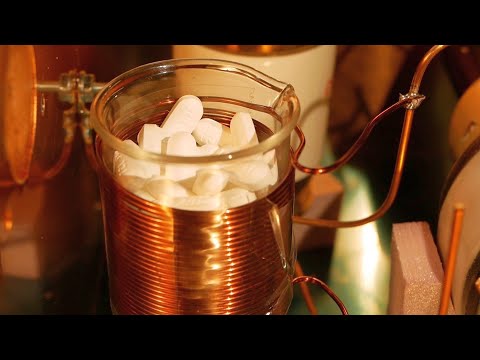
How to build and test an NQR spectrometer, which is similar to MRI, but uses no magnets. NQR frequencies are unique among all tested compounds, so detecting a resonance indicates a near certainty that a specific chemical is present.
Tektronix 2-series oscilloscope: https://www.tek.com/en/products/oscilloscopes/2-series-mso Video capture was done via VNC client
Zeeman effect shifting optical spectral lines: https://youtu.be/JV4Fk3VNZqs?t=74
Atomic clock calibration using Zeeman effect: https://www.youtube.com/watch?v=xTy1kY_wtsY
W2AEW's RF tutorial on quarter wave transmission lines: https://www.youtube.com/watch?v=A1BAq0KxIdc
Water deflected by electric field: https://youtu.be/NjLJ77IuBdM?t=468
Litz wire only helpful between 50KHz and 1.5MHz - https://youtu.be/FUCRB9UdfUg?t=2010
Support Applied Science on Patreon: https://www.patreon.com/AppliedScience
Q/A Why use vacuum variable capacitors? The parallel LC circuit develops well over 1000 volts during transmit, and they are much easier to finely adjust over a large range.
I've spent quite a few hours making this work since late last year. I failed to detect a signal from urea, which burned dozens of hours. Switching to NaNO2 suddenly produced a huge signal.
NQR calculations spreadsheet - https://docs.google.com/spreadsheets/d/1pkWlgvEXlANemZt3DR1J5g59S7hsejbvs995Y4FRsl0/edit?usp=sharing
NQR references (many!) : https://docs.google.com/document/d/1XoNUhFceH38nSjAFZoxglNiZlUzn6QMxa6CYTyAM92c/edit?usp=sharing