

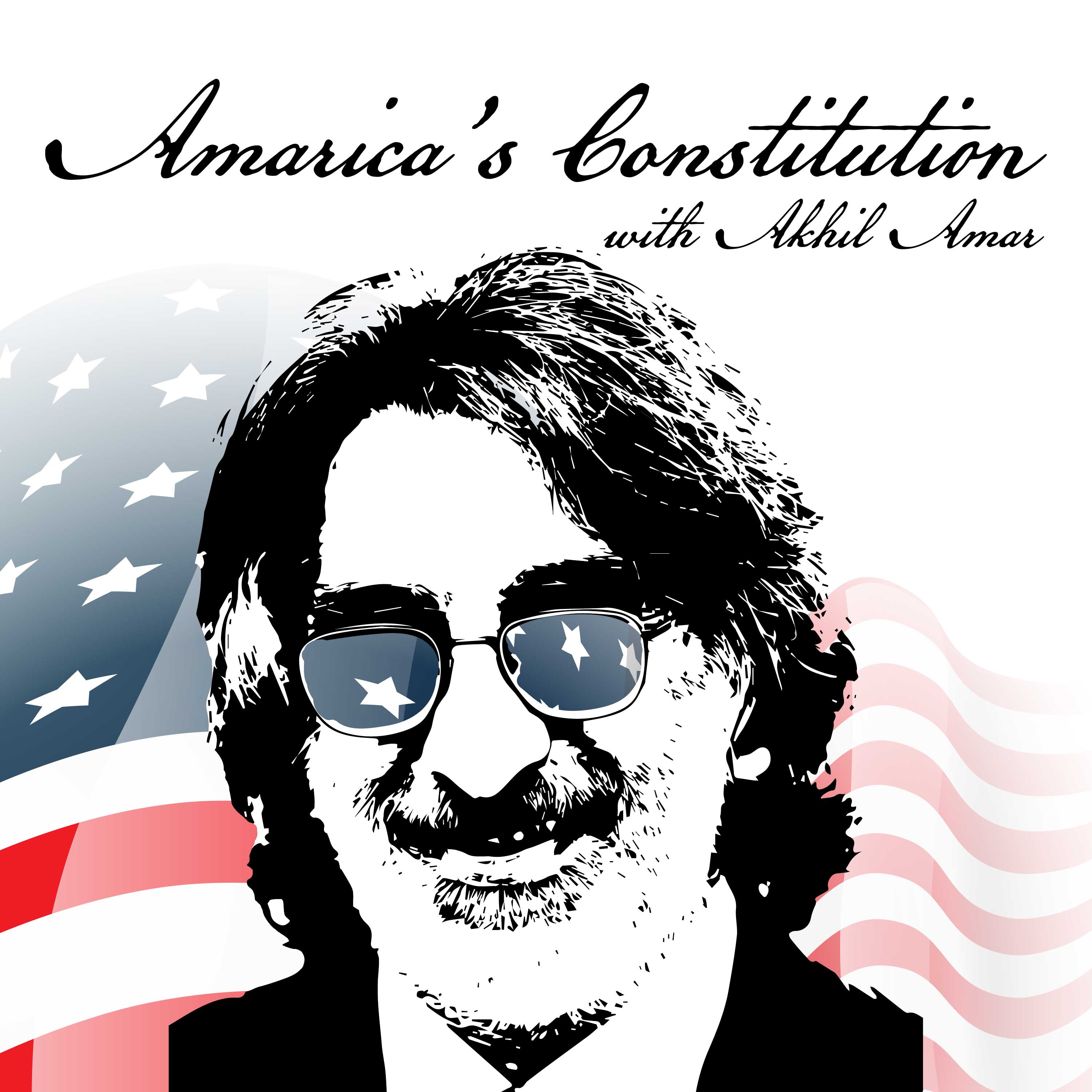
Amarica's Constitution
Akhil Reed AmarAudio
- Format:
- Podcast
- New episodes:
- Weekly
- Typical length:
- about 1 hour 20 minutes
- Latest episode:
About this show
Professor Akhil Reed Amar, Sterling Professor of Law and Political Science at Yale University and one of the nation’s leading authorities on the Constitution, offers weekly in-depth discussions on the most urgent and fascinating constitutional issues of our day. He is joined by host Andy Lipka and guests drawn from other top experts including Bob Woodward, Lawrence Lessig, Neal Katyal, Michael Gerhardt, and many more.
Show details and episodes come from the publisher's public feed at feed.podbean.com. Last updated . Names, artwork and text belong to their publishers.
Cosmos
Similar by topic and creator
- Dialogue Works
Shares the topics Education, History and News and Politics. - Perun
Shares the topics Education, History and News and Politics. - Plain Civics
Shares the topics Education, History and News and Politics.
Similar shows





Explore more
Episodes
The Power of Peaceful Witness
· 1 hr 33 min
The Electoral College is on the ropes, say some, as the discussion begun by Professor Amar many years ago and resumed with the recent election continues. Last week’s podcast outlined the history, the case for it, and the issues, and since then the conversation has been picked up by outlets seemingly everywhere. We follow up, and we begin to look at some of the big statements the recent election made. The vision of Lyndon Johnson and Martin Luther King has returned, but in what form? Where do we see it? Is it in the number of new African-American elected officials, in the volume of voting, or elsewhere? So many directions to go, and we pursue several of them in this journey from Mississippi to Shelby County. CLE credit is available for lawyers and judges from podcast.njsba.com.
Not rated yetA (Popular Vote) Compact Professor
· 1 hr 37 min
The election results are so overwhelming that they raise possibilities which were previously nearly unthinkable. One such proposal is Professor Amar’s own National Popular Vote Interstate Compact, which now moves into the spotlight with several trifecta-enabled Democratic states tempted to join the fold. The media is turning to Akhil for his take, and what better way to learn about it than on our podcast, as we take our time and explore the background, complexities, and current thinking on this vital topic. Meanwhile, we also look back a week at a remarkable set of predictions and begin to lay out some of the other remarkable aspects of this democratic dynamo. (Note: this podcast file replaces an earlier version with some minor corrections.) CLE is available to lawyers and judges from podcast.njsba.com
Not rated yetPreserving Voting, in Booths and on Juries - Special Guest Steven Calabresi
· 1 hr 29 min
America hopes for an election, and as it approaches, it feels tenuous, as the President seeks to exert control over ballots and those who would vote. Circuit courts step up; will the Supreme Court? We think so. Meanwhile, voting of another kind - on juries - is at issue in a case that follows the Jarkesy opinion from 2024. Professor Steven Calabresi has submitted an amicus brief in the case, and he joins Akhil and Andy for a lively discussion of the facts, the law, and the implications of this case. While he is here, Steve also weighs in on the election matters, as well. CLE credit is available for lawyers and judges from podcast.njsba.com
Not rated yetThe Innocent Ham Sandwich
· 1 hr 11 min
The election is upon us, and worries about possible anti-democratic actions, especially by those who make wild claims in an attempt to justify extraordinary intrusions into the voting process, have many on alert. From the beginning of our podcast we have looked for these “bullets” that must be dodged to keep the Republic, and once again we peer ahead to see what to watch out for, and to review the constitutional law and history so we are armed with the truth. Meanwhile, a grand jury has defied another federal prosecutor, and this prompts a proud Professor Amar to dive into our traditions on this great subject. Election season has begun. CLE credit is avaialble for lawyers and judges from podcast.njsba.com (http://podcast.njsba.com) after listening.
Not rated yetFriends Reunited, Citizens Divided - with Justice Stephen Breyer
· 1 hr 33 min
At the James Otis Lecture at Faneuil Hall in Boston, Professor Amar sat on a panel with (retired) Justice Stephen Breyer, Sarah Isgur, and the moderator, Chris Duggan. Remarkably, the Justice and the Professor engaged in a debate on a case Justice Breyer sat on: the sometimes-notorious Citizens United v. FEC from 2010. Rarely does one have the opportunity to hear a Justice defend their opinion against arguments after the fact, but there is nothing unethical about it, and now you can enjoy and learn from it. Surely there is more to say and we hope to do so in the future, but here is a real treat as Amarica’s Constitution turns 300 episodes old (though the celebration will have to wait). Lawyers And Judges are eligible for CLE credit by visiting podcast.njsba.com (http://podcast.njsba.com/) after listening.
Not rated yetDelivering Justice - with Judge Patrick Schiltz and Michael Stokes Paulsen
· 1 hr 16 min
This episode features Judge Patrick Schiltz, a deeply respected and honored judge on the US District Court in Minneapolis, interviewed by Professor Michael Stokes Paulsen, long time friend of this podcast and distinguished scholar. Judge Schiltz has been in the belly of the beast that was the dramatic escalation in ICE activity in his area, with a geometric increase in cases, motions, and need for his and his staff’s services. Amidst all this, he has come under fire from the Trump Administration in recent days for speaking about the judiciary to news outlets, despite the affirmative obligation that judges have to engage in appropriate forms of this activity. Now listen and hear the voice of a distinguished and dedicated public servant and judge for yourself. Before and after the interview broadcast, Akhil weighs in on some of the legal issues and the background. And in the show notes on akhilamar.com/podcast (http://akhilamar.com/podcast) you can hear Akhil’s own keynote at this same symposium on converse-1983 and related matters. CLE credit is available for lawyers and judges from podcast.njsba.com (http://podcast.njsba.com).
Not rated yetGet Off My Plane - Guests Eugene Volokh and Vikram Amar
· 1 hr 21 min
The President has been throwing news organizations out of various places: the White House in general, including the Press Room, and Air Force One. Can he do that? Does it matter why he is doing it? Has this come up before? Is it a constitutional matter? We welcome a leading First Amendment expert, Professor Eugene Volokh, to the podcast to discuss. Meanwhile, the Eight Circuit wasn’t quite ready to fade into the night, so they emerged one more time with the attempted congressional election districting map. The Supreme Court spoke quickly, clearly, and in one voice, and Professor Vik Amar is back as a guest to explain the significance - and the vehemence - of the Court’s words. Never a dull moment as the supposed off-season comes to a close and September ends. CLE credit is available for lawyers and judges from podcast.njsba.com.
Not rated yetCircuit Breaker
· 46 min
The Eighth Circuit is at it again, believe it or not. Despite what appeared to be a clear directive from the Supreme Court to use the 2022 map in the upcoming federal election in Missouri, a panel of three judges from the circuit went in the other direction. Akhil has had about enough of this, and while he expects the Supreme Court to once again shoot down the eighth circuit, perhaps with feeling, we wonder what the mechanisms are to prevent this sort of rogue behavior. Akhil then employs one of them. Is that all there is? CLE credit is available for lawyers and judges from podcast.njsba.com.
Not rated yetThe Constitution Goes to Princeton
· 1 hr 23 min
It’s Constitution Day, or rather Constitution Eve as we record. Akhil is the invited speaker at Princeton University’s gala event, and ahead of the speech, we invited Princeton undergraduates to come and talk about the Constitution with us; to voice their questions, and to help us honor the mission of the day by engaging with American citizens on that thing that we all share and that hopefully embodies some set of shared values, history, and tradition. Akhil fielded, Cosell-style, the barrage of questions, and we came away reassured about the next generation and the likelihood of the document enduring. And Happy Constitution Day to all of you! CLE credit is available for lawyers and judges from podcast.njsba.com.
Not rated yetMore Statesmanship, and State Constitutions - Special Guests Steven B. Smith and Vikram D. Amar
· 1 hr 44 min
The big issue in the news today is the Missouri legislature’s attempt to avoid the state constitution’s referendum provisions in order to impose a legislative map that would advantage Republicans to the tune of all but one of the state’s seats in the US House. The Supreme Court is asked to intervene, and Justice Kavanaugh - after we taped - declined to do so. This may not be end of the story, but our guest Vik Amar is on top of it together with Akhil. Listen to get the details, and check out Scotusblog.com (http://Scotusblog.com) to stay updated - Akhil and Vik have a new column there. Meanwhile, our interview with Professor Steven Smith discussing his new book, On Statesmanship, precedes this discussion this week - don’t miss that, either! CLE credit is available for lawyers and judges from podcast.njsba.com (http://podcast.njsba.com).
Not rated yetThe Statesman's Constitution - Special Guest Steven B. Smith
· 1 hr 34 min
Originalists venerate the Founders, who were by most reckonings a group of remarkable statesmen. Today, many Americans look seemingly in vain for a statesman worthy of the moment and its challenges. But what is a statesman? Does the U.S. Constitution assume a statesman will be at the helm? Does it enable such a leader, or is it designed to thwart the designs of what Lincoln called the “towering genius?” Acclaimed author and scholar Steven B. Smith joins us from Yale on the occasion of publication of his new book, On Statesmanship, in the first of two fascinating segments on many aspects of this many-faceted concept. And, Andy and Akhil take a look at an important law emerging from the California legislature and awaiting the governor’s signature. CLE credit is available for lawyers and judges at podcast.njsba.com.
Not rated yetAn Amendment Like Some Others - Special Guest Vikram D. Amar
· 1 hr 21 min
Voting rights are in the news. The state and federal governments have sought to weigh in and intervene on election laws, as we have seen in previous cycles. This time, a number of states have passed laws that address mail-in or absentee voting, but in doing so, what seems on its surface to be addressing some needs of seniors may in fact be more constitutionally questionable than first meets the eye. And in so doing, the states are implicating the 26th amendment. A circuit split has developed and as a result, the Supreme Court may get involved and this modern amendment may get its first case before the court. We bring in the expert on such things: Professor Vik Amar, who has already published a new article on these questions in recent days. The “brothers-in-law” are at it again, and we are all the beneficiaries. CLE credit is available for lawyers and judges from podcast.njsba.com (http://podcast.njsba.com).
Not rated yetPreclearing the President
· 1 hr 14 min
What happens when the president loses in court, even at the Supreme Court, but repeatedly attempts to fight the battle again? New tariffs are offered after the old ones are thrown out. Birthright citizenship, resoundingly affirmed, is challenged anew. To Americans who lived in the South after Brown v. Board, this might sound familiar. And indeed, as we wrap up our Roberts court constitutional survey, and we arrive at the cases we take great issue with, this theme echoes back to the Shelby County case. We therefore discuss a question that has rankled many Americans in recent years. CLE credit is available for lawyers and judges from podcast.njsba.com (http://podcast.njsba.com).
Not rated yetThere You Go Again
· 1 hr 8 min
The President did not file for reconsideration of the Court’s decision in Trump v. Barbara, but the President nevertheless doesn’t let the Constitution rest, issuing two new executive orders that purport to extend the set of persons not receiving birthright citizenship upon their birth, among other things. We take a look. Meanwhile, our review of the Roberts Court’s important constitutional cases brings us back to the Affirmative Action cases, and we take a look at them three years in. Finally, another listener question takes us to yet another corner of the constitutional canon - and Akhil is ready even without advance notice. CLE is available for lawyers and judges from podcast.njsba.com.
Not rated yetDobbs and Bruen Plus Time
· 1 hr 19 min
As we make our way through the 20 most constitutionally significant cases of the Roberts court, this episode takes us through two cases that have continued to have resonance with the American people and with the justices. Dobbs saw an infamous leak, a momentous decision, powerful electoral impact, and ongoing questions that echo back to an important limiting concurrence. Bruen brought a controversial methodology to questions of gun rights, caused mayhem at the lower courts, and spawned a number of subsequent cases that seek to clarify and perhaps recover from this sweeping opinion. We take you back - and forward - as we examine these cases on our way to an overall accounting of the Roberts Court. CLE credit is available for lawyers and judges from podcast.njsba.com (http://podcast.njsba.com).
Not rated yetFaces of Intratextualism
· 1 hr 23 min
We continue our survey of the Roberts Court’s oeuvre of constitutional cases, with particular emphasis on the series of cases that concerned making rules for voting and for voting districts. These cases make particular use of “intratextualism” - a term coined by Professor Amar that provides tools - and traps - for textual analysis of the Constitution. And as it turns out, it is also valuable on some of the most important themes and cases in the history of the nation, including Brown v. Board and its companion case, Bolling v. Sharpe. A listener’s question takes us down this road, which intersects with our own prior path in fascinating ways. These and more cases are explored as only Professor Amar can. CLE credit is available for lawyers and judges from podcast.njsba.com (http://podcast.njsba.com).
Not rated yetThe Surprising Score
· 1 hr 22 min
The SCOTUS term is behind us, and we take a look back - not just at this term, but at the entirety of the Roberts Court. What are the most important constitutional cases of its time? Where do the justices line up on the important cases - that is, how often are they in the majority; how often is the opinion right-leaning, as many believe is usually the case, and how many are left-leaning? How often is the Court “clearly wrong” according to Professor Amar? And where does Professor Amar come out in terms of his alignment with the Court? The cases may be familiar, but our own look at this suggests to us that you may well be surprised when it all gets added up. We also have some listeners’ questions, and they turn out to be more far-ranging than you might have expected. CLE credit is available for lawyers and judges from podcast.njsba.com (http://podcast.njsba.com).
Not rated yetDissenting from the Dissents
· 1 hr 26 min
How could the vote in Trump v. Barbara have been as close as it was? Many have been bewildered by the vote in this case, given the strength of the arguments in Chief Justice Roberts' majority opinion, the long history of birthright citizenship, the statutory history, and the clear text of the 14th amendment. We try to understand this by looking at how the dissents took an aberrant and incorrect approach to the very act of dissenting. To do this, we have to look at a general theory of dissents at the Supreme Court - and so we do. Meanwhile, a foreign nation's holiday is celebrated, as well it should be given this nation's role in our own achievement of independence. Lawyers And Judges Are Eligible For Continuing Legal Education Credit by visiting podcast.njsba.com (http://podcast.njsba.com/).
Not rated yetUnitary Duality - Guests Steven Calabresi and Vikram Amar
· 1 hr 30 min
he Supreme Court ruled in two cases framing Unitary Executive theory. So it’s entirely appropriate that we have two great experts on the topic joining us. Steve Calabresi literally wrote the book on this theory, and perhaps it’s not surprising that he is more pure than the Court itself. Meanwhile, Vik Amar has seen his theories concerning non-delegation and Congressional lock-in come up again and again this term - and here we see it again; if the agencies were meant by Congress to preserve its role in exercising certain powers, how can it reclaim those powers when the independence of the agencies is eliminated? Meanwhile, Akhil, cited in the Slaughter case, reviews the originalism involved in the opinions, and puts the cases in an overall perspective of sorts. All in all, an impressive resource for you to draw on. Lawyers and Judges are eligible for Continuing Legal Education credit by visiting podcast.njsba.com (http://podcast.njsba.com/) after listening.
Not rated yetLincoln's Promise Kept
· 1 hr 18 min
America gets a 250th birthday present from the Supreme Court as Chief Justice John Roberts authors an opinion for the ages in Trump v. Barbara. The Court went big and decided on the basis of the Constitution, not merely the Congressional statutes, that Abraham Lincoln's wish for the nation, birthright citizenship, which gives rise to the chance for birth equality and therefore the "new birth of freedom" Lincoln bequeathed us, will live on - and will have its best chance to endure. We look deeply into the opinion to find the great themes the Chief Justice, joined by four women, sounds. And what about the arguments made on this podcast in recent months? Can they be found in the opinion, and if so, do they strengthen it? Join us for a close look. Lawyers and Judges are eligible for Continuing Legal Education credit by visiting podcast.njsba.com (http://podcast.njsba.com/) after listening.
Not rated yet